

























































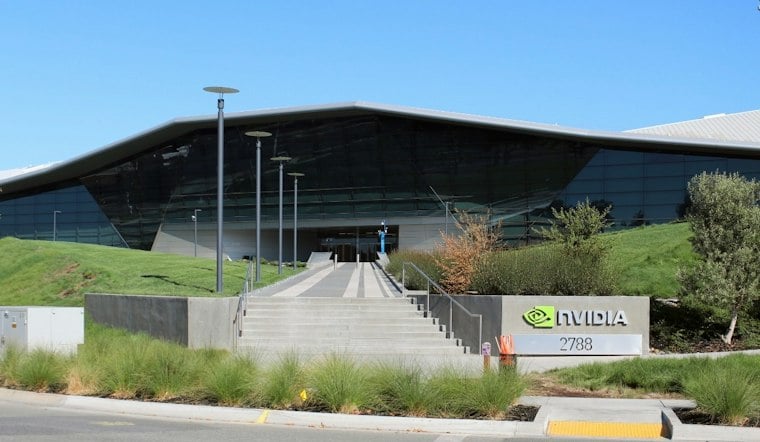
Nvidia's board has approved an additional $150 billion in share buybacks, pushing the Santa Clara chipmaker's total stock repurchase program to $235 billion and marking the largest single buyback authorization increase in U.S. corporate history. The move comes as Nvidia stock climbed 2.3% in morning trading Monday and remains up about 24% so far this year, even as questions swirl over how long the artificial intelligence spending boom can last.
The scale of the increase eclipses even Apple's previous record of $110 billion set in May 2024, according to Morningstar. As reported by WTOP News, Nvidia plans to execute the full buyback through its fiscal year ending January 30, 2028. Nvidia founder and CEO Jensen Huang said the company's growth is being driven by what he called a once-in-a-generation platform shift to AI and accelerated computing, and that Nvidia's cash generation enables both continued investment in new technologies and returns of capital to shareholders, per the same report.
A Modest Slice of a Massive Company
Big as the number sounds, the full $235 billion program represents roughly just 4% of Nvidia's total equity value, according to Forbes, given the company's roughly $5.4 trillion market capitalization in late September. That valuation is so large that Nvidia alone is worth nearly $2 trillion more than the combined market value of all roughly 2,000 companies in the U.S. Russell 2000 small-cap index, which Benzinga pegs at $3.5 trillion.
Hitting that $235 billion target on schedule will demand a dramatic acceleration in Nvidia's buyback pace. The company repurchased $40.4 billion of its own stock in fiscal 2026 and another $39 billion in just the first half of fiscal 2027, the Forbes report notes, meaning management will need to buy back roughly $176 billion annually — more than four times its prior pace — to complete the program by January 2028.
Cash Flow Backs the Bet
The buyback authorization is backed by real liquidity rather than borrowed money. Nvidia generated $21.34 billion in free cash flow during its second fiscal quarter and held $56.6 billion in cash, cash equivalents, and marketable debt securities as of July 26, according to Business Insider. That quarter capped a run in which Nvidia reported quarterly profits of $59.69 billion in August, part of the same earnings report Hoodline covered in its story on Nvidia's record-breaking quarter.
Yet the buyback lands amid a striking contradiction in how Wall Street values the company. Nvidia's 12-month forward price-to-earnings ratio was about 18.7 at the September 25 close, as investors debate whether massive AI data-center spending can be sustained. The authorization gives Nvidia capacity for future repurchases, though it does not itself indicate that actual capital returns will accelerate fourfold.
From a $300 Million Cap to $235 Billion
The scale of Nvidia's transformation becomes clearer against its own history. The $150 billion increase is roughly 500 times larger than Nvidia's original stock repurchase program, authorized back in August 2004 and capped at just $300 million, according to TheStreet. That two-decade arc traces a company that began as a niche graphics chip designer and now sits among the most valuable corporations on Earth.
Nvidia's high-end chips remain the leading building blocks for artificial intelligence and continue to be highly sought after, fueling stock market gains and broader U.S. economic growth in recent years. Still, the AI industry faces growing skepticism over whether the technology will justify trillions of dollars in spending, along with pushback over data-center expansion and its potential to displace jobs, as WTOP News reported.
New Safety Platform Alongside the Buyback
Nvidia paired its buyback news with a product announcement aimed at emerging concerns about autonomous AI systems. The company unveiled its Open Agent Safety Platform on the same day, releasing open-source software and hardware reference designs meant to monitor and constrain AI agents against security risks, according to Nvidia's own announcement. The platform is intended to help address security risks posed by autonomous AI agents.
Fueling Nvidia's Growing Santa Clara Footprint
Combined data-center capital spending is projected to rise from nearly $800 billion in 2026 to $1.2 trillion in 2027, a demand signal cited by the Motley Fool that helps explain executives' confidence in future cash generation. That level of spending has real consequences close to home: Nvidia's balance sheet has translated into an expanding physical presence around its headquarters, including its absorption of roughly 500,000 square feet of office space across four buildings on San Tomas Expressway, detailed in Hoodline's report on Nvidia's Santa Clara land grab. The company's financial firepower continues to ripple through the local commercial real estate market and reinforce its role as the dominant economic engine of Silicon Valley.


