

























































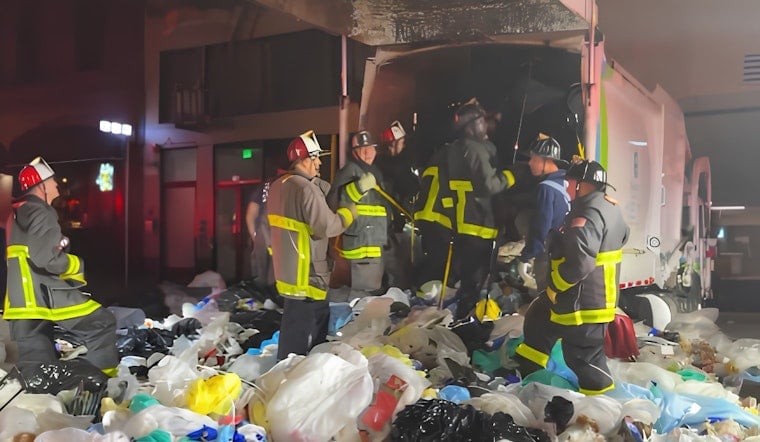
San Francisco firefighters spent today digging through garbage inside a Recology truck's hopper to free a person trapped inside, after the driver was flagged down on the 100 block of Mason Street by a passerby who heard yelling coming from the truck's garbage compartment. The San Francisco Fire Department was dispatched at 4:11 AM to the report, and crews were still working to remove trash and reach the victim as of 5:38 AM, according to San Francisco Fire Department Media.
At 04:11 AM SFFD was dispatched to a report of a person trapped inside a Recology garbage truck on the 100 block of Mason St. The driver of the truck had been flagged down and was told there was yelling inside the garbage area of his truck. Crews are currently working to remove… pic.twitter.com/0TrOWGL1oz
— SAN FRANCISCO FIRE DEPARTMENT MEDIA (@SFFDPIO) September 2, 2026
According to the department's post, the truck driver was alerted to the person's presence by someone who reported hearing yelling inside the garbage area of the vehicle, and the driver stopped so crews could respond. SFFD crews were then tasked with removing all of the garbage to access the trapped victim, per the department's account. The scene unfolded on the 100 block of Mason Street, a stretch situated in San Francisco's Tenderloin district near Mid-Market — an area known for dense commercial activity and a high concentration of unsheltered residents, according to sfpulse.
A Recurring and Dangerous Hazard
Unhoused residents in the Tenderloin frequently seek shelter in commercial alleyways and inside heavy-duty dumpsters, sfpulse notes, a pattern that puts them at risk when those bins are emptied into compactor trucks. This is not the first time someone has been trapped inside a Recology vehicle in San Francisco. In February 2017, a man survived being dumped from a commercial bin and compacted inside a truck before being rescued from a pile of recyclables at Recology's Pier 96 facility, an incident Hoodline covered in a 2017 report on a man found crushed with recycling. Recology representatives at the time said such incidents occur roughly every five to eight years, and noted that crews are trained not to move victims immediately and instead to call emergency services, per Waste Dive.
How Compactor Trucks Work — and Why Checks Matter
Mobile waste collection equipment governed by American National Standards Institute Z245.1 protocols requires operators to follow strict safety procedures and check compactors before activation, since truck hydraulic systems can cycle up to 1,200 times per route under 25,000 pounds of compaction force, according to guidance from ANSI and Allegiance Refuse Systems. Industrial compactors of that size present severe crushing hazards if activated while someone remains inside the hopper. Industry safety guidelines separately recommend that collection drivers keep radio volumes low so they can hear screams, tap or shake dumpsters before dumping them, and pause before starting a compaction cycle if an occupant is suspected, the same Waste Dive reporting notes.
Recology operates as San Francisco's exclusive refuse and recycling collection contractor, a monopoly role established under the city's 1932 Refuse Collection and Disposal Initiative Ordinance, according to San Francisco Public Works. That means the city's entire municipal and commercial waste stream — and the safety protocols governing it — runs through a single company's trucks and drivers.
Homelessness and Risk in the Tenderloin
Preliminary 2026 Point-in-Time data showed a 4% decrease in San Francisco's unhoused population following a 2024 count that identified 8,323 homeless individuals, though thousands still sleep unsheltered in the city nightly, per CalMatters. Cold or damp overnight conditions often push unsheltered residents to seek shelter inside closed dumpsters, the outlet reports — a habit that can turn deadly once a truck's hopper begins its work. Separately, U.S. Bureau of Labor Statistics data shows the fatal injury rate for refuse and recyclable material collectors stood at 22.6 per 100,000 full-time workers in 2022, underscoring how hazardous the collection environment can be even for the workers operating the trucks.
SFFD Station 3, which covers the Tenderloin district where Mason Street sits, houses Engine 3 and Truck 3 — among the busiest emergency response units in the country, logging more than 10,000 call responses annually according to the San Francisco Fire Commission. That volume reflects the frequency with which crews in this stretch of the city handle complex medical and technical rescue calls.
Growing Legal Scrutiny for Waste Haulers
Incidents like Wednesday's have fueled broader legal scrutiny of waste management companies nationally. A lawsuit filed in Denver in May against a major waste hauler, which Hoodline covered in its report titled Denver Dumpster Nightmare, centered on allegations that the company failed to perform visual checks of dumpsters before dumping and compacting an unsheltered person. Attorneys in such cases frequently cite federal OSHA guidance and ANSI standards requiring visual checks of hoppers before compaction begins.
It remains unknown what condition the trapped person was in as of SFFD's last update, or whether the specific dumpster that was emptied into the Mason Street truck had been checked before collection. The San Francisco Fire Department directed the public to call or text 911 for emergency situations, and to call 311 to report non-life-threatening hazards. SFFD said it serves the City and County of San Francisco, San Francisco International Airport, the Presidio, and the Golden Gate National Recreation Area.





