

























































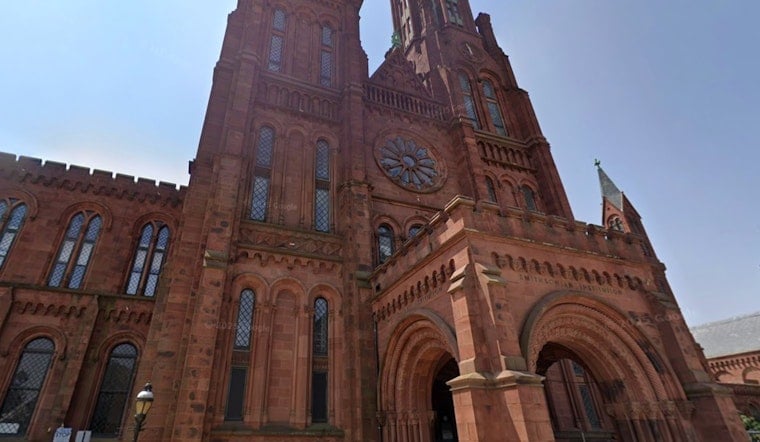
Renovations are scheduled to resume at the Smithsonian Institution Building, better known as the Castle, the Smithsonian's first and oldest building on the National Mall in Washington, DC. Part of the first floor will stay open daily through Monday, September 7, before construction crews return to the 170-year-old landmark, with officials encouraging visitors to experience the historic building during its transformation.
The building had been partially open through Monday, hosting programming commemorating the nation's founding as part of the 250th anniversary of 1776, according to DC News Now. Officials said the building's renovations were temporarily paused for that summer 2026 commemoration before work is scheduled to resume this month. That pause allowed the Smithsonian to showcase its “American Aspirations” exhibition, co-curated by Smithsonian Secretary Lonnie G. Bunch III, which brought together treasured objects, according to a Smithsonian Women video.
A Planned Seismic Moat Beneath the Castle
What visitors won't see is the most consequential part of the project. Engineers are planning a subterranean “seismic moat” around the Castle's perimeter, using a technique called base isolation to untether the unreinforced masonry structure from ground movement during future earthquakes, according to Facilities Dive. Excavation has not yet begun. The approach lets historic buildings ride out shaking without damaging their exterior facades. According to the National Park Service, seismic retrofits for historic buildings can improve safety without destroying significant historic materials.
The precaution traces back to real damage. The Castle was cracked by the magnitude 5.8 earthquake that struck Louisa County, Virginia, in August 2011, damaging interior beams and five decorative exterior turrets, per the same outlet's reporting. A U.S. Geological Survey report notes that the town of Wells sustained significant damage to unreinforced masonry buildings even though the earthquake occurred in a region of low seismic hazard.
Underground, the project is also replacing the Castle's mechanical, electrical, plumbing and security systems while building an underground Central Utility Plant beneath the South Mall campus, one that will serve both the Castle and the adjacent Arts and Industries Building, per Loring Consulting Engineers. Moving that heavy equipment below grade reduces the impact on the Castle's historic interiors as work continues overhead.
Matching 19th-Century Stone That No Longer Exists
Restoring the Castle's red sandstone exterior has posed its own puzzle. The original quarry in Montgomery County, Maryland, closed in 1901. The restoration has used salvaged sandstone from a demolished or slated-for-demolition New Jersey church to supply masonry for the project.
The building itself almost looked entirely different. Architect James Renwick Jr. designed the Castle after winning an 1846 design competition. The Castle was clad in sandstone and completed by 1855.
From One Building to a Whole Institution
The Castle is part of the Smithsonian's institutional history. The National Museum of Natural History was originally housed in the Castle, a history Hoodline has previously noted.
Before its closure on February 1, 2023, the Castle's last comprehensive renovation dated to the late 1960s, making the current project the building's first top-to-bottom overhaul in more than 50 years. The current focused restoration of the Castle and the neighboring Arts and Industries Building prioritizes the historic core.
What Comes Next
The total revitalization is estimated to cost approximately $530 million, with full completion and permanent reopening targeted for 2028. The resumption of construction this month continues that multi-year effort. Open questions remain around final costs, the subterranean construction timeline, and how future museum additions on the South Campus — including the Smithsonian's pick of a nearby Mall building for a Latino museum — will interface with the newly upgraded utility grid.
The Smithsonian has also faced more mundane infrastructure trouble recently. Hoodline reported that a cooling-system failure temporarily shut down seven Smithsonian museums, underscoring just how aged the campus's shared utilities have become even as the new Central Utility Plant takes shape underground.





