

























































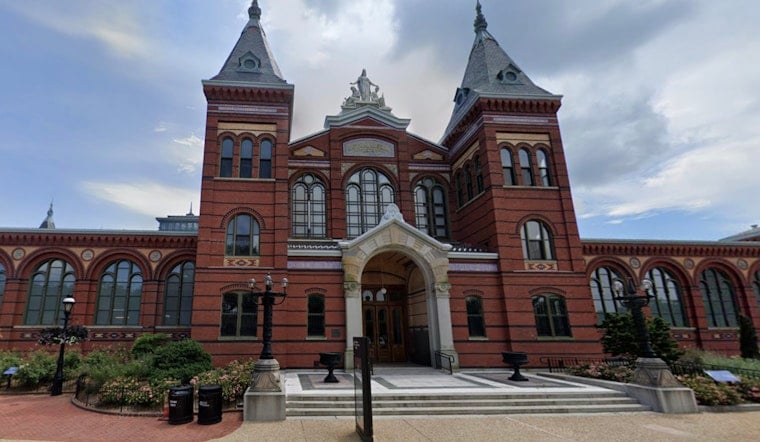
The Smithsonian Board of Regents has picked a permanent home for the National Museum of the American Latino, and it's not a new building at all. On Monday, regents designated the 145-year-old Arts and Industries Building at 900 Jefferson St. SW in Washington, D.C., as the museum's permanent site, ending years of uncertainty over where the institution would ultimately land on the National Mall.
The move lets the Smithsonian sidestep a step that has tripped up other Mall expansion plans: getting new construction approved on National Park Service land, which requires congressional sign-off, according to WTOP News. Because the Smithsonian already owns the Arts and Industries Building, it can place the Latino museum inside without seeking additional legislation. As Hyperallergic notes, that also means the museum's location can't easily be blocked or defunded by a Republican-led Congress or the Trump administration, a real risk given how politically fraught the project has become.
That risk is not hypothetical. The Trump administration released a report titled Saving America's Story in July 2026, which criticized the Smithsonian's National Museum of American History for what it called ideological capture, and specifically cited the American History Museum's exhibit ¡Presente! A Latino History of the United States as an example of the museum erasing American heritage, per the seed reporting. The Latino museum previously used temporary exhibition space inside the American History Museum starting in 2022.
A Landmark With a Rough History
The Arts and Industries Building itself carries a heavy legacy of its own. Designed by architects Adolf Cluss and Paul Schulze, it opened on the National Mall in 1881 as the U.S. National Museum and even hosted President James A. Garfield's inaugural ball that same year, according to The Art Newspaper. It sits between the Smithsonian Castle and the Hirshhorn Museum, and it is the second-oldest building on the Mall after the 1855 Castle.
That distinction hasn't spared it from decades of decline. The building was declared a National Historic Landmark in 1971 but closed to the public in 2004 due to structural deterioration, and it landed on a list of America's 11 Most Endangered Historic Places in 2006, Hyperallergic reports. It was one of four sites considered for the museum's permanent location back in 2022, alongside undeveloped National Park Service land near the Washington Monument and the Capitol Reflecting Pool, according to NPR Illinois. Those open-land options ultimately would have required congressional land transfers.
Decades of Advocacy Behind the Decision
National Museum of the American Latino director Jorge Zamanillo said the designation places the U.S. Latino story at the heart of the National Mall, framing it as the culmination of advocacy dating back to 1994, according to reporting from The Washington Post. That advocacy traces to a 1994 Smithsonian task force report called Willful Neglect, which found that less than 1 percent of Smithsonian staff and featured historic figures were Latino at the time, per The Heritage Foundation. Congress formally authorized the museum in 2020, but the building announcement this week marks the first time it has a concrete physical address.
Congress created the Latino museum alongside the Smithsonian American Women's History Museum in the same 2020 spending package, though the women's museum remains in early development without a physical building on the Mall, per the Congressional Research Service. That companion project has drawn its own political fights over exhibit content, as Hoodline reported in its piece on the fight over Smithsonian gender rules.
The Money Question Still Looms
Securing a site doesn't solve the museum's biggest remaining hurdle: money. Under the federal law that established the museum, construction costs must follow a 50/50 public-private cost-sharing model, meaning half of all funds have to come from non-federal private sources, according to the Cornell Law School Legal Information Institute. Advocates estimate the total project could cost as much as $700 million.
Congressional oversight records show private fundraising had topped $65 million by 2024, boosted by gifts such as a $2 million donation from PepsiCo, according to the U.S. Government Publishing Office. That leaves a substantial gap to close before construction inside the historic building can move forward. For comparison, the last new museum built on the Mall, the National Museum of African American History and Culture, opened in 2016 at a cost of $540 million after a 13-year development process following its 2003 congressional authorization, as Hoodline detailed in its coverage of the museum's 10th anniversary celebration.
Retrofitting a 145-year-old landmark that spent years closed for structural repairs presents its own architectural challenges beyond fundraising. The Arts and Industries Building was also among the National Mall facilities affected by an aging cooling system, as Hoodline reported when a decades-old D.C. cooling plant failure temporarily shut down seven Smithsonian museums. For now, the Board of Regents' vote gives the Latino museum a definitive address after more than three decades of advocacy, even as the harder work of funding and rebuilding the space still lies ahead.





