

























































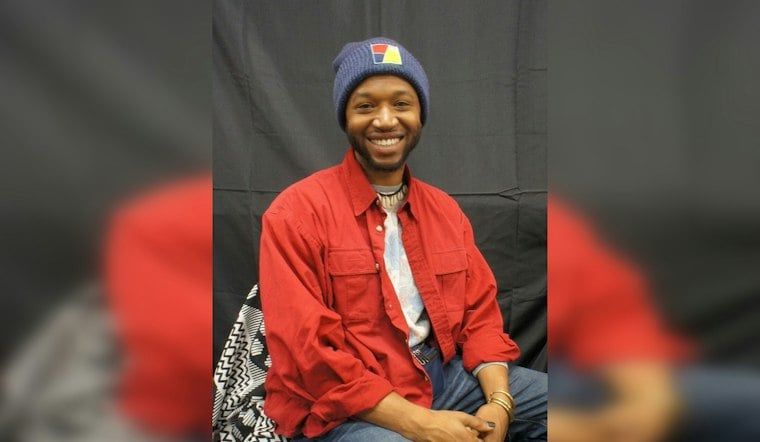
A grassy lot on Chippewa Street that once sat mostly unused now holds monkey bars, dip stations and a junior-size basketball court, all free to use, all funded in part by a St. Louis textile artist who says outdoor workouts saved his mental health. Basil Kincaid, a multidisciplinary artist and St. Louis native known for large-scale quilts, opened the calisthenics park with collaborators at a community cookout Saturday, right on the border between Dutchtown and Gravois Park.
Kincaid splits his time between St. Louis and the greater Accra region of Ghana, according to St. Louis Public Radio, and that back-and-forth life is what put the idea of a public fitness park in his head in the first place. While traveling to show his fiber-art work, he encountered outdoor gyms in New York, Los Angeles, Milan and London, and he came home wanting one for his own block. The park sits in an underused grassy lot next to the Melvin Theater community center, which anchors the Chippewa Street corridor.
Kincaid is no stranger to blending continents in his creative work. His large-scale textile and quilt pieces incorporate repurposed fabrics sourced from both St. Louis and West Africa, including handwoven Ashanti Kente cloth from Ghana, and his work has landed in permanent collections including the Smithsonian American Art Museum, according to Hauser & Wirth. He was awarded a United States Artists Fellowship in 2021 and was named a co-winner of the 2024 Great Rivers Biennial award by the Contemporary Art Museum St. Louis and the Gateway Foundation, per the same gallery's biography of the artist.
From Quilts to Calisthenics
The link between Kincaid's textile practice and his new park is not just biographical. The Contemporary Art Museum St. Louis hosted his patchwork exhibition from September 2024 through February 2025 as part of the Great Rivers Biennial, a show that the Contemporary Art Museum St. Louis says traced his cross-continental focus on wellness, family history and community resilience — the same themes now embedded in a lot full of steel bars on Chippewa Street.
Kincaid told St. Louis Public Radio that he started a calisthenics training program to improve his mental health and wound up muscular almost by accident. He said the exercise improved his mind, spirit, sleep, depression and clarity of thought. He also said calisthenics parks tend to foster a more inclusive and supportive culture than conventional gyms, which shaped how he wanted the Chippewa Street space to feel.
Built to Need Almost No Upkeep
Kincaid worked with Kompan, a Texas-based playground and exercise equipment designer, and with the Melvin Theater community center to build the park. The equipment supports assisted pushups, dips, pullups, rolls, decline pushups, abdominal workouts and squats, along with monkey bars and fixed bars, and it has no moving parts. Industry research from Kompan notes that outdoor calisthenics parks rely entirely on bodyweight resistance without moving parts or electrical infrastructure, which keeps ongoing municipal maintenance low and lowers the barrier to entry for community health efforts.
The park itself includes an oval-shaped space with shock-absorbent flooring, and signs posted throughout carry QR codes linking to more detailed exercise directions. Those codes tie into Kompan's free Outdoor Fitness mobile app, which the Apple App Store lists as offering 189 exercise video demonstrations across three difficulty levels and 16 structured workout plans. A junior-size basketball court sits on the same lot.
A Neighborhood With High Stakes
Kincaid paid for half of the project himself, though he declined to specify its total cost. The rest came from a few donors and a grant from the Regional Arts Commission of St. Louis, which in July 2025 awarded more than $3.7 million in grants to 122 arts organizations across St. Louis City and County, funded primarily through local hotel and motel tax revenues, according to the St. Louis American.
The location matters as much as the funding. Dutchtown is the city's second most populous neighborhood, with 15,356 residents representing 5.1 percent of the total citywide population, according to 2020 U.S. Census data published by the City of St. Louis. Neighboring Gravois Park has 4,683 residents, with Black residents making up 60.7 percent of the population and White residents 20.6 percent, per the same city data. Planning figures published by DutchtownSTL in January 2025 show that Dutchtown and Gravois Park contain the city's highest concentrations of youth under 18 and households without access to a personal vehicle — a detail that helps explain why a free, walkable fitness option carries outsized weight here.
Community Center's Founder Weighs In
David Godbout, the Melvin Theatre community center's founder and director, said the project aims to bring the community together and make the Chippewa neighborhoods healthier, happier and safer. The theater itself has history behind it: located at 2912 Chippewa Street, the Melvin Theater opened in 1914 as a 481-seat neighborhood cinema and operated for nearly 80 years until its final film screening on October 18, 1992, according to Cinema Treasures.
At Saturday's opening cookout, children climbed the monkey bars while adults tried out the parallel bars and dip stations. Raj Brown, who used the park's parallel bars for dips, said calisthenics training builds mental toughness, persistence and perseverance. The gathering doubled as a low-key celebration of a lot that had mostly gone unused before Kincaid and his collaborators stepped in.
The project lands at a moment when Dutchtown and Gravois Park have drawn attention for both new investment and ongoing struggles. Hoodline recently reported that a Dutchtown bar shootout wounded three people, and earlier this year covered the opening of a new health clinic on South Grand serving Dutchtown residents. Those stories sit alongside broader neighborhood revitalization efforts that community members hope projects like the Chippewa Street park can help support.





