

























































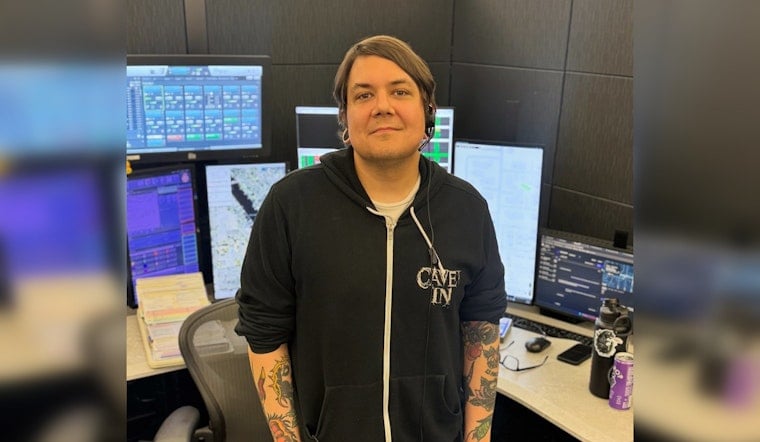
A baby boy arrived earlier than expected at a Tampa-area home, and the man who helped bring him safely into the world wasn't a paramedic standing in the room — he was a 911 dispatcher on the other end of the phone line. Michael V., a Tampa Fire Rescue dispatcher with a decade behind the headset, guided the newborn's father and grandmother through the delivery before rescue crews ever reached the door.
According to Tampa Fire Rescue, Michael V. talked the family through what to do as the baby came faster than anyone anticipated, coaching the father on delivering his son while the grandmother helped tend to the mother. It marked the first time in Michael V.'s ten years as a dispatcher that he had walked a family through a 911 baby delivery, the department said. By the time Tampa Fire Rescue's Rescue 19-B pulled up, both mother and baby were already receiving care, and crews arrived to provide additional support rather than handle the delivery itself.
The Voice Before the Crew Arrives
Moments like this one highlight a role that rarely gets much attention: emergency dispatchers are often the first responders a family encounters during a crisis, even though they never leave the call center. Tampa Fire Rescue notes that its dispatchers routinely provide lifesaving instructions over the phone before fire or rescue crews arrive, whether that means talking a caller through CPR, helping control severe bleeding, or, in rarer cases, coaching someone through childbirth.
That gap between the first 911 call and a crew showing up at the door is exactly why phone guidance matters so much. Tampa Fire Rescue maintains an average emergency response time target of under six minutes citywide, according to WTSP, a window during which a dispatcher's instructions can be the only medical support a family has. Rescue 19-B, the unit that responded to this delivery, was added to Fire Station 19 in March 2023 specifically to handle rising medical call volume in South Tampa — the station's first additional rescue vehicle in 25 years, per the City of Tampa.
Not Tampa's First Home Delivery Call
Unexpected home births aren't entirely new territory for Tampa's 911 system. In May 2014, a Tampa Fire Rescue dispatcher guided an eight-year-old girl through delivering her baby brother at home before crews arrived, a call that drew national attention at the time, Fox News reported. Cases like Michael V.'s remain uncommon for any individual dispatcher, but they underscore how often Tampa's emergency communicators are called on to manage the unexpected.
Behind every one of those calls sits a rigorous certification process. Florida law requires all 911 public safety telecommunicators to complete a state-approved training curriculum of at least 232 hours and maintain certification through the Florida Department of Health, under Section 401.465 of the Florida Statutes. Dispatchers must also complete 20 hours of continuing education every two years, including updated telecommunicator CPR training, according to the Florida Department of Health, to keep their certification current.
Legal Protections Behind the Headset
Florida law also shields dispatchers who follow recognized Emergency Medical Dispatch protocols. Under Section 768.1335 of the Florida Statutes, emergency dispatchers and the agencies that employ them receive statutory immunity from civil negligence liability when providing pre-hospital medical instructions over the phone — a legal backstop designed to let telecommunicators talk callers through high-stakes moments like childbirth without fear of liability for following approved guidance.
Emergency medical calls make up more than 80 percent of Tampa Fire Rescue's total annual call volume citywide, according to the City of Tampa, a reflection of just how central this kind of phone-based coaching has become to the department's daily work. Tampa Fire Rescue operates 23 fire stations and two rescue stations across a 128-square-mile service area in Hillsborough County, with every incoming call routed through its Communications section. It's within that vast network that dispatchers like Michael V. quietly do the work of coaching panicked families through the most vulnerable moments of their lives — sometimes, as with this delivery, before any crew ever walks through the door.





