

























































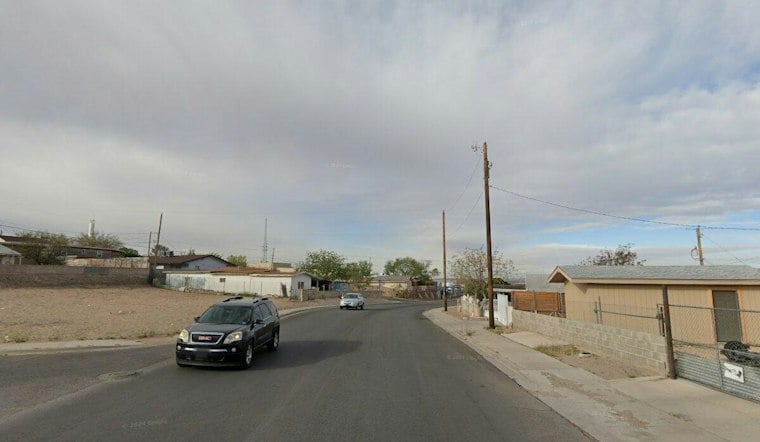
Veronica Magallnes says the ground behind her family's home in Sparks has washed away so badly that the arroyo eating into her yard now sits just feet from the bedroom where she and her elderly, disabled mother sleep. Days of heavy rain turned the Grand River Drive arroyo into what she describes as a raging river, and the erosion it left behind is creeping closer to her house with every storm.
Magallnes told KFOX that water gushed behind her house at night during the recent storms, and that her family has lived in the neighborhood for more than 20 years. She said her foundation has shifted since the rain, and that both her house and a nearby wall now face a risk of falling. Fast-moving water washed away not just the ground around her property but the dirt separating the flow from other nearby homes, according to the same report.
Light Poles and a Neighborhood on Edge
Magallnes said the erosion could also threaten four light poles that line the arroyo, warning that they could be pulled down if the eroding wall gives way. She and her neighbors have watched the erosion move steadily closer to their houses in recent days, per the KFOX account. Many families in the community have lived there for decades and say they have few options to relocate even if they wanted to, since moving elsewhere may simply not be feasible for them.
Magallnes wants a permanent fix, not a stopgap. She has proposed running cement through the ditch to stop the erosion for good, telling KFOX she believes the community feels overlooked compared to a nearby development that is less than five years old, where homes cost about half a million dollars.
What El Paso County Says About the Arroyo
When KFOX asked El Paso County officials about flood mitigation and preventative measures, the county described the arroyo as a low-water crossing that is functioning as designed. County officials said they are working on reshaping the arroyo in preparation for future heavy rains, framing the corridor as an engineered feature rather than a failure — even as residents living beside it describe active property loss and structural damage just feet from their homes.
That gap between official classification and lived experience is not new to this stretch of the border. El Paso County Commissioner Iliana Holguin has acknowledged, amid the broader September storm response, that rapid commercial and residential development north of Interstate 10 near Horizon has increased stormwater runoff into lower arroyos, according to Hoodline's earlier coverage of flooding in neighboring Socorro. The county has labeled mitigation projects tied to that growth SOC1 and SOC2, though officials have noted that required design and environmental studies must happen before any excavation begins.
A Colonia Built Without the Infrastructure Other Areas Take for Granted
Sparks is an unincorporated border colonia in El Paso County with roughly 4,700 residents who have historically faced low median incomes and a lack of basic municipal infrastructure, including paved roads and formal storm drainage, according to research published by Texas Tech University Health Sciences Center El Paso. Unlike the City of El Paso, which has run a dedicated stormwater utility funded by monthly fees since 2008 to maintain over 500 miles of drain conduits, unincorporated colonias like Sparks depend on county government or state and federal grants for drainage work, according to El Paso Water.
That funding has arrived before, just not fast enough to outrun this month's storms. In May 2022, the Texas Water Development Board approved just over $10 million in Flood Infrastructure Fund assistance for the Sparks Arroyo Drainage Improvement Project, intended to build culverts, concrete channel linings, and retention basins across a 2,288-acre watershed spanning El Paso County, Horizon City, and Socorro, according to the City of Socorro. Long planning and environmental review cycles mean those engineering fixes often lag well behind the damage caused by a single severe storm.
A Storm Fed by a Hurricane's Remnants
The multi-day storm system that soaked El Paso County in late September was driven by tropical moisture from the remnants of Hurricane Polo, which pushed precipitable water levels to near 1.5 inches — roughly 250% of normal for the desert region, Hoodline reported. Intense tropical moisture moving over dry, hard-packed desert soil is a classic recipe for flash flooding, since the ground simply cannot absorb rain that fast.
The rain's damage wasn't limited to Sparks. The same rainfall triggered widespread soil erosion across the county, including an indefinite closure of Scenic Drive along the Franklin Mountains after water washed away earth beneath the roadbed, leaving a large, cavernous drop-off, according to footage and reporting from KFOX.
Erosion Risk Is Baked Into the Region's Growth
Engineering researchers have long flagged this exact dynamic. The El Paso County Stormwater Master Plan, developed for the Texas Water Development Board, found that unincorporated county areas face severe erosion risks in natural arroyos because rapid upstream real estate development increases both the volume and speed of stormwater runoff flowing into unlined earthen channels — precisely the kind of channel running past Magallnes' bedroom wall.
The region has seen catastrophic flooding before. An August 2006 storm dumped a year's worth of rain on El Paso in just two days, causing more than $315 million in total damages and destroying $115 million in stormwater infrastructure, according to the North American Development Bank. That disaster helped spur the modern regional stormwater planning that today includes Texas's first statewide flood plan, a $54.4 billion framework the Texas Water Development Board adopted in August 2024 to fund high-priority mitigation projects across the state's 15 planning regions, including the El Paso area.
For now, Magallnes and her neighbors on Grand River Drive are left watching the ditch behind their homes after every storm, hoping the wall holds until a permanent fix arrives.



