

























































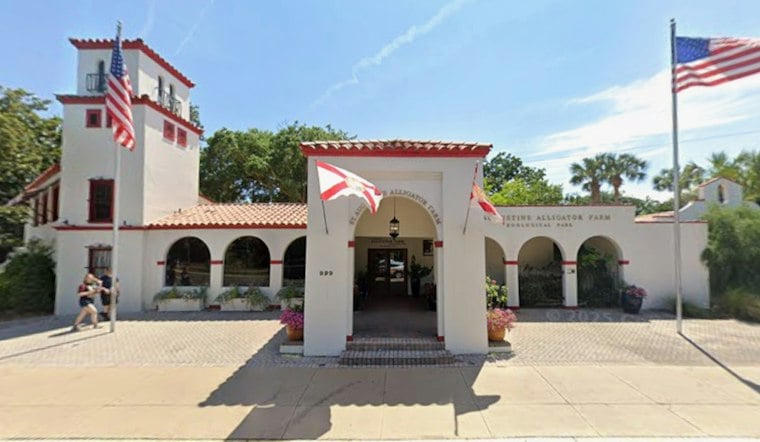
Two small monkeys named Hermione and Lochte have moved into a brand-new habitat at the St. Augustine Alligator Farm Zoological Park, positioned right beside the Komodo dragon exhibit and next door to Maximo, the park's 15.5-foot, 1,250-pound Australian saltwater crocodile, and his 9-foot mate Sydney. The pair of Geoffroy's marmosets made their public debut at the Anastasia Island park on July 2, 2026, after living behind the scenes at the facility since 2024.
According to News4JAX, the habitat was built by the park's Bird & Mammal team specifically to give visitors an up-close look at one of the smallest monkey species on exhibit. Megan Victoriano, the park's Bird & Mammal Curator, said guests have responded wonderfully to the marmosets since their debut, per the same report. Victoriano also serves as the national Association of Zoos and Aquariums Species Survival Plan Coordinator and Studbook Keeper for the Hooded Vulture population, according to a video posted by the St. Augustine Alligator Farm.
Meet Hermione and Lochte
Hermione, a 17-year-old female, is described as the more gregarious of the two, often engaging with staff during training sessions and checking out new enrichment items, News4JAX reports. She can be identified by a shorter tail and one eye. Lochte, a 14-year-old male, tends to favor higher perches and plants, using the vantage point to keep a lookout, per the outlet's account.
Male and female Geoffroy's marmosets look similar to one another, the report notes, typically growing to about 8 inches in body length with an 11-inch tail. They sport a blackish-brown coat, long black ear tufts, darker brown patches, a black tail with light rings, and a white forehead, chest, and throat. As omnivores, the species eats fruit, flowers, nectar, gum from trees, and small animal prey including lizards, snails, frogs, spiders, and insects, using their larger incisors to gouge holes in bark to reach tree gum.
A Species Survival Plan Transfer
Hermione and Lochte arrived at the St. Augustine Alligator Farm in 2015 from other AZA-accredited facilities as part of a Species Survival Plan recommendation, the outlet's report states. These national programs, coordinated by the Association of Zoos and Aquariums, are managed by experts from AZA-accredited facilities across the country and beyond, and they allow accredited institutions and sustainability partners to collaboratively manage each species to ensure genetically diverse, demographically varied, and biologically sound populations.
Geoffroy's marmosets are small monkeys native to the lowland forests of Brazil, according to News4JAX. The species is native specifically to Brazil's Atlantic Forest and is classified by the CABI Compendium as a species of Least Concern on the IUCN Red List, though forest fragmentation and agricultural expansion remain localized threats in eastern Brazil. The Bird & Mammal team hopes the two monkeys will educate the public about Geoffroy's marmoset background, needs, and conservation efforts, and support broader wild-animal conservation, per the outlet.
A Park Built on Rare Animal Milestones
The new exhibit adds to a facility with an unusually deep bench of animal-care distinctions. Founded on May 20, 1893, the St. Augustine Alligator Farm is one of Florida's oldest continuously operating roadside attractions and is listed on the National Register of Historic Places, according to Legends of America. In 1993, it became the only zoological park in the world to house all 24 recognized living species of crocodilians, a distinction noted by the St. Augustine Alligator Farm itself.
That reptile-focused legacy has intersected with rare mammal and bird care before. The park produced the first recorded hatching of an Indian gharial crocodile in North American history in June 2016, a milestone Hoodline highlighted in its report on Fort Worth Zoo's gharial hatchings. The park also once raised Claude, the famous albino alligator who later became a beloved fixture at San Francisco's California Academy of Sciences until his death at age 30, as Hoodline reported in its coverage of Claude's passing.
Beyond the Marmoset Exhibit
Visitors to the park can also find animal encounters, the Crocodile Crossing adventure course, a natural rookery, zoo camps, and conservation-supporting community events, according to News4JAX's report. The park additionally hosts a natural native Wading Bird Rookery, where wild Florida egrets, herons, spoonbills, and wood storks build nests directly above alligator lagoons each spring and summer, according to a video from the St. Augustine Alligator Farm.
Florida law treats marmosets differently outside accredited institutions. Under Florida Fish and Wildlife Conservation Commission rules, marmosets are classified as Class III wildlife, meaning private Florida residents must obtain a Class III Personal Use Permit, which requires meeting state facility safety and care guidelines, to keep them as pets, according to the Florida Fish and Wildlife Conservation Commission. Information and tickets for the St. Augustine Alligator Farm are available at alligatorfarm.com, per News4JAX.





