

























































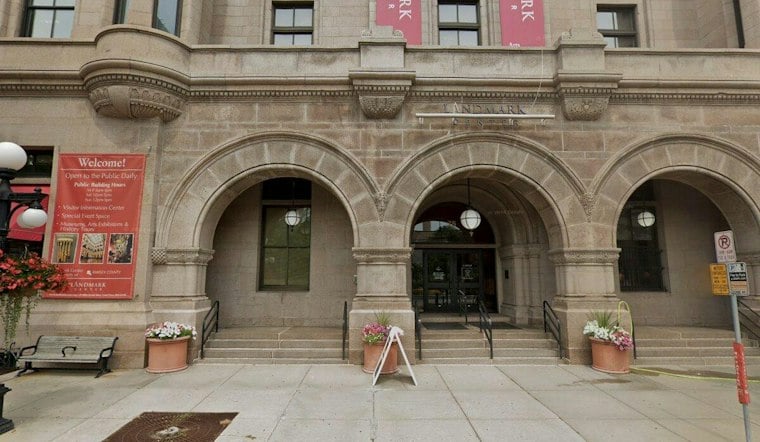
A century-old Minnesota stock fraud that targeted German American investors is returning to a St. Paul stage this week. Smooth Criminals, an original play about the scheme led by Clarence Cochran, opens at Landmark Center's F.K. Weyerhaeuser Auditorium on Thursday, October 1, 2026. The case later brought a major federal trial to the courthouse that now houses the production.
A Scheme Built on Trust and a Subscriber List
The scheme's reach depended in part on an existing community connection. According to the Ramsey County Historical Society, Cochran began selling stock in the Volkszeitung Publishing Company in 1923, after its owner, Clara Bergmeier, could not find German American buyers willing to pay her $100,000 asking price. Cochran contracted to acquire the paper for $150,000, relying on an inflated appraisal of its real estate. The newspaper's 16,000-name subscriber list—made up mostly of aging, thrifty German Americans—became a ready-made audience for his pitch.
The fundraising extended well beyond the newspaper. The same historical account says the Loring Holding Company authorized up to $2 million in bond sales against assets valued at about $275,000. From November 1923 to July 1926, Cochran incorporated four brick companies called Hardstone. New stock sales helped pay investors whose earlier notes and bonds came due, allowing the operation to continue.
Indictments, a Fine, and a Suspension of Trading
The legal response began while the companies were still operating. The Ramsey County Historical Society account says a Hennepin County grand jury indicted Cochran, Ed Ritter and six others on Aug. 6, 1924, for violating state securities laws. That charge was dismissed on a technicality. Cochran later pleaded guilty to a related matter and paid a $900 fine in Washington County in 1925. On Dec. 6, 1925, the state securities commission rejected Loring's application to sell preferred stock, saying the sale would likely “work a fraud upon the purchasers thereof.”
At a hearing involving Hardstone Little Falls, commission investigator Ingolf A. Grindeland called Cochran “one of the most crooked promoters ever,” according to the same account. Cochran was convicted and sentenced to prison at Leavenworth.
The Ramsey County Historical Society account identifies a chance meeting between Cochran and Ritter in the Ramsey County jail in early 1923 as an important early turn in the case. It also says both men had been arrested twice in 1922: once over bonds stolen in a New York City mail robbery, and once for cashing a worthless $3,618.50 check.
From Microfiche to the Stage
The play's origins trace to Amy Mino, executive director of Minnesota Landmarks, who asked attorney Terrance Newby to dig into a 1920s fraud case she had come across. Newby, a partner at Maslon LLP in Minneapolis who normally handles commercial litigation, intellectual property, patents and copyright matters, reviewed more than 100 articles on microfiche before writing the resulting script, titled Smooth Criminals: The True Story of a 1920s Fraud Scandal That Rocked Minnesota. His research drew in part on work published in 2024 by Paul Nelson, a St. Paul resident and historian, and on reporting that the Pioneer Press broke on the fraud case at the time it unfolded, according to the seed reporting from the Pioneer Press.
The Pioneer Press reports that Cochran and 17 others were accused of mail fraud for selling fraudulent stocks. The scheme used German immigrants to sell bogus shares to other German immigrants across Minnesota and the Midwest, though Cochran himself was of Irish origin. The federal trial took place in 1928. The newspaper's account says at least 1,000 people lost money and that combined losses reached millions of dollars.
An Era of Suspicion Toward German Immigrants
Newby's research also placed the fraud against a backdrop of anti-German sentiment after World War I, the Pioneer Press reports. The play examines anti-German prejudice during that period.
Newby told the Pioneer Press that the parallels to today are hard to ignore. “Remarks about Germans then are almost identical to remarks about Somalis and immigrants now,” he said, comparing the treatment of German immigrants a century ago with anti-immigrant rhetoric directed more recently at Somali immigrants. The reporting also discusses the Feeding Our Future scheme, which placed Somali immigrants at the center of a major Twin Cities fraud case, and says the 1920s trial drew attention to government corruption.
What the historical record shows
The National Archives describes World War I restrictions on people designated “alien enemies,” including a ban on firearm ownership and permit requirements for residence or work in restricted zones, or for leaving the country. Those records document wartime controls, not a federal ban on German immigration under President Woodrow Wilson. Separately, the Securities Exchange Act of 1934 formed part of a broader series of laws Congress passed to restore confidence and establish a regulatory framework.
Lawyers and Judges Take the Stage
Director Chad Snyder works primarily in commercial litigation and copyright and trademark matters. He also serves as senior minister at First Unitarian Society of Minneapolis and board chair of Applause Community Theatre in the Twin Cities, and helped start Rubric Legal in Minneapolis. The Pioneer Press reports that most of the cast are lawyers and judges, bringing professional familiarity with legal proceedings to a story about courtroom battles and financial deception.
The production's creators describe Smooth Criminals as historical fiction based on extensive research, and the Pioneer Press reports that cast and crew see connections between the case and current events. They aim to use the history to prompt audiences to consider how fraud, corruption and prejudice endure—and how those patterns affect people today.
Where and When to See It
Smooth Criminals marks the 20th original production staged at Landmark Center since 2003, part of a tradition in which the center, managed by Minnesota Landmarks, hosts a history play each fall based on real events typically tied to St. Paul or Minnesota. The venue itself carries its own history: the Old Federal Courts Building was constructed in 1902 and served as the federal courthouse until 1965.
Performances run Thursday and Friday at 7 p.m. and Saturday at 2 p.m., with additional showtimes October 1 and 2 at 7 p.m. and October 3 at 2 p.m., all at the F.K. Weyerhaeuser Auditorium inside Landmark Center in St. Paul. Tickets are $11.55 including processing fees and are available through landmarkcenter.org or by calling 651-292-3063.




