

























































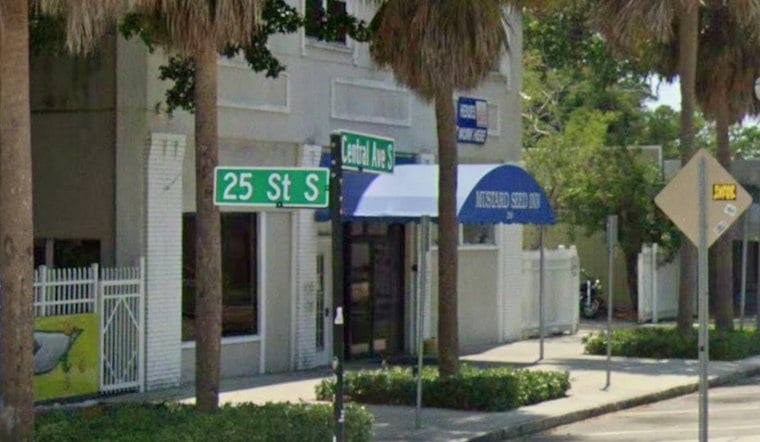
St. Petersburg's rainbow crosswalk and a colorful geometric intersection nearby have been painted black for a second time, and this time the city's mayor isn't staying quiet. Crews recently recovered the Progressive Pride mural at Central Avenue and 25th Street and artist Cecilia Lueza's Common Ground mural at Central Avenue and 5th Street, erasing the colors that had just started peeking back through worn asphalt.
Mayor Ken Welch condemned the move on Wednesday, accusing the Florida Department of Transportation of what he called a “deliberate campaign of erasure,” according to St. Pete Catalyst. Welch said the state “cannot erase our pride or change our values.” The mayor had previously declined to challenge FDOT's original 2025 removal order, wary of jeopardizing the city's state transportation funding, the outlet reported.
The Progressive Pride mural was installed in 2020, while Lueza's Common Ground design dates back to the 2016 SHINE Mural Festival, according to the Tampa Bay Times. Both were among five St. Petersburg installations FDOT ordered removed last year, the newspaper noted.
City Officials Say They Were Kept in the Dark
St. Petersburg officials said Tuesday they had no idea the murals were being blacked out again and confirmed no city personnel were involved in the work, per Florida Politics. FDOT did not immediately confirm whether its own contractors carried out the repainting, the outlet reported. City workers had also refused to physically remove the art during the original 2025 order, according to the same report.
The renewed cover-up came after vehicular traffic wore through the original August 2025 paint job, allowing the rainbow colors and geometric patterns to resurface on the pavement, roughly two weeks before crews returned with more black paint, according to WTSP. Community members had celebrated the peeking colors as a symbol of local resilience, the station noted.
A Statewide Mandate Rooted in a 2025 Law
The crackdown traces back to Florida Senate Bill 1662, signed by Gov. Ron DeSantis in June 2025, which led to a June 30, 2025 FDOT memo banning non-standard surface markings and pavement art carrying political, social, or ideological messaging on public roadways, according to WUSF. State officials have argued the art creates driver distractions and safety hazards, the outlet reported.
Florida officials have also pointed to a July 2025 directive from U.S. Transportation Secretary Sean Duffy instructing governors to strictly enforce the federal Manual on Uniform Traffic Control Devices and limit highway dollars to safety features, per St. Pete Catalyst. Federal officials have said public money should not fund non-standard roadway art, the outlet noted.
In August 2025, FDOT rejected St. Petersburg's request to exempt five local street installations from pavement marking rules and threatened to withhold state transportation funding if the city didn't comply, according to the same St. Pete Catalyst report. Beyond the Pride and Common Ground murals, the original order also targeted the Black History Matters mural near the Woodson African American Museum, a USF St. Petersburg campus mural, and a neighborhood installation in Childs Park, the Tampa Bay Times reported.
Local Crash Data Complicates the Safety Argument
Local transportation data from Forward Pinellas, cited by the St. Petersburg Area Chamber of Commerce, showed the painted intersection at Central Avenue and 5th Street saw a 73% drop in traffic crashes after its 2016 installation. The Chamber noted that similar asphalt art nationally has been linked to an average 17.3% reduction in pedestrian crash rates.
St. Petersburg isn't alone. FDOT's statewide mandate has led to the removal of dozens of street murals across Florida, including 47 installations in Tampa, rainbow crosswalks in Jacksonville, Pompano Beach, and Sarasota, and a Pulse Nightclub memorial crosswalk in Orlando, according to WTSP's earlier reporting. Municipalities across the state have faced similar community pushback and legal challenges, per CBS News Miami.
Jacksonville activists responded to the ban by relocating public art off roadways entirely, as Hoodline detailed in its report on Five Points' $130K mural. Whether St. Petersburg advocates pursue a similar private-wall strategy, or whether city leaders mount a formal legal or administrative challenge over local jurisdiction of city-maintained streets, remains an open question.




