

























































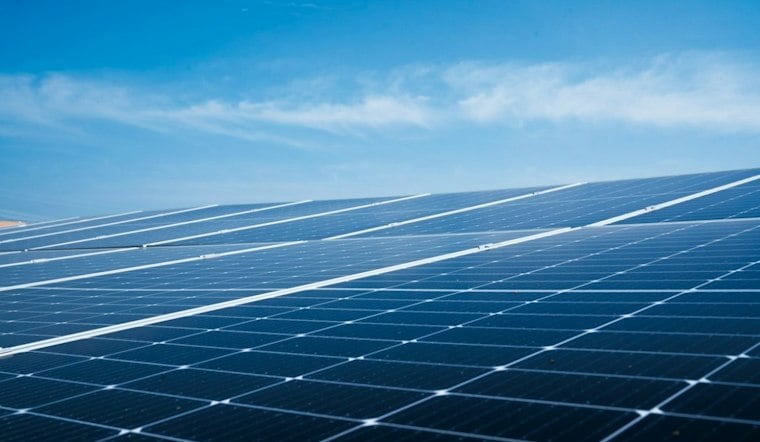
Construction crews have begun driving steel piling across roughly 2,500 acres of farmland in the towns of Elba and Oakfield, where nearly 1 million solar panels are rising to form what will become New York's largest solar farm. The 500-megawatt Cider Solar Farm, once fully operational, is expected to supply electricity to around 120,000 New York households and deliver about 1 million megawatt hours of renewable power annually.
The project, reported by EcoPortal.net, traces back to original developer Hecate Energy, which secured the state's approval before selling long-term ownership to Greenbacker Renewable Energy Company in 2024. Hecate remains on board as construction manager, according to Hecate Energy, an arrangement that splits long-term operation from the actual build-out happening in the fields right now.
A Regulatory First for New York's Fast-Track Solar Process
When Cider Solar Farm won its original approval on July 25, 2022, it became the first major renewable energy facility permitted directly under New York's Section 94-c rules, rather than transferred over from the older Article 10 review process, per Hecate Energy's project history. That distinction matters because Section 94-c was created in 2020 specifically to speed up siting decisions for large-scale renewable projects, and Cider Solar served as an early test case for how the streamlined process would hold up.
New York state regulators followed with a conditional notice to proceed on November 18, 2024, and major construction ramped up roughly six months later, in May 2025. The developer has said all construction phases would be fully under way by midsummer, with steel piling and racking installation now joined by electrical wiring and high-voltage utility interconnection work across the site.
Financing Ballooned as Equipment Costs Climbed
The project's price tag grew substantially along the way. In July 2024, project entity Hecate Energy Cider Solar LLC petitioned the New York State Public Service Commission to raise its authorized debt financing ceiling from $350 million to $950 million, citing steep equipment cost increases and restructured borrowing terms. The owner has since secured that full $950 million in aggregate financing to cover acquisition, construction and operation.
More capital arrived earlier this year: in February 2026, Greenbacker closed a $440 million tax equity financing commitment for the project, backed by U.S. Bank and M&T Bank, according to Solar Builder. The project also has a Renewable Energy Credit agreement.
Sheep, Steel and Miles of Buried Cable
The physical scale of the build is considerable. Cider Solar Farm will include 34 fenced array areas, 56 miles of perimeter fencing, 23 miles of access roads, and about 73 miles of buried medium-voltage collection line feeding a collection substation and interconnection point. The nearly 1 million solar modules are mounted on galvanized steel single-axis tracker frames designed to follow the sun from morning to dusk.
While initial environmental and siting studies evaluated roughly 4,000 acres, the facility's actual footprint covers approximately 2,200 acres across 60 private land parcels in Elba and Oakfield, according to Hecate Energy. The project also incorporates agrivoltaics, with rotational sheep grazing planned on more than 300 acres to control vegetation between the panel rows.
Grid Connection and Local Financial Stakes
The 500 MW facility will deliver its electricity directly into the state's high-voltage grid by interconnecting to the New York Power Authority's Dysinger-to-New Rochester 345 kV transmission line, per project scheduling documents at cidersolarfarm.com. Before electricity reaches homes, the substation must be commissioned, and interconnection and metering must be tested and certified — steps that stand between the current construction phase and commercial operation, which is expected in late 2026.
Locally, the project carries substantial financial weight. Public agreements approved by the Genesee County Economic Development Center project that Cider Solar will generate between $73.5 million and $100 million in PILOT payments and host community revenues over its operational lifespan for Genesee County, the towns of Elba and Oakfield, and two local school districts. To help manage oversight of a project this size, the towns arranged to retain code enforcement officers as independent contractors earning up to $22,500 each, WBTA reported in October 2025, reflecting how small municipal governments often lack the staffing to monitor utility-scale developments on their own.
Jobs, Emissions and a Growing Regional Cluster
The build is expected to support hundreds of construction jobs, with craft labor recruiting prioritized in western New York. Once operational, Cider Solar Farm is expected to offset roughly 680,000 metric tons of carbon dioxide in its first year, equivalent to the annual emissions of more than 150,000 passenger vehicles — output tied to New York's climate law requirement that the bulk of the state's electricity come from renewable sources by the end of the decade.
Cider Solar joins a broader cluster of utility-scale energy projects reshaping Western New York's agricultural belt, including NextEra's 280 MW Excelsior Energy Center in neighboring Byron and the 200 MW Orleans Solar project in Orleans County, according to the Pragmatic Environmentalist of New York. As steel piling continues to go into the ground across Genesee County this fall, the project stands as one of the most visible tests yet of how New York balances large-scale clean energy buildout against the rural farmland it depends on.





