

























































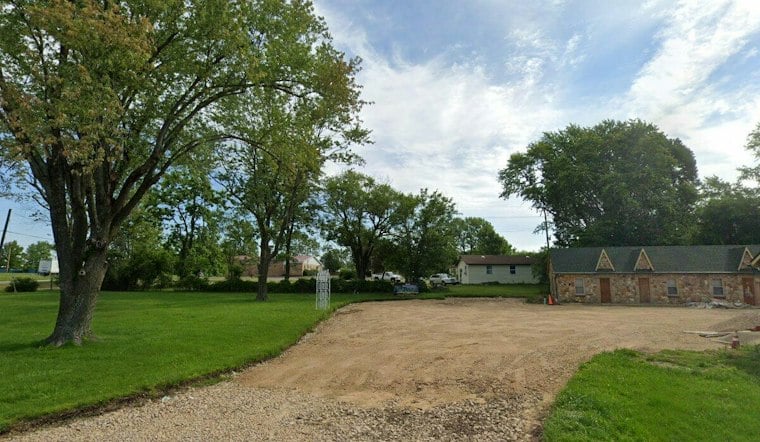
The Shamrock Court Motel in Sullivan, Missouri, has reopened to overnight guests for the first time in more than 45 years. The 1948 roadside motor court, which stood vacant and deteriorating for more than a decade, welcomed its first guests on May 29, 2026, according to Route 66 Road Trip.
Rich Dinkela, known among Route 66 enthusiasts as “Roamin' Rich,” and his wife, Christina, bought the property in 2021 after agreeing to keep it from demolition, as reported by Route 66 News. Dinkela, a former president of the Route 66 Association of Missouri, had found the abandoned motel along Interstate 44 in 2016, according to St. Louis Public Radio. What began as an effort to stabilize the property for a future buyer became the couple's own restoration project, the outlet reported.
A Motor Court Frozen in Time, Then Revived
The Shamrock Court was built between 1947 and 1948 using what locals call “giraffe rock” or “giraffe stone” masonry — an Ozark regional style of flat sandstone slab construction with raised mortar joints that artisans shaped into sunburst and diamond patterns, according to Route 66 Road Trip. The property's exterior still features 22 of those decorative sunburst patterns, and St. Louis Public Radio reports the stonework had remained in excellent condition despite the building's decades of neglect.
The Weiland family bought the motel in 1953 and lived in its center portion while running it as their main source of income, per St. Louis Public Radio. In 1980, the same year the interstate system bypassed Sullivan's original business route, the Weilands converted the guest rooms into efficiency apartments. John Weiland died in 2009, and the motel sat unoccupied from that point until Billy Weiland and his brothers sold it to the Dinkelas in 2021, the outlet reports.
Volunteers, Grants and a Roof That Wouldn't Wait
Restoring the motor court took more than sentiment. Rich Dinkela installed a new roof and drew on labor from dozens of volunteers, along with donations from the community and Route 66 enthusiasts, according to St. Louis Public Radio. The project also received grants from the U.S. Department of the Interior and the National Trust, on top of a $30,000 cost-share grant awarded in 2021 through the National Park Service's Route 66 Corridor Preservation Program specifically to help replace the roof and stabilize the structure, per Route 66 News.
Workers removed roughly 90 tons of soil by hand during the rebuild, St. Louis Public Radio reports, and the total renovation cost topped $1 million. The Shamrock Court was officially listed on the National Register of Historic Places on March 28, 2022, according to Route 66 News. Days earlier, on March 19, 2022, preservationists and community members gathered for a public ceremony to relight the motel's fully restored neon sign and roofline neon for the first time in decades.
A Ten-Room Motor Court Finds New Guests
The Shamrock Court now operates with 10 rooms and has been open for about three months. The reopening restores lodging to a property that had served as a motel, then as efficiency apartments, before falling vacant. Dinkela has said the site could be expanded in the future, while Billy Weiland, whose family owned and lived at the property for decades, told St. Louis Public Radio that the Shamrock will remain part of Route 66's story.
The Dinkelas' preservation ambitions have since grown beyond Sullivan. In April 2026, the couple purchased the historic Wagon Wheel Motel, a 19-room native-stone property in nearby Cuba, Missouri, for $1 million, according to Route 66 News. The 1935 Wagon Wheel is considered one of the oldest continuously operating motels on Route 66.
Part of a Bigger Centennial Moment
The Shamrock Court's rebirth arrives as Route 66 marks its 100th anniversary this year. Congress established a 15-member presidential commission in late 2020 to coordinate centennial events and preservation projects across all eight states the highway crosses, a mandate that runs throughout 2026. Missouri holds a particular claim to the highway's origin story: the numerical designation “Route 66” was first proposed via telegram sent from Springfield, Missouri, in April 1926, and the state contains roughly 317 miles of the drivable historic route between St. Louis and Joplin.
A Documented Preservation Landscape
The Shamrock Court is part of a larger, documented collection of historic roadside resources rather than an isolated survivor. A National Park Service special resource study says a Missouri survey identified 249 Route 66 properties, including 85 hotels, motels or camps, as well as garages, gas stations, restaurants, stores and drive-in theaters. Missouri State Parks' National Register listings also include a Multiple Property Documentation Form devoted to Route 66 in Missouri, placing individual sites such as the Shamrock Court within a statewide historic-resource framework, according to Missouri State Parks. The preservation effort extends beyond Sullivan and beyond any one owner's project. The National Trust for Historic Preservation says its Preserve Route 66 campaign has provided more than $2.3 million in grants across the highway's eight states over more than 35 years. In Missouri, the organization says 10 Route 66 sites have received more than $321,000 for preservation work, illustrating how grant programs and nonprofit campaigns complement property-specific restorations such as the Dinkelas' work at the Shamrock Court.
Sullivan is a roadside community of roughly 6,900 residents about 70 miles southwest of St. Louis, near Meramec State Park and the Franklin-Crawford county line. The town was largely bypassed when Interstate 44 replaced the old highway route through downtown in 1980. The Shamrock Court's reopening therefore restores a lodging business to a landscape shaped by the shift from two-lane highway travel to interstate traffic, while preserving the stone construction and neon features associated with the earlier roadside economy.





