

























































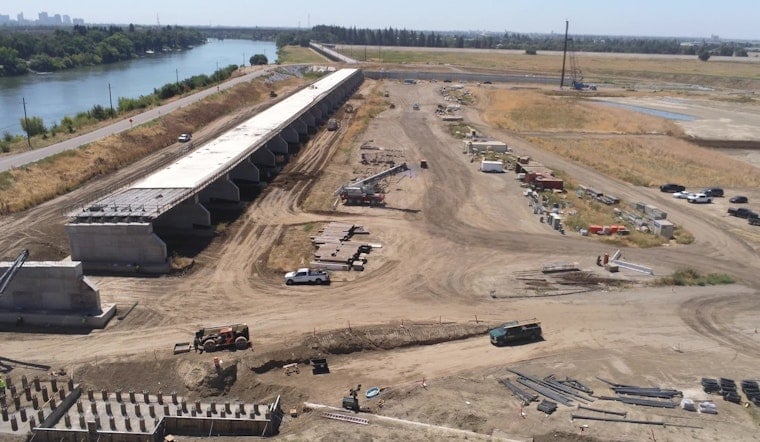
A sinking concrete support on the northern edge of the Sacramento Weir has cost the region's flood-protection upgrade a full year, pushing the project's completion date from December 2026 to winter 2027. Engineers discovered the unexpected settling beneath the foundation where the new structure meets existing levee embankments, forcing crews to tear out and rebuild the affected section before pouring new concrete this summer.
The delay traces back to March 2025, when project engineers first identified the settling issue, according to the U.S. Army Corps of Engineers Sacramento District. The Corps demolished the original north abutment wall in April 2026, began building a redesigned structure the following month, and started placing new concrete in July. As Abridged reporter Daniel Hennessy notes, the project team has confirmed it found no other settling elsewhere on the site after rebuilding the affected structure.
Hoodline first reported on the emerging soil concerns a year ago, when the settlement was discovered on the north abutment before officials extended the completion date to December 2027. The underlying cause is what engineers call differential settlement, in which uneven soil compression causes concrete foundations to sink at varying rates — a problem serious enough that a two-star U.S. Army general from Washington, D.C. inspected the site in July 2025, according to CBS News.
Why the 1916 Gates Still Matter
Despite the setback, officials say the new timeline will not increase regional flood risk, because the century-old, manually operated weir remains fully functional throughout construction. Built in 1916, the Sacramento Weir features 48 individual wooden gates held by steel beams that must be manually released via tethering cables, letting 1,824 wooden planks float into the bypass to lower river levels when the Sacramento and American rivers get high. It is the only manually operated weir among the six major flood control weirs on the Sacramento River, and the oldest.
Those manual gates have only been opened 23 times since 1916, most recently in 2017 during torrential rains, per the same reporting from Abridged. The Sacramento Weir sits along the eastern edge of Yolo County just north of West Sacramento and serves as a release valve for the region's entire flood-management system, which the Abridged report notes ranks the Sacramento region behind only New Orleans for metropolitan flood risk. That risk dates back to the Great Flood of December 1861 and January 1862, when winter storms breached newly built levees and inundated Sacramento, exposing the dangers of the city's location at the confluence of two rivers.
A Passive Weir Built for Automatic Overflow
Once complete, the expansion will add a 1,455-foot passive concrete weir alongside the existing 1,950-foot structure, increasing total floodway discharge capacity to 177,000 cubic feet per second, according to HDR. Unlike the original gates, the new passive section will spill floodwater automatically into the bypass once river levels reach a set elevation, with no manual intervention required; the historic manually operated gates will still be reserved for more extreme situations. The concrete support that settled is one of 26 supports planned to eventually hold up a new vehicular bridge, per Abridged's reporting.
That bridge will replace Old River Road, carrying cars over the weir on a new 25-span structure, according to Construction Dive. Heavy civil contractor Granite Construction was awarded the $173 million contract in May 2023 to build the widened weir, the vehicle bridge, and levee embankments, part of the broader $1.8 billion American River Watershed Common Features 2016 project set to fund flood work across the Sacramento Valley.
Fish Passage Built Into the Flood Fix
The project isn't just concrete and steel. Engineers also completed a 1.6-mile dual-channel fish ladder between 2024 and 2025, designed to let endangered salmon, steelhead, and 10-foot sturgeon safely cross between the Sacramento River and Tule Canal during high-water events, according to America's Engineers. Hydraulic modeling had shown that standard single-channel ladders created water velocities too fast for migrating sturgeon, prompting the dual-channel design.
Funding for the entire effort was authorized upfront by Congress through emergency supplemental appropriations in the Bipartisan Budget Act of 2018, according to the Sacramento Area Flood Control Agency. That upfront money means the project's schedule slip stems purely from the technical soil problem rather than any budget shortfall — construction remains ongoing, with the Corps now targeting winter 2027 for a finished weir, bridge, and fish passage north of West Sacramento.




