

























































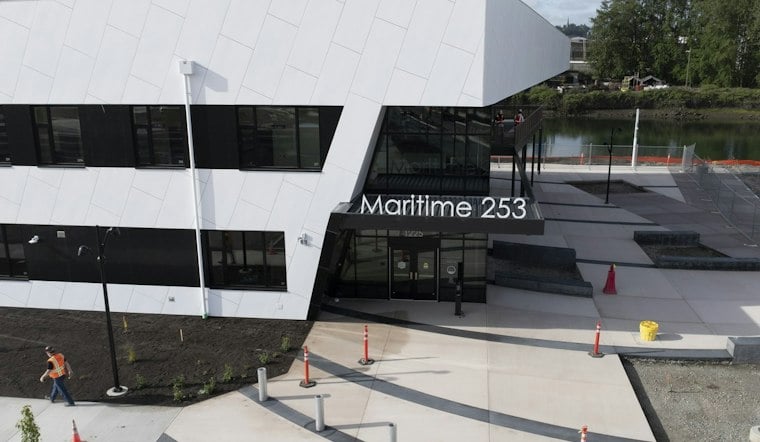
A new tuition-free high school program on Tacoma's working waterfront welcomed its first class of students this week, putting teenagers shoulder to shoulder with real port operators as they train for careers in shipping, manufacturing and marine science. Maritime|253 is billed as the first program of its exact kind in the nation, according to Fox 13 Seattle, and it's designed to funnel Pierce County high schoolers directly into an industry desperate for new workers.
The program, developed in partnership with the Port of Tacoma, serves high school juniors and seniors who split their day between their home high schools and hands-on coursework at the port facility, as reported by Fox 13 Seattle. Students spend half the day on standard coursework and the other half at the Port of Tacoma facility, where Maritime|253 transports them for training in manufacturing, marine technology and logistics. The program offers industry credentials, college dual-credits, and more than 1,000 hours of training, all free of charge.
Kristie Wolford, the program's director, said the training mirrors what students will encounter on the job. “Everything we have here is industry grade, so students are getting that applicable experience right away that they can bring back to their future employers,” Wolford said, per the same Fox 13 Seattle report.
A Waterfront Campus Built for Co-Location
Maritime|253 isn't just partnered with the Port of Tacoma — it physically shares a 21-acre waterfront campus with the port's business operations center on the Thea Foss Waterway, according to the Port of Tacoma. That business center houses roughly 150 Port and Northwest Seaport Alliance staff, meaning students train within steps of the professionals whose jobs they may one day fill. The dual-building project was designed and built by progressive design-build partners BNBuilders and TCF Architecture, who were selected in 2023, as noted by Inside Marine.com.
The waterfront site carries its own layered history. It formerly housed the Wheeler-Osgood Company door mill and sits within an original spuyaləpabš village site, requiring environmental remediation and ongoing cultural resource coordination with the Puyallup Tribe of Indians, according to Future Tides. Tribal members were among those who welcomed the program's opening, alongside local builders, educators and Port of Tacoma representatives, per Fox 13 Seattle's coverage.
Funding, State Approval and Regional Reach
The project traces back to a $535 million school construction bond that Tacoma voters approved in February 2020, with the skills center's own budget estimated at roughly $42 million, according to the Washington State Skill Center Association. Once fully operational, the center is designed to accommodate up to 600 high school students per year across half-day morning or afternoon sessions, while those students remain enrolled at their home high schools throughout Pierce County.
Getting there required state sign-off. The Washington Office of Superintendent of Public Instruction granted two-year conditional approval for Maritime|253's core programs in October 2023, enabling Tacoma Public Schools to establish inter-district agreements across the county, per Tacoma Public Schools. The center is open primarily to Tacoma-area and south-end high school juniors and seniors, but Fox 13 Seattle reports there's space available for students from other participating area districts as well. Curriculum is organized around four career pathways: Advanced Manufacturing and Skilled Trades; Maritime Operations, Transportation and Logistics; Maritime/Marine Science Technology; and Maritime Sustainability, according to Tacoma Public Schools' announcement.
Chasing a National Worker Shortage
The stakes behind the launch are steep. Maritime|253 aims to combat a national shortage of maritime professionals, with industry reports projecting upwards of 200,000 workers will be needed in the field over the next decade, according to Fox 13 Seattle. The financial upside is significant too — a study by McKinley Research Group for the Washington Maritime Federation found that Washington's maritime sector supported 174,300 total jobs and generated $45.9 billion in economic output in 2022, with average worker compensation reaching $112,000 annually including benefits, per the Port of Seattle.
Marine cargo operations across the joint Port of Seattle and Port of Tacoma facilities supported 52,100 jobs statewide and nearly $14 billion in business output in 2023, with average annual wages of $117,300, according to the Northwest Seaport Alliance. Tacoma's program follows a similar model launched by Highline Public Schools, whose Maritime High School opened in Des Moines in September 2021 in partnership with the Port of Seattle and Northwest Maritime Center.
Students See a Bridge to Their Future
For some in the inaugural class, the appeal isn't just the maritime trades themselves but the exposure to professionals across fields. Jeremiah Commodore, a student interested in industrial design and architecture, told Fox 13 Seattle the port setting gives him access he wouldn't otherwise have. “The port is over there so you can talk to people from big time places and get a better idea of what you're going into for college, whether it's science, math, architecture for me, or industrial design,” Commodore said.
His mother, Melissa Commodore, said she hopes the experience builds his confidence heading toward a college path. “I hope that he has more confidence in his ability to be able to go into architecture,” she told the outlet. With open enrollment and a curriculum built around real industry credentials, Maritime|253's organizers are betting that the program can turn that kind of early exposure into a steady pipeline of workers for a waterfront economy that badly needs them.





