

























































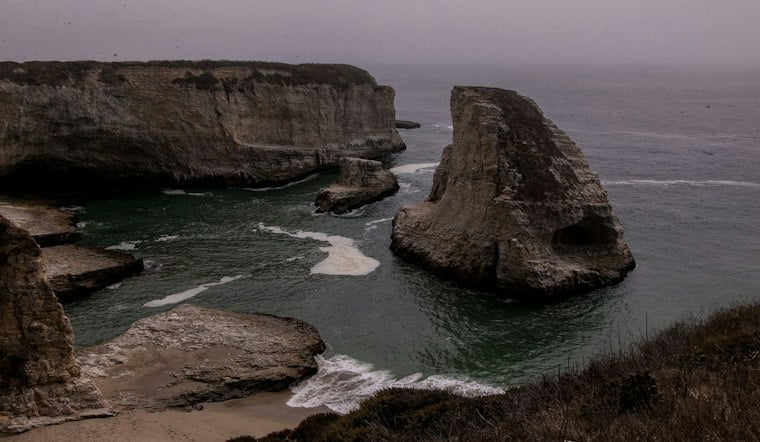
A 19-year-old fell 25 to 30 feet down a cliff face at Panther Beach on Saturday, landing on a rocky shelf below before emergency crews hoisted them to safety by helicopter. The teenager was transported in stable condition to a nearby hospital, and authorities have not released their identity.
According to a statement from CAL FIRE cited by the San Francisco Chronicle, firefighters, California State Parks personnel, and medical first responders worked together to package and stabilize the patient on the cliff shelf before CAL FIRE BEU Copter 610 arrived. The helicopter executed a hoist rescue on September 12 to lift the teen off the rocky shelf south of Panther Beach, according to CAL FIRE BEU. From there, the victim was transferred to Stanford Life Flight and taken to a hospital in stable condition.
A Beach Known for Its Rocks and Its Risks
Panther Beach sits in a secluded cove off Highway 1, about 10 miles north of downtown Santa Cruz, and is known for dramatic rock formations that draw visitors off the sand and onto unstable terrain. The Chronicle reports that strong ocean winds and large waves make the coastal cliffs, bluffs, and rocks along this stretch more hazardous, and that a fall off the rocks can end in the ocean. CAL FIRE has warned people to stay off cliffs, bluffs, and rocks along the coastline.
The beach is officially designated by the USGS as Yellow Bank Beach, named for Yellow Bank Creek, and falls within Coast Dairies State Park, managed under Wilder Ranch State Park, according to California Beaches. Coast Dairies protects seven miles of undeveloped Santa Cruz County coastline, much of it marked by cliffs, caves, and rocks that can pose hazards to visitors.
Rising Foot Traffic Meets a Fragile Coastline
The rescue comes months after transportation officials opened a newly paved parking lot with public restroom facilities at Panther and Yellow Bank beaches, part of the North Coast Rail Trail project along Highway 1, as reported by SFGATE. That access point, built by the Santa Cruz County Regional Transportation Commission ahead of the rail trail's full completion, has made it easier than ever for the public to reach a stretch of coastline that emergency crews already knew intimately. Transportation planners expect to begin construction in 2028 on a Highway 1 pedestrian overcrossing linking that parking lot directly to the Cotoni-Coast Dairies National Monument trail system inland, according to the same SFGATE report.
Coastal bluffs and cliff faces across Santa Cruz County pose hazards, and stranded beachgoers are urged to remain on high ground and call 911 rather than attempt a descent, as Hoodline reported in its coverage of a rescue surge along the same one-mile corridor. That June report detailed five separate ocean and coastal rescues within a single month between Yellow Bank Beach and Bonny Doon Beach, as narrow cove beaches rapidly submerge against steep cliffs when tides rise.
A Pattern of Close Calls Along the North Coast
Panther Beach's terrain has proven especially unforgiving. The cove connects at its southern edge to Hole-in-the-Wall Beach via a natural sandstone keyhole arch that fills rapidly during high tide, frequently trapping visitors against the cliff face, Hoodline reported in its account of a sea cave rescue near Davenport in May. That incident saw a multi-agency effort, including a U.S. Coast Guard helicopter, rescue eight people stranded inside a sea cave near Panther Beach after rising tides trapped them, with three non-swimmers hoisted from the shoreline.
A month later, on June 10, two Bay Area college students died after being swept into the ocean by rising tides while sleeping near that same keyhole rock formation connecting Panther Beach and Yellow Bank Beach, according to SFGATE. The incident drew an emergency response. The danger extends beyond this stretch of coast.





