

























































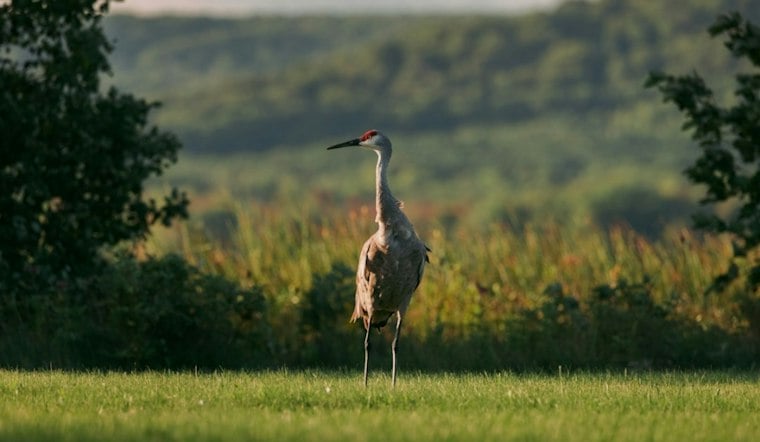
Michigan's largest bird is on the move again. Sandhill cranes are gathering by the thousands in fields and marshes around Calhoun County as they prepare for fall migration, with Michigan Audubon volunteers counting 889 of the birds roosting at the Bernard W. Baker Sanctuary near Bellevue in late October last year.
The sanctuary, located at 21145 15 Mile Road and anchored by Big Marsh Lake, spans roughly 980 acres and ranks as Michigan Audubon's second-largest owned and managed property, according to the Detroit Free Press. It holds a distinct place in conservation history as the first sanctuary in the nation set aside specifically to conserve sandhill cranes, a legacy that traces back to conservationist Bernard W. Baker's donation of the original 491 acres in 1941, according to the Grand Haven Loutit District Library. The property today includes three trails and, per the same account, has nearly doubled in size since Baker's original gift.
That founding matters because Michigan's cranes were once nearly wiped out. Ornithologist Lawrence Walkinshaw estimated in 1931 that only 17 breeding pairs survived in southern Michigan and fewer than 100 pairs remained in the Upper Peninsula, according to the Songbird Protection Coalition, with habitat destruction and unregulated hunting driving numbers to alarming lows in the early 20th century.
What Makes a Sandhill Crane
Sandhill cranes stand 3 to 4 feet tall with wingspans of 6 to 7 feet, sporting a bright red crown, a straight neck, tan-gray fluffy feathers and a loud, trumpet-like echoing call, the Free Press reports. They're often seen in family groups roosting in marshy areas or flying overhead, and can live 20 to 40 years, according to the Iain Nicolson Audubon Center. They may even snore while sleeping, per the National Park Service.
People sometimes mistake them for great blue herons, but the two birds look quite different up close. A great blue heron has a black crown stripe on a whitish head, an s-shaped neck, a blue-gray body and a yellow spear-like beak, standing the same 3 to 4 feet tall but with a slightly smaller 5- to 6-foot wingspan. The Michigan Department of Natural Resources recommends Baker Sanctuary, Kensington Metropark and Waterloo Recreation Area as prime spots for viewing the migrating birds.
Evening Fly-Outs and CraneFest
Each evening in October, just before dusk, the cranes leave their favorite feeding fields and head to Big Marsh Lake to roost for the night, according to the Battle Creek Kiwanis Club. The club will host its 31st annual CraneFest on Oct. 10 and 11 at the Kiwanis Youth Conservation Area near Bellevue, running from noon to 6 p.m. both days at 22300 15 Mile Road. Admission is $10 per vehicle and covers both days, with vendors, food trucks, local art, nature walks and craft booths on offer alongside restrooms and a pavilion. Visitors are encouraged to bring cameras, binoculars, chairs and blankets.
Jackson County offers another major staging ground during the same season. The Phyllis Haehnle Memorial Sanctuary, established in 1955 near the Waterloo Recreation Area and jointly managed by Michigan Audubon and the Jackson Audubon Society, has recorded peak fall counts exceeding 5,000 to 8,000 cranes before evening roosting.
A Species Once Nearly Gone, Now Booming
Sandhill cranes are not endangered in Michigan today, and the National Park Service says populations have held steady or increased over the last few decades. That recovery mirrors a broader regional trend: fall survey data coordinated by the U.S. Fish and Wildlife Service shows the Eastern Population of sandhill cranes has grown from an initial management target of 30,000 birds to more than 90,000 across a flyway spanning eight states and two Canadian provinces.
The birds are protected under the Migratory Bird Treaty Act of 1918, which makes it illegal to kill, harass, capture, transport, sell or trade sandhill cranes, though the Michigan DNR recognizes legal, non-lethal methods to keep them from becoming a nuisance. Once migration begins, cranes from Upper Michigan tend to travel far: a 30-year tracking study found that 97% of radio-tagged birds wintered in wet prairies and pastures in Florida and southern Georgia, showing an 85% year-to-year fidelity to the same wintering grounds, according to the North American Crane Working Group. They generally stay put on those southern grounds until spring migration begins in late February.
Booming Numbers, Growing Farm Friction
The population surge hasn't come without conflict. While birdwatchers celebrate the massive autumn fly-ins, agricultural groups face significant crop loss from cranes plucking sprouting seed corn, according to Michigan Farm Bureau. To fight that damage without harming birds, farmers treat seed corn with Avipel, a chemical seed treatment containing 9,10-anthraquinone that causes temporary, non-toxic digestive discomfort and pushes cranes toward alternate food sources, per Michigan State University Extension. Farmers suffering agricultural losses can also apply for federal depredation permits from the U.S. Fish and Wildlife Service to lethally remove problem birds, but only after demonstrating non-lethal deterrents have failed, and federal rules strictly prohibit possessing or consuming any birds taken under those permits.
That friction has spilled into the Michigan Legislature. Senate Resolution 20, introduced in 2021, urged the Natural Resources Commission to designate sandhill cranes as a game species and request a hunting season, even as non-game protections remain in place. Hunting advocates argue a regulated harvest would help manage population growth, while opponents point to the species' notoriously slow reproduction. Sandhill cranes are among North America's slowest-reproducing birds, typically taking four to seven years to reach breeding maturity and needing a 5% to 10% annual recruitment rate just to hold numbers steady, since females usually lay only two eggs per clutch with often just one chick surviving to fledge, according to the Songbird Protection Coalition.
The contrast with Michigan's other migratory crane is stark. The Eastern Migratory Population of endangered Whooping Cranes, which occasionally travel alongside their sandhill cousins, numbered just 66 individuals as of a January 2026 update from the International Crane Foundation. Tracking flocks of sandhill cranes remains one of the tools conservationists use to locate their far rarer relatives across Mississippi Flyway states.





