

























































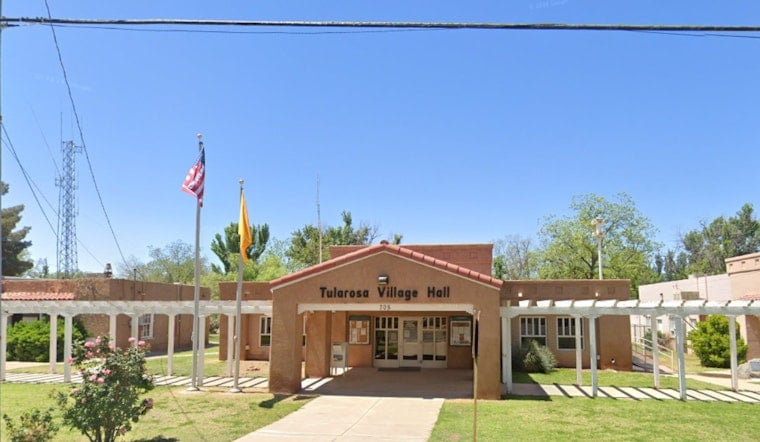
The Village of Tularosa's board of trustees has approved the purchase of an 84-acre tract south of the village to build a supplemental groundwater treatment facility, a project aimed at giving the community a backup water source as flows on the Rio Tularosa have steadily declined. The village currently depends on a surface water treatment plant fed by the river, but officials say that supply alone can no longer be counted on to meet demand, especially during hot summer months when irrigation and household use both peak.
The land purchase clears the way for redeveloping the old Monazuma well, drilled in the 1950s, as the source for a new reverse osmosis desalination plant, according to 2nd Life Media Alamogordo Town News. Tularosa officials have been planning the project since 2022, and it comes as historical stream gauge data recorded mean annual flows on the Rio Tularosa near the village at more than 11,000 acre-feet per year during mid-20th-century monitoring, a figure that dwarfs today's summer flows after the river experienced a steady decline from 2001 through 2024, per City of Alamogordo and John Shomaker & Associates records. Tularosa officials said failure to act risks repeated water shortages and emergency restrictions.
Why the Monazuma Well Needs Heavy Treatment
Groundwater from the Monazuma well contains roughly 2,250 parts per million of total dissolved solids, exceeding the EPA's secondary drinking water standard by more than four times, the village's reporting shows. That guidance limit of 500 mg/L, set by the U.S. Environmental Protection Agency's National Secondary Drinking Water Regulations, is a non-enforceable benchmark aimed mainly at taste, odor, and pipe-scaling concerns rather than direct health risks, according to the U.S. Environmental Protection Agency.
The scale of the problem is regional. Hydrological studies from the New Mexico Bureau of Geology and Mineral Resources indicate that less than 0.2 percent to 4 percent of saturated groundwater deposits in the Tularosa Basin contain fresh water under 1,000 mg/L of total dissolved solids, a condition the agency attributes partly to over-pumping and reduced recharge that have pushed brackish water into existing freshwater zones across Otero County. Reverse osmosis membrane filtration at the new plant will reduce total dissolved solids in the treated water to below 5 parts per million, the village's plans show, but the process will reject about 18 percent of pumped water as brine that becomes concentrated, starting around 13,000 parts per million and eventually exceeding 100,000 parts per million.
Handling the Leftover Brine
To manage that byproduct, the village plans to dedicate roughly 25 to 30 acres of the new parcel to lined evaporation ponds with six-foot water depths, polyethylene liners, berms, fencing, and state-required monitoring wells intended to guard against groundwater contamination. Officials say the treatment plant and evaporation ponds will sit outside the Rio Tularosa waterway and will not affect the river channel itself, according to the same village reporting.
The plant itself is designed with two redundant treatment units, allowing operations to continue during maintenance or if one unit runs into problems. The Village of Tularosa also plans to install solar panels to offset desalination power consumption, a strategy that mirrors research from Otero County's own federal desalination facility, where field trials in 2024 demonstrated that direct solar-powered reverse osmosis systems can harness more than 94 percent of solar panel electrical energy without needing auxiliary battery banks, per MIT News.
Water Rights and a Two-Thirds Cut
The Monazuma well currently holds 210 acre-feet of agricultural water rights, but converting that allocation to municipal use triggers state conversion rules expected to reduce the usable rights to about 70 acre-feet, a two-thirds cut. New Mexico law does give public water entities some flexibility here: under Section 72-1-9 of the state statutes, municipalities and community water systems may reserve unused water rights for up to 40 years based on projected population growth without risking forfeiture, according to Justia Law.
The new facility will not replace the cheaper surface water supply and is intended only to supplement it, and even at full build-out it will not fully cover peak summer irrigation demand. That framing matters for a village whose relationship with the Rio Tularosa runs deep. Tularosa was founded in 1862 by settlers who built acequias fed by the river, and its original 49-block layout was added to the National Register of Historic Places in 1979, according to Visit Alamogordo. Municipal water managers and the Tularosa Community Ditch Corporation have also seen recurring legal disputes over Rio Tularosa diversions and allocations dating back to the late 19th century.
Concerns From Well Owners and Growers
Not everyone is convinced the plan is risk-free close to home. Private well owners near the Monazuma well have worried that increased pumping could reduce their own water supplies, and the village's reporting notes that increased pumping could hurt pecan and pistachio operations in the area. The concern carries weight regionally: the Tularosa Basin accounts for roughly 5 percent of New Mexico's pecan production acreage and serves as the epicenter of the state's commercial pistachio industry, per NMSU Extension.
Regulators are not skipping past those concerns. The state conducts impact reviews and regulates groundwater withdrawal volumes, and the water system could eventually tie into aquifer storage and recharge programs down the line. Grants and state funding have supported the design phase of the project so far.
Timeline and Cost
Project construction is expected to begin by mid-2027 and last about 15 months, with the supplemental groundwater treatment facility planning to begin operating and deliver water by late 2028. The capital cost is estimated at $4 million to $5 million, while annual pumping and treatment costs are projected at $30,000 to $40,000 once the plant is operating at full capacity.
Tularosa's approach echoes what neighboring Alamogordo has already built. That city completed a 1-million-gallon-per-day brackish groundwater desalination facility designed as a peaking plant to meet 18 percent to 20 percent of municipal demand during summer peaks, relying on a 16-mile pipeline connecting remote wellfields to the plant. Otero County is also home to major federal investment in the technology: in May 2023, the U.S. Department of the Interior awarded $12.6 million from the Bipartisan Infrastructure Law to upgrade the Brackish Groundwater National Desalination Research Facility in Alamogordo, which tests pilot-scale desalination technologies and concentrate management strategies for Western communities, according to the U.S. Department of the Interior. The article on Tularosa's land purchase was written by Chris Edwards, editor.





