

























































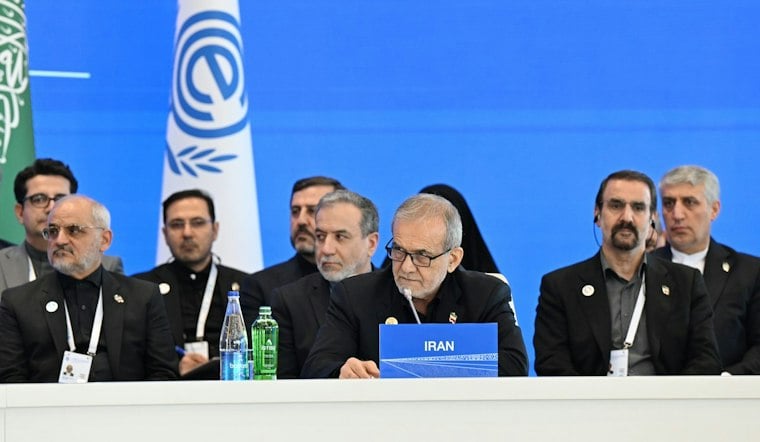
Iran could not confirm that its core delegation, including President Masoud Pezeshkian and Foreign Minister Abbas Araghchi, had received U.S. visas to attend next week's United Nations General Assembly high-level meeting in New York.
The approval comes as the U.S. has imposed significant sanctions on Iran and launched a campaign aimed at severing critical financial lifelines to Tehran. There remains no near-term agreement to reopen the Strait of Hormuz, and the report does not establish whether there will be a near-term return to talks on Iran's nuclear program. The State Department confirmed that Iran's core delegation will be able to attend the high-level week, the outlet notes, even as Washington classifies Iran as the world's leading state sponsor of terrorism.
The article describes regional maritime impediments that have helped drive a surge in global oil prices, per the AP report relayed by WKMG, and says Iranian-backed rebels in Yemen have attacked Saudi Arabia; it separately mentions attacks on oil tankers near the Strait of Hormuz.
A Legal Obligation Washington Can't Easily Sidestep
The visa approval reflects a legal reality more than a diplomatic gesture. Under Sections 11 and 12 of the 1947 UN Headquarters Agreement, the United States is obligated to permit foreign representatives transit to and from the UN headquarters district irrespective of the relations existing between their governments and the host country, according to FPIF.org. That obligation was written into force when the UN seat was established in New York, and it limits how far Washington can go in blocking attendance outright — even amid active hostilities.
To manage that duty while still exerting pressure, the U.S. created the C-2 nonimmigrant visa category, which grants visiting diplomats a geographically restricted status confining their movement to a 25-mile radius centered on Manhattan's Columbus Circle, as detailed by the LMU Institutional Repository. That framework has allowed the U.S. to grant core access while layering on additional restrictions for specific delegations it wants to squeeze.
Smaller Delegation, Tighter Leash
Iranian diplomats last September faced travel restrictions, including prohibitions on purchasing luxury and other goods, per the WKMG report. Iranian diplomats last September were barred from shopping at wholesale membership stores like Costco and Sam's Club without prior approval, a restriction detailed by Peoples Dispatch. The outlet also reported that U.S. movement boundaries prevented Iranian delegates from participating in several multilateral UN meetings held in Manhattan outside designated travel zones during last year's session.
In an earlier episode, the U.S. restricted travel for Iranian officials in New York to a six-block zone covering the UN headquarters, the Iranian UN mission, the ambassador's residence, and JFK Airport, according to TRT World. Just days before this year's session opened, Iranian Foreign Ministry spokesman Esmaeil Baghaei said Tehran had not yet received confirmation of U.S. visa approvals for its delegation, per NAMPA.
Questions Beyond New York
The article also considers whether travel restrictions on Iranian officials could extend beyond New York.
A Starkly Different Outcome for the Palestinian Authority
The contrast with the Palestinian Authority's treatment this year is stark. The State Department denied visas to Palestinian President Mahmoud Abbas and his delegation, accusing Palestinian leadership of undermining peace efforts and opposing statehood efforts, according to the AP report carried by WKMG. The Palestinian Authority condemned the denial, while the report said the restrictions undermined trust and relations.
Washington does not recognize the Palestinian Authority as the government of a full UN member state, even though the Palestinian Authority administers parts of the Israeli-occupied West Bank. The sources describe Palestine as an observer at the UN. The Palestinian Authority said it remained committed to long-stalled negotiations, while the WKMG report also notes the Authority continues to pay stipends to prisoners jailed in Israel for attacks on Israelis.
This isn't the first time a U.S. visa denial to Abbas has drawn international pushback. Last September, the State Department revoked or denied visas to roughly 80 Palestinian Authority officials, including Abbas, according to the Associated Press. In response, Abbas addressed world leaders by video link, per the same report. The article provides no documentation that Hoodline previously covered this year's renewed ban on Abbas ahead of the same General Assembly session.
Echoes of a 1988 Precedent
The dynamic isn't new. In November and December 1988, the Arafat dispute prompted related legal proceedings, according to the Los Angeles Times. As the host country for UN headquarters, the United States remains limited in its ability to prevent foreign leaders from attending the General Assembly outright, even as it uses visa conditions, restricted perimeters, and shopping bans to constrain who gets full access once they arrive.





