

























































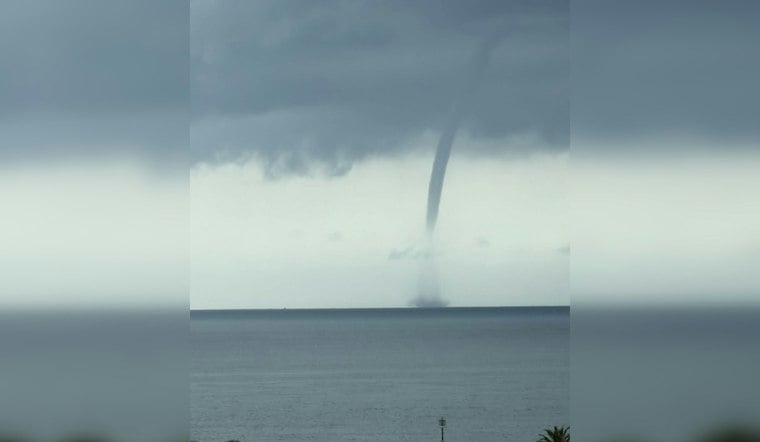
A Clearwater police officer reported spotting a waterspout off Sand Key Park on Saturday afternoon, part of a Facebook warning that storms were lurking just offshore and that the water and sand were unsafe places to be while the weather system passed. The sighting adds to a string of waterspout reports along Florida's Gulf Coast this year, and it comes at a moment when the 95-acre county park's beaches sit without lifeguard coverage for the season.
The report came in a post from the Clearwater Police Department, which said an officer saw the funnel off Sand Key Park and cautioned that storms remained close by. Sand Key Park itself is a 95-acre Pinellas County park at 1060 Gulf Boulevard, sitting directly across Clearwater Pass from Clearwater Beach, according to Pinellas County, and its shoreline includes both Gulf-facing beach and salt marsh habitat.
This isn't the first time a waterspout has rattled nerves on this stretch of coast. In June 2023, a waterspout moved onshore near Clearwater Beach's Lifeguard Tower 2, scattering beachgoers and sending two visitors from Kansas to the hospital with minor injuries from flying debris, as reported by WUSF. That earlier event prompted warnings from Clearwater Fire and Rescue and stands as a local reminder that offshore funnels can pose a real hazard once they reach land.
How Waterspouts Escalate From Warning to Warning
Under National Weather Service procedures, forecasters issue Special Marine Warnings for waterspouts spotted over open water, but they automatically escalate to a Tornado Warning if a waterspout moves onshore or toward land. The agency also distinguishes between two types: fair-weather waterspouts, which build upward from the water surface beneath developing cumulus clouds and tend to move very little in light winds, and tornadic waterspouts, which form downward during severe thunderstorms and share characteristics with land tornadoes.
Florida's coastal waters see more waterspouts than anywhere else in the country, with roughly 75 percent of the state's reported spouts forming during the wet season between May and September, according to National Weather Service and NOAA research. South Florida and the Keys alone log hundreds of sightings in a typical year, a pattern Hoodline also noted in its coverage of a dawn waterspout off Miami Beach in July and a boat trip interrupted by a funnel near St. Augustine's Salt Run in August.
If a waterspout does appear, National Weather Service safety protocols call for boaters and beachgoers to move away at a 90-degree angle to its apparent path rather than approaching to get a closer look, since the storms can produce wind gusts exceeding 40 knots even after coming ashore.
No Lifeguards on Duty as Storm Season Continues
The waterspout sighting also lands during a stretch when Sand Key Park has no lifeguard presence at all. Pinellas County provides seasonal lifeguard coverage at the park only from mid-March through Labor Day in September, meaning the towers are now unstaffed and swimmers are on their own if conditions turn dangerous.
That staffing gap has been a live issue at the county level. In August, Pinellas County officials discussed eliminating $374,000 in funding for seasonal lifeguard positions at Sand Key Park and Fort De Soto Park, citing ongoing difficulty filling the seasonal roles, according to the St Pete Catalyst. Hoodline previously connected those proposed cuts to a fatal wave incident at Fort De Soto that same month.
Beyond staffing, county commissioners have floated other changes at the two parks. They proposed replacing the flat $6 daily parking fee at Sand Key Park and Fort De Soto Park with a $3.50 hourly rate for fiscal year 2027, a shift intended to push more visitors toward annual passes, per WUSF. Separately, commissioners unanimously approved a $54.5 million agreement with the state to fund beach and dune restoration along Sand Key after storm erosion, with the money split between state environmental grants and tourist tax revenue, also according to WUSF.
Sand Key Park reopened to the public in December 2024 following post-hurricane cleanup, restoring access to its Gulf beaches and marsh trails. With storm season still active and lifeguard towers empty, county officials and forecasters alike are urging beachgoers to keep a close eye on the horizon before heading into the water.





