

























































Sora Vigorito was three years old when she was taken to Auschwitz with her twin sister in 1944. On Tuesday, September 15, she will stand before a University of Utah audience at Siciliano Auditorium in Gardner Commons and tell them what happened next — including how her sister died in the camp while she survived its liberation in 1945.
The 7 p.m. event, first reported by KSL.com, is organized by Chabad at the University of Utah alongside Hillel for Utah, Prosperity U, Interfaith U and the Smith-Pettit Foundation. Vigorito is described as the youngest known survivor of the medical experiments Nazi doctor Josef Mengele conducted on twins and people with inherited anomalies at Auschwitz, according to the same report. Organizers expect between 150 and 200 attendees, and while attendance is not required, those interested are encouraged to reserve seats online, per the station's account. Donations are also being encouraged to help fund the event.
Rabbi Moshe Nigri, director of Chabad on campus at the University of Utah and co-director of youth and family programming there, told KSL that Vigorito rarely travels to Utah, visiting a notable one for the campus. “We want as many people as we can to come,” Nigri said, per the station's report. He framed the talk as reaching well beyond any single faith community: “This is a story for any religion. Everyone should hear about this story,” he said, according to KSL. Nigri, who will also speak at the event alongside the Interfaith U director, said he expects a strong turnout.
A Story Preserved Across Decades
Vigorito was born Ute Seiler in Berlin in October 1941 to parents Miriam and Jakob Seiler, who had fled Syria and Siberia to Germany before the family went into hiding, according to the Williamsburg Yorktown Daily. The family remained hidden until 1944, when Vigorito and her twin sister were captured and deported to Auschwitz. Historical records compiled by the CANDLES Holocaust Museum indicate Mengele subjected roughly 1,500 pairs of twins — about 3,000 children in total — to medical experiments at the camp, with only around 200 individual children surviving until its liberation in January 1945.
Vigorito's testimony is preserved under her birth name, Ute Seiler, in the United States Holocaust Memorial Museum's oral history collection, and she has directed an Emmy Award-winning documentary about her life, the Williamsburg Yorktown Daily reports. Her University of Utah appearance follows a broader 2026 campus speaking tour that has included stops at the University of Florida in January and the College of William & Mary in March, according to The Independent Florida Alligator. Chabad organizations in multiple states have hosted her to share firsthand accounts with college communities, the Alligator notes.
Why Utah, and Why Now
Utah has a relatively small Jewish population, estimated by demographers and Jewish community organizations at somewhere between 6,500 and 13,000 residents statewide — roughly 0.2% to 0.4% of Utah's total population, according to Hey Alma. Most of that population lives along the Wasatch Front in the Salt Lake City metro area. At the University of Utah itself, Hillel International census figures put the Jewish student population at roughly 400 — about 300 undergraduates and 100 graduate students — within a student body of more than 36,000.
State lawmakers have already signaled support for this kind of programming. In February 2021, the Utah Legislature passed Senate Concurrent Resolution 1, encouraging local school districts and the State Board of Education to weave Holocaust and genocide education into public school curricula, noting that teaching past atrocities helps counteract prejudice, stereotyping, and bigotry. The university has since taken its own steps toward supporting Jewish student life on campus in partnership with groups including Hillel and Chabad.
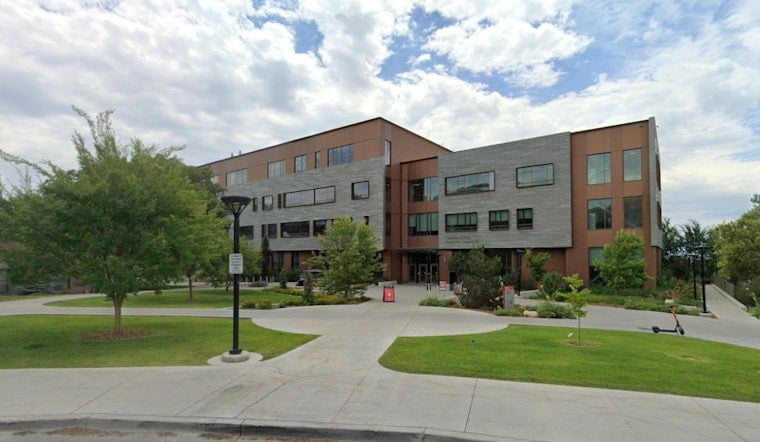
The Gardner Commons venue hosting Vigorito opened in fall 2018 as a 225,000-square-foot academic hub that replaced Orson Spencer Hall, home to the university's College of Social and Behavioral Science and featuring 33 classrooms and auditoriums used for major campus lectures and gatherings, according to the University of Utah.
A Vanishing Window for Firsthand Testimony
Global Jewish organizations have noted that as living Holocaust survivors dwindle in number — most now in their mid-80s or 90s — opportunities to hear firsthand testimony are becoming increasingly rare, according to the Alachua Chronicle. Community leaders have stressed the importance of recording and hearing direct testimony while survivors are still able to speak, the outlet reports.
The connection between survivor legacy and University of Utah leadership isn't new to campus. Hoodline previously reported that Dr. Michelle Hofmann, the daughter of a Holocaust survivor, was appointed interim senior associate dean at University of Utah Health to lead regional medical education initiatives, crediting her family's wartime resilience with shaping her approach to public health and medical training. Vigorito's appearance next Tuesday adds another direct, firsthand link between that history and the campus community.


