

























































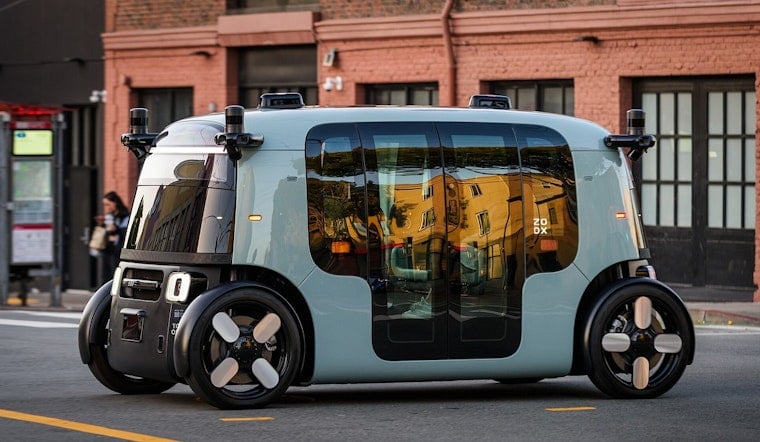
A driverless Zoox robotaxi drove past a road-closed sign in Las Vegas's Arts District on September 4, traveling the wrong way down a closed road before a viral video of the moment set off new questions about how autonomous vehicles handle unexpected road conditions. The vehicle appeared to hesitate at the sign before rolling past it, according to the footage circulating online.
Jim Ehlinger, a longtime Las Vegas rideshare driver and U.S. Army veteran, told KSNV that his main concern is safety, not competition. He said people need to be able to react quickly in emergency situations, something he worries a driverless system might not always manage the same way a human would behind the wheel.
What the Sensors Saw, According to a UNLV Expert
Shashi Nambisan, director of the UNLV Transportation Research Center, examined the road-closure sign and said it appeared to meet the requirements for a proper closure notice, using standard black lettering on a white background. He told the station the road had enough space for the vehicle to move into a travel lane, and he believes the vehicle's sensors likely treated the sign as a physical obstacle to steer around rather than as an instruction to stop.
Nambisan said the sensors did not detect anything blocking the vehicle from entering the lane, which is a distinct problem from the vehicle failing to recognize the sign existed at all. That distinction matters because it points to a gap between object detection and traffic-command interpretation, a gap that has surfaced in other Zoox incidents in recent weeks.
A Driver Weighs Safety Against His Own Paycheck
Ehlinger said he is uneasy whenever his SUV crosses paths with a Zoox robotaxi on the road, and he is worried about what might happen if a similar sensor mistake occurs near people, on wet pavement, or on a severely damaged stretch of roadway. He is not opposed to driverless robotaxis becoming common in Las Vegas, but he said he supports the technology only if it operates safely, and he criticized what he called prioritizing profits over human safety.
He acknowledged being concerned about robotaxis affecting his own income as a rideshare driver, but he said that worry is secondary to his concerns about safety. For now, he has a blunt recommendation: he advised people to avoid Zoox robotaxis and urged both residents and tourists to put safety first.
Not every Las Vegas rider is convinced the robotaxis are worth the risk regardless of the fare. One passenger told the station he uses Uber about ten times a week and prefers rides that support human driving jobs, adding flatly that he would never ride in an autonomous car. Zoox vehicles do include an in-vehicle help button meant to connect riders with a live operator, though it is unclear whether that feature applies in situations like the road-closure incident. Zoox did not respond to KSNV's request for comment by Monday afternoon.
A Company Scaling Up Fast Across the Valley
The Arts District incident lands just as Zoox is rapidly expanding its footprint in Las Vegas. The company began testing robotaxis on the Las Vegas Strip after launching its public service there on September 10, 2025, and on August 10, 2026, it shifted from free demonstration rides to paid commercial fares, operating under a temporary federal exemption covering up to 2,500 vehicles built without traditional steering wheels or pedals, according to Gadget Review. That exemption came from the U.S. Department of Transportation in July 2026, marking a departure from federal standards that had long required manual driving controls, per TNW.
Just days before the Arts District video surfaced, Zoox became the first driverless robotaxi operator cleared to serve Harry Reid International Airport, launching paid pickups and drop-offs at both terminals on September 3. The company's pickup points sit at Level 0 below baggage claim, giving it a direct proximity advantage over traditional rideshare services that operate out of parking garages, as Casino.org reported.
The rapid rollout has already produced at least one collision. As Hoodline reported, an unoccupied Zoox robotaxi was rear-ended after an abrupt stop at Decatur Boulevard and Russell Road on August 25, when the vehicle halted in the intersection to yield to an emergency vehicle and a Ford 4Runner struck it from behind.
Recalls and Regulatory Scrutiny Pile Up
Federal regulators have taken notice of the software issues underlying these incidents. In July 2026, Zoox filed a voluntary safety recall with the National Highway Traffic Safety Administration covering 105 robotaxis after finding its driving software failed to properly detect and navigate heavy smoke at active emergency scenes. That followed an earlier recall in December 2025 covering 332 autonomous test vehicles, tied to a software flaw that caused vehicles to cross yellow center lines unnecessarily or stop in front of oncoming traffic near intersections.
Workplace safety records add another layer of context. Occupational Safety and Health Administration data from 2024 and 2025 found at least 24 injuries among autonomous test drivers at Waymo and Zoox, largely tied to sudden braking and swerving maneuvers, according to SlashGear.
Meanwhile, Nevada regulators are clearing the way for even more driverless vehicles on Clark County streets. The Nevada Transportation Authority unanimously approved commercial operating permits in August 2026 for Waymo, Tesla Robotaxi, and Aviari Services, authorizing hundreds of additional autonomous vehicles for paid passenger service. Under Nevada Revised Statutes Chapter 482A, all of these operators must register their fleets with the state DMV, follow state traffic laws unless granted specific exemptions, and carry at least $5 million in liability coverage.
For Ehlinger, the regulatory momentum doesn't erase his unease about what happens on the ground. He said he supports driverless robotaxis becoming common in Las Vegas only if they operate safely, a conditional endorsement shaped by his own experience navigating the same streets these vehicles are now sharing with human drivers.





.jpg)