

























































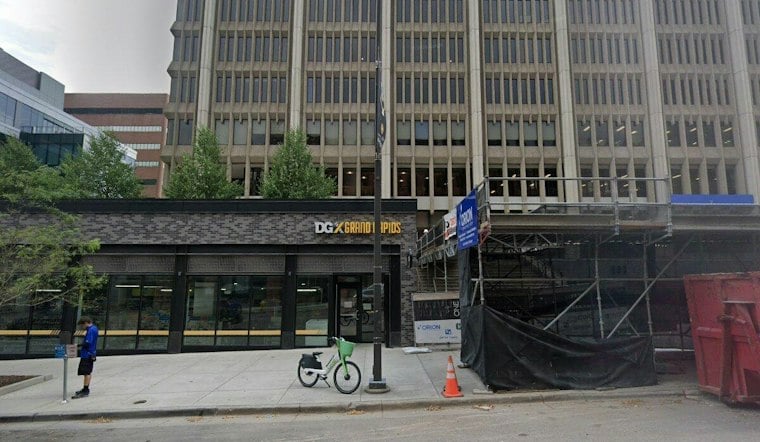
The 10-story tower at 111 Lyon St. NW opened its doors to residents on June 1, 2026, six decades after the building was constructed in 1966 as part of the Vandenberg Center complex. The project was proposed as a $31.7 million renovation by developers CWD Real Estate Investment and Orion Construction, transforming the structure's upper seven floors into 140 apartments, while Fifth Third Bank's regional headquarters continues operating out of the lower three floors.
According to WGVU, the finished project includes 105 one-bedroom and 35 two-bedroom units ranging from 600 to 1,000 square feet. Rents run from $1,500 to $2,500 a month, and 28 units are set aside as income-restricted housing for households earning up to 100% of Area Median Income, according to WZZM13. Fifth Third Bank's lease on the lower floors runs through 2031, the station reported, letting the developers stabilize an existing corporate anchor while converting the mostly empty space above it.
Crain's Grand Rapids Business reported that CWD is converting the seven upper floors of 111 Lyon St. from commercial space into the 140 residential units, framing the project as part of a broader push lifting downtown's commercial real estate market, according to Crain's Grand Rapids Business.
A Social Club's Second Act
Developers also repurposed lower-level space into what they call The University Club, an amenity hub with an indoor pool, pickleball court, saunas, fitness center, and golf simulator. The name nods to the century-old social club that once occupied the building's top floor before closing in 2023, per the same WGVU account.
The project leaned on local financing tools to pencil out. The Grand Rapids Brownfield Redevelopment Authority was set to consider the plan. Michigan's Housing Tax Increment Financing framework is a tool for residential projects, according to the Grand Rapids Chamber. The completed project is Michigan's first major office-to-residential conversion.
Why Grand Rapids' Office Market Looks Different
Colliers put West Michigan office vacancy at 9.6% at the end of 2025. WZZM13 reported that Downtown Grand Rapids Inc. shared a mid-2026 Vitals report on the central business district, according to WZZM13.
Changing post-pandemic work habits have made office demand less certain. Partial conversions like 111 Lyon St. allow owners to keep corporate tenants on lower floors while adding housing above, according to Orion Construction.
Demand Keeps Building Downtown
The housing side of the equation helps explain the appetite for these conversions. Experience Grand Rapids cited local official estimates that the metro area will need 35,000 additional housing units by 2027.
CWD and Orion have run this playbook before. The pair previously completed a $12.3 million adaptive reuse project at the historic 1874 Ledyard Building at 125 Ottawa Ave. NW, creating 40 apartments while also converting part of the ground floor — a project Hoodline covered in our report on Grand Vin's new home. Other developers are following suit: WGVU reported that Lee Shore Enterprises plans to convert the top four floors of the 143-year-old Lemon Wheeler building into 27 apartments.
Downtown's shifting commercial landscape isn't limited to office towers finding new life as apartments. Hoodline recently reported on a planned downtown Panera closure amid declining in-person business, another sign of changing conditions downtown. Whether Grand Rapids' AMI-based affordability formulas, including setting aside a share of units for households at 100% AMI, meaningfully address low-income housing needs versus middle-income workforce housing remains an open question for the city's planners to sort out as more towers follow 111 Lyon St.'s lead.



