

























































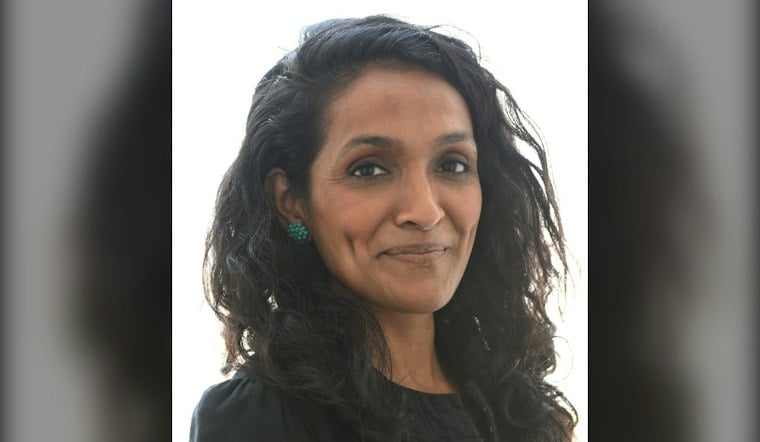
An AI-generated voice posing as Los Angeles mayoral candidate Nithya Raman has reportedly been fielding live phone calls from voters, telling them tent encampments are headed to their block. Raman's campaign says the voice is fake, the ads behind it are deceptive, and the group running them never disclosed who's footing the bill.
Raman's campaign team filed a complaint against Thrive LA with the Los Angeles City Ethics Commission, according to the Los Angeles Times. A separate complaint was also filed with the state's Fair Political Practices Commission, as reported by KTLA. Thrive LA, which has publicly endorsed incumbent Mayor Karen Bass, placed social media ads promoting an interactive AI phone line, per the Times' reporting.
The posters behind the campaign are styled as real estate advertisements for a fictitious “Nithya Raman Realty,” complete with an arrow labeling a designated “poop zone” and the tagline “Coming to a neighborhood near you!” One ad shows Raman holding a tent under the slogan “Keeping tents on our streets,” while video versions depict an RV driving around the city plastered with her image, according to the Times account. The posters include a phone number that connects to the AI system, and KTLA reports the specific line cited in the complaint is (818) 740-4592, billed as belonging to Raman.
What Callers Reportedly Hear
According to the Times, the AI-generated voice falsely identified as Raman's carries on a live conversation with callers and plays a message claiming tent communities would be brought to their block. The voice does not clarify that it isn't a real person unless a caller directly asks, the Times reports, at which point the bot identifies itself as a fictional AI. In recordings included in the complaint, the bot reportedly said the ad was paid for by Thrive LA, used AI, and was not coordinated with any city candidate or committee — but told callers it could not disclose who actually paid for the phone line.
Raman's campaign claims Thrive LA failed to report the AI phone system on required campaign spending forms and imitated her voice without disclosing who paid for the ads, the Times reports. The complaint argues that nondisclosure could lead voters to believe the AI voice really is Raman. KTLA additionally reports the campaign alleges the setup violates California Elections Code Section 20012, which restricts distributing maliciously fabricated candidate audio within 30 days of an election, and Government Code Section 84514, which requires committees to disclose AI-generated or substantially altered media in their ads.
Raman campaign spokesperson Liz Garcia did not mince words. “It's both sad and illegal for Karen Bass' conservative allies to be cloning Nithya's voice, manufacturing her words, and hiding who is paying for it,” Garcia said, per KTLA's report. Bass' campaign had not immediately responded to the allegations, KTLA reported, and the Los Angeles City Ethics Commission did not immediately respond to the Times' request for comment. The commission has said generally that, by law, it cannot confirm or deny the existence of any complaint or investigation, according to its own enforcement guidance.
Thrive LA Calls The Complaint Absurd
Thrive LA executive director Ana Teresa Dahan pushed back hard, calling the complaint false and absurd, the Times reports. Dahan said the group properly disclosed its advertising spending and maintained that the satirical ads are protected political speech that complies with campaign finance rules. She also criticized Raman's response to what she described as a parody phone number, pointing instead to Raman's record on homelessness, according to the Times. Thrive LA, which describes itself as a centrist political advocacy group backed by business and community leaders, says it plans to keep running the ads through Election Day.
This isn't the first friction between Thrive LA and Raman. The group drew backlash over anti-Raman ads during her 2024 reelection campaign for City Council, the Times notes. Under city rules, independent expenditure committees can raise unlimited donations but cannot coordinate with candidates, and any such committee's audio ads must identify themselves as political ads at the beginning or end.
Homelessness Remains The Race's Defining Issue
The dispute lands squarely in the middle of a mayoral race where homelessness has become the central issue, with the election scheduled for November 3. Bass made homelessness the central focus of her first term and launched Inside Safe to move people into hotels, motels and other interim housing. Los Angeles has spent more than $300 million on the program since it launched in December 2022, moving roughly 5,800 people into interim housing, according to the Times' earlier reporting. Bass has credited the program with a 17.5% reduction in street homelessness, though the same Times reporting found about 40% of those moved indoors — 2,300 of the 5,800 — had since returned to the street, with the average stay running 362 days despite a program goal of permanent housing within 90 days.
Unsheltered homelessness in Los Angeles decreased during Bass' first two years in office, but the latest homeless count showed the numbers growing again, the Times reports. LAHSA's 2026 Greater Los Angeles Homeless Count data page lists 2026 count data. Homelessness in Raman's own council district dropped 49% this year, and she has said she aims to deliver the same results citywide if elected mayor.
On the policy dividing line at the heart of Thrive LA's ads, Raman has voted against no-camping zones proposed by other councilmembers in their districts, arguing the restrictions simply move the problem from one neighborhood to another. But she has said she would not oppose no-camping zones if elected mayor, framing herself as committed to ending homelessness even as some small-business owners in her district say they've faced encampment and public-safety issues without support from her office, according to the Times.
A Fast-Growing National Pattern
The fight over Raman's cloned voice fits a broader surge in AI-generated political advertising. The Wesleyan Media Project identified at least 220 political ads produced or enhanced with artificial intelligence this cycle, costing just under $137 million, according to NBC News. Only 27% of those ads disclosed their AI use, the outlet reports, even as AI ad spending climbed to $20 million by May — up from less than $50,000 during the entire 2024 presidential election. Thirty-one states have enacted laws regulating AI and deepfakes in campaigns and elections, according to the National Conference of State Legislatures, though enforcement and disclosure standards vary widely.
This is also not the only ethics fight swirling around Raman's campaign this fall. Earlier this month, two influencers filed complaints accusing her campaign of paying for promotion without proper disclosure, with the Times reporting that Bass' campaign covered the influencers' legal costs and directed them to the Kaufman Legal Group. For violations on or after January 8, 2025, the Los Angeles Ethics Commission can impose a maximum monetary penalty of the greater of $15,000 per violation or three times the amount of money at issue, though no finding or enforcement action has been announced in either dispute.




