

























































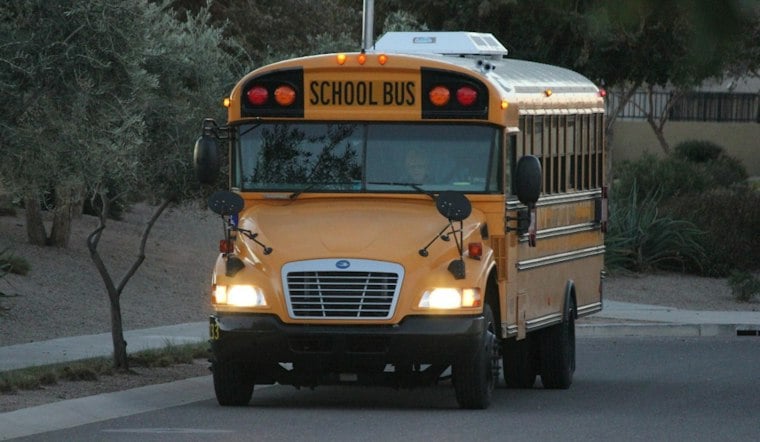
Arizona districts are absorbing higher transportation costs in different ways. Deer Valley Unified School District increased its current fiscal-year budget by roughly $500,000, just over 14%, largely because of surging diesel costs. Gilbert Public Schools is spending an extra $8,000 a week to keep its buses fueled. The fuel spike is adding pressure to districts already dealing with a yearslong shortage of qualified bus drivers.
Arizona diesel recently averaged $6.37 per gallon, up from $3.59 a year earlier, according to AAA figures cited by Axios. AAA tracking data separately showed the state price reached a record $6.445 per gallon in September. KJZZ reported that diesel rose 17 cents that week to $6.37 a gallon, according to its October 16 report. Deer Valley spokesperson Brittany Sutton said the district is closely monitoring fuel prices and staffing needs as it tries to absorb the cost increase.
Districts Scramble to Consolidate Routes
Cave Creek Unified School District has combined bus routes to manage costs. Fleet supervisor Ken Doss said the district reviewed how its buses were being deployed, according to Cronkite News reporting referenced in the Axios story. Route changes are one way districts are trying to limit transportation expenses rather than absorb all of the added costs.
A May survey of 188 school officials found that 40% had adjusted bus routes, 27% had enforced anti-idling rules to save fuel, 25% had cut routes outright, and 8% had gone as far as making students walk farther to reach their stops. Those numbers illustrate just how widespread the cost-cutting has become among transportation departments nationwide, not just in Arizona.
Earlier Responses Varied by District
Staffing shortages have also prompted route changes in earlier Arizona cases. In August 2024, Paradise Valley Unified had 52 drivers against a full staff of 110, leading to route consolidation, fewer stops and doubled driver schedules, Arizona’s Family reported.
Responses to fuel costs have differed, too. During a separate southern Arizona fuel-cost episode in March 2022, Marana Unified’s director of PR and community engagement said the district did not plan to cut transportation, citing the population and area it served, according to KOLD News 13.
Transportation Costs Add to District Pressure
Transportation costs add to the financial pressure on Arizona school districts. Higher diesel prices are another expense districts are managing.
That's a tough ask given the broader financial picture. An Arizona Auditor General report released in February found that statewide public school district spending climbed to $13.4 billion in fiscal year 2025, even as the share going to actual instruction slipped to 52.1% amid mounting non-operational overhead, per the Arizona Auditor General. Fuel costs are just one more line item competing with classroom spending for scarce dollars.
The Driver Shortage Makes Everything Harder
Layered on top of the fuel crunch is a persistent shortage of commercial driver's license holders willing to take school bus jobs. Peter Mannella, affiliated with the National Association for Pupil Transportation, said route changes made to cope with the squeeze ripple directly into families' lives — more parents end up driving kids to activities themselves, or districts move pickup points farther from students' homes. Nick Martini, a former school bus driver and now an executive at a Minneapolis-area school bus contractor, has noted that drivers must manage children and traffic while also meeting demanding training, licensing and safety requirements that not everyone wants to take on.
Arizona's licensing bar is especially high: bus drivers need a Class B Commercial Driver License with both Passenger and School Bus endorsements from the Arizona Department of Transportation, plus a physical clearance card and a School Bus Driver Certificate from the Arizona Department of Public Safety, according to the Arizona Administrative Code. Applicants also face background checks, fingerprinting, drug testing and mandated safety instruction. Meanwhile, districts are competing for CDL holders against delivery and logistics companies that often pay more — Bureau of Labor Statistics data from May 2025 put Arizona's median school bus driver wage at $43,620 annually, or $20.97 an hour, trailing the national median of $47,920.
The squeeze is sharpest in rural Arizona, where children may live miles from the nearest school and districts already struggle to match private-sector pay or find third-party operators willing to take on long routes. Arizona districts must manage daily routing networks across both suburban and rural regions.
Electric Buses Aren't a Quick Fix
Some of Arizona's transportation headaches predate the current fuel spike. Hoodline reported last year that Kyrene School District in Tempe changed bus transportation for middle-school athletic events amid a driver shortage, assigning remaining drivers to afternoon routes; athletic-event transportation was later available for the first semester. In May 2024, the EPA announced $8.345 million for Arizona districts under its Clean School Bus Program, but some federal electric-bus programs have since slowed or ended.
Even where funding exists, electrification isn't a simple swap. Elleka Yost, affiliated with the Association of School Business Officials International, has pointed to barriers including narrow or winding roads, small bridges, extreme temperatures and a lack of trained technicians able to service electric fleets. These barriers can make electrification challenging, even as districts face high diesel prices.
State leaders have taken notice of how broadly the fuel spike is straining public services. Governor Katie Hobbs issued executive orders in October directing state officials to temporarily suspend enforcement of rules barring agricultural haul trucks from using cheaper untaxed red dye diesel, an effort to help agricultural deliveries amid war-related market disruption and rising agricultural costs. Higher fuel costs and driver shortages together can mean missed breakfasts, late classes and fewer school activities for students across the state, a combination that district officials say they're trying to manage one route at a time.





