

























































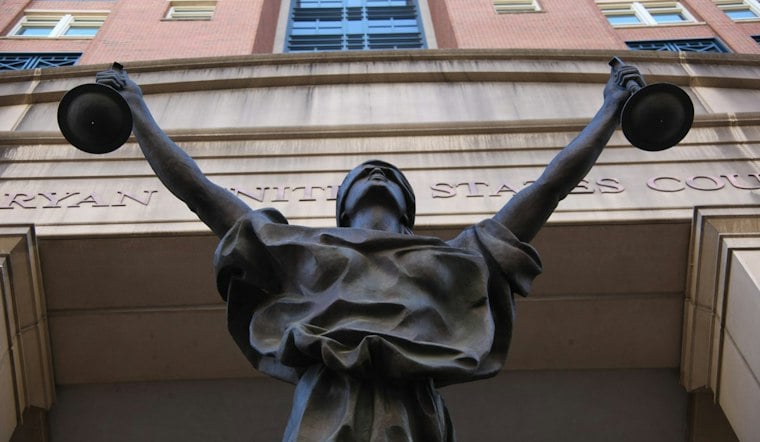
Arlington County has sued the Trump administration in federal court, seeking to block armed ICE and FBI agents from showing up at its polling places, early voting sites, and ballot drop boxes as Virginians head into the final stretch of the Nov. 3 midterm elections. The county argues the policies under challenge are illegal and could intimidate voters, with residents already voicing concern about encountering armed federal officers while trying to cast a ballot.
The county filed the lawsuit in the U.S. District Court for the Eastern District of Virginia's Alexandria Division, with Arlington's County Attorney's Office working alongside the national advocacy groups Democracy Forward and Public Rights Project, according to Democracy Forward. As first reported by WJLA, Arlington County Board Chair Matt de Ferranti said threatening to send armed agents to polling stations is unlawful and contravenes the bedrock values of free and fair elections Americans hold dear. The county is asking a federal judge to strike down the challenged policies and to block armed federal agents from operating at or near polling places, early voting sites, and ballot drop-off locations.
Naming the Officials Behind the Policy
The complaint names top federal officials as defendants, including Homeland Security Secretary Markwayne Mullin, Acting Attorney General Todd Blanche, and FBI Director Kash Patel, along with their respective agencies, as detailed by Patch. Federal officials have pushed back on the premise of the suit. Per WJLA, Tom Homan said in September there is no plan to sweep polling places looking for illegal aliens, while Mullin said ICE agents could appear at polling places only to respond to threats or serve warrants on people already being tracked. Federal officials have separately said there are no plans for widespread enforcement operations at polling places.
Arlington's complaint rests heavily on 18 U.S.C. § 592, a Civil War-era statute from 1865 that makes it a felony to order, bring, or keep armed troops or federal agents at a polling site, carrying a penalty of up to five years in prison and permanent disqualification from federal office, according to Democracy Docket. The outlet notes the statute carries only a narrow exception for repelling armed enemies of the United States. Virginia law adds another layer of protection: Code § 24.2-604 restricts firearms within 100 feet of a polling-place building. A separate order requires election guidance.
Why Patel's Senate Testimony Raised Alarms
Concerns about federal intent were fueled in part by testimony from Patel himself. During a Senate Judiciary Committee hearing in September, the FBI director refused to rule out sending FBI agents to polling sites on Election Day, telling senators, “I don't know that we can't legally do it,” when pressed on statutory restrictions, according to Civaro Pulse. Patel reportedly noted that FBI field offices would host election-crimes coordinators and analysts during the election.
Arlington's suit is not the first of its kind. In September, the NAACP and a coalition of civil-rights and labor organizations filed a separate federal lawsuit in Washington, D.C., alleging that federal poll monitoring policies violate Section 11(b) of the Voting Rights Act, which broadly prohibits voter intimidation, threats, and coercion, as reported by States Newsroom. States including California have also moved to shore up protections; Assembly Bill 2230, a proposal that cleared a committee and was headed to another, would create 100-foot buffer zones and bar election officials from authorizing federal immigration personnel at vote centers, as Hoodline previously reported on buffer zone legislation.
A Local Election Machine Bracing for Disruption
The lawsuit underscores that Arlington is not just a political actor in this fight — it is the local government directly responsible for running elections. The county operates 54 neighborhood polling precincts and has early-voting sites and ballot drop boxes. Arlington officials are preparing for the possibility of armed federal agents showing up at the polls even as early voting continues ahead of Nov. 3.
That anxiety is not confined to Arlington. A September survey reported by the Los Angeles Times found voters of color are about four times as likely as white voters to expect intimidation from ICE agents near polling places, with 49% of Black respondents and 45% of Hispanic respondents expecting intimidation, compared with 11% of white respondents, Hoodline previously reported on midterm trust levels. Overall, 37% of surveyed voters nationwide anticipated an ICE presence near voting locations.
Just days before Arlington filed suit, anonymous flyers bearing a DHS logo turned up on dozens of vehicles in neighboring Alexandria, warning about noncitizen voting — an incident local residents condemned as voter intimidation, as Hoodline previously reported. Federal officials confirmed DHS had no role in producing or placing those flyers. That episode, paired with Patel's testimony and the federal officials' own statements about limited enforcement authority, helps explain why Arlington officials view recent federal rhetoric as an active source of strain on an election system already managing 54 precincts, satellite voting sites, and drop boxes.
Arlington asked the court to block the policies before Election Day, according to Democracy Docket.





