

























































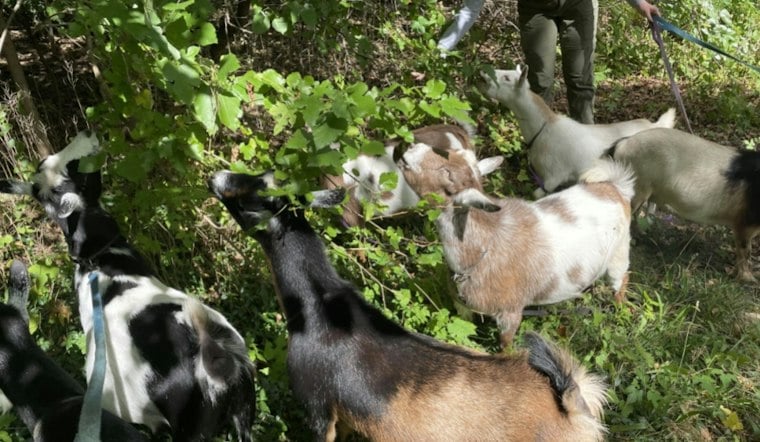
A rented herd of goats has been chewing through the tangled undergrowth at 21 Pond Lane, a half-acre, Select Board-owned lot near Spy Pond that town officials are eyeing for transformation into a native-plant park. The goats are the first visible step in a slow-moving effort to turn a long-neglected, overgrown parcel into something Arlington residents have been asked to imagine for themselves: a lush, walkable garden space just off the Minuteman Bikeway.
A Weedy Lot Gets a Temporary Four-Legged Crew
According to the Town of Arlington, the goats began grazing on the town-owned open space to clear invasive plants and prepare the site for a future project that would bring in native trees, shrubs and herbaceous plants. The property has long been considered for various uses but remains undeveloped, according to arlingtonma.gov, which describes the parcel as owned by the Arlington Select Board. As reported by YourArlington, the lot has been neglected for years under Select Board jurisdiction, is overgrown and infested with invasive plants, and is currently used by residents as a walking shortcut.
The goats grazing the property belong to Goodwin Hill Goat Farm in Lexington and are led by goatherder Halé Sofia Schatz, who has owned goats for 18 years, per the same account. The herd consists of Nigerian dwarfs, a breed about half the size of typical goats that can begin foraging at around five weeks old. Schatz transports roughly ten goats at a time in her Volvo wagon to grazing sites and moves her herd to a new area daily, since, as she put it, goats are nomadic foragers by nature — a trait the YourArlington report says makes them well suited to tackling a tangled lot like this one.
Why Goats, and What They Can (and Can’t) Fix
Schatz told YourArlington the goats wear bell collars so their handlers can keep track of them, and she emphasized that the animals are trained for activities that can be harmful to them or people. “That is not what goats do,” she said, pushing back on the idea that goats could be used for anything beyond browsing vegetation. She added that the work underway is only phase one and isn’t meant to clear the entire lot, and she noted that grazing small properties can carry risks, particularly when dogs are present — hunting animals, she said, can make the job dangerous for the goats, their handlers, and even leash-holding teenagers.
Longtime Arlington resident Ben Barkan, owner of HomeHarvest, approved using the goats as a temporary clearing solution, but he cautioned that the intervention is unlikely to permanently kill off many of the weeds, per the same YourArlington account. Barkan said the broader 21 Pond Lane project will require a substantial investment to remove invasive species and plant thousands of new ones. That caution lines up with what Mass Audubon has documented at its own goat-grazing sites: the base of cleared plants is often left in the ground and will likely regrow without manual removal or follow-up treatment, according to Mass Audubon.
From Feasibility Study to ‘Secret Garden’ Vision
The town hired Barkan in 2025 as a consultant to prepare a feasibility report on the site’s future, and Arlington set aside a $15,000 Community Preservation Act budget to assess the area, according to YourArlington. That funding matches what the Department of Planning and Community Development secured to review existing conditions and design a proposal for the site’s use, according to arlingtonma.gov. The proposal, brought forward by Barkan, envisions transforming the weedy parcel into what the Community Preservation Act Committee describes as a vibrant hub of activity and botanic garden park, with amenities similar to the Arlington Orchard, capitalizing on its proximity to the Minuteman Bikeway and Spy Pond Park.
Barkan spoke with residents about the lot’s future and said most welcomed the idea of gardens, flowers and earth-conscious beautification, according to YourArlington. Residents reportedly expressed interest in an ecologically beneficial oasis with a lush garden and walking path, while opposing concrete or other significant built elements, the outlet reports. Barkan has since prepared a 100-page report on the site, though Arlington has not guaranteed it will accept his suggested garden design — the town’s own materials establish only that funding was secured to study existing conditions and draft a proposal, not that any final design or construction plan has been approved.
The Connections Behind the Herd
The goats ended up at 21 Pond Lane partly through a personal connection: Laura Olivier connected Schatz with former town environmental planner David Morgan over the summer after the planner mentioned the idea of using goats, according to YourArlington. Olivier said she made the introduction once Morgan floated the possibility. Separately, the outlet notes that invasive species removed from sites like this one must be disposed of with particular labeling or eaten, rather than simply tossed in with regular yard waste.
How Other Massachusetts Towns Have Used Goats
Arlington’s approach echoes goat-grazing projects elsewhere in the region. Belmont’s Habitat Education Center has kept goats as permanent property stewards since 2010, when property manager Sandy Vorce first learned how goats and sheep could help manage invasive plants, according to Mass Audubon, which also notes that goats can clear an area in days or weeks depending on a parcel’s size and plant mix. In Stoneham, four goats spent a week near the Botume House Visitor Center in the Middlesex Fells working through Asian bittersweet, multiflora rose, buckthorn and porcelain-berry as part of a project run by Stoneham Volunteers with the Massachusetts Department of Conservation and Recreation, according to the Friends of the Middlesex Fells Reservation, which also frames goat grazing as an environmentally friendly alternative to herbicides or mechanical clearing.
Farther south, goats were brought to New Bedford’s Riverside Park, where native planting was also part of the project. Goat grazing can also avoid herbicides and emissions tied to power equipment. Boston took a similar tack when its Parks Department teamed up with the Southwest Boston Community Development Corporation and a Duxbury-based goat-grazing company to bring goats to the West Street Urban Wild in Hyde Park.
For now, the goats at 21 Pond Lane remain in what Schatz described as phase one of the clearing work, with no guarantee of what comes next. Whether Arlington ultimately adopts Barkan’s vision of a botanic-garden park, or some other use for the long-undeveloped lot, remains an open question the town has yet to answer.




