

























































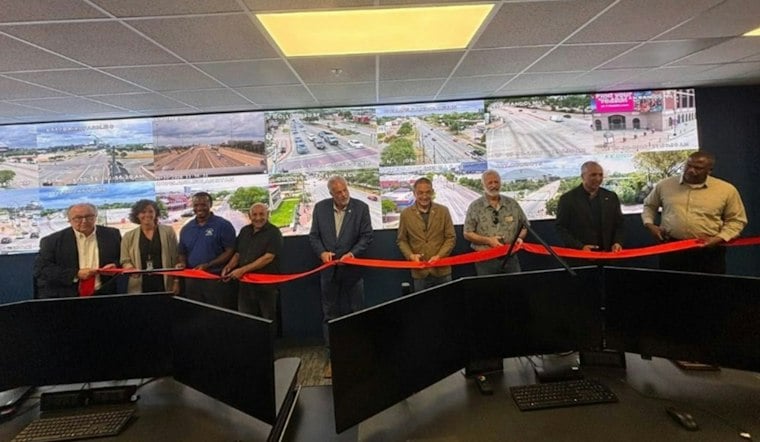
Arlington has opened a new Traffic Management Center inside the Municipal Office Tower downtown, retiring a cramped operation that had run the city's roadways for 20 years. The upgrade replaces that operation with a facility featuring 10 workstations, giving the city a central nerve point for watching nearly 200 cameras across its 380 signalized intersections.
The city held an official ribbon-cutting in late September, according to the City of Arlington. The old space had far less room to work with before the city moved operations into the tower. As Spectrum News reports, the new center now includes 10 workstations, more cameras, updated technology and LED screens, and Arlington officials say the city's setup now rivals the high-tech traffic centers in Houston, San Antonio and Austin.
From Five Seats to a Regional War Room
Arlington City Traffic Engineer Chris Funches told Spectrum News the new center gives the city a bigger technology foundation and lets staff respond to roadway incidents more proactively instead of simply reacting after the fact. That shift matters because the center can now pull in outside partners, with Arlington able to invite TxDOT, the regional Council of Governments, law enforcement and other agencies directly into the room when something goes wrong on the road network, per the same report.
Day to day, signal system engineer Manisha Shi and her colleagues keep an eye on the nearly 200 cameras feeding into the center, watching for congestion and crash activity across the grid. The station's report notes that engineers can adjust signal timing on the fly and get first responders to crash scenes faster when trouble pops up. Shi said her team specifically watches congestion build along Cooper Street and tweaks signal timing in response, the outlet reported.
Stadium Days Mean Longer Shifts
Traffic work ramps up sharply whenever AT&T Stadium or Globe Life Field hosts an event, and staff start covering those events four hours before kickoff and stay on for two to three hours afterward, according to the article. Shi said staff call the Arlington Police Department and field personnel directly to resolve problems as they crop up during games and concerts, per the same account.
The region had already concluded its nine 2026 FIFA World Cup matches, held June 14 through July 14, according to the North Central Texas Council of Governments. Regional planning from the North Central Texas Council of Governments shows Trinity Railway Express trains delivering passengers to CentrePort Station on major event days, where a fleet of 125 charter buses carried more than 40,000 fans between CentrePort Station and the Bus Hub.
Why Surface Streets Carry So Much Weight
That reliance on buses and trains dropping people onto surface streets is especially significant because Arlington is the largest city in the United States without a comprehensive public mass transit system, according to the Dallas Business Journal. The city also uses real-time signal timing and arterial monitoring to manage event traffic.
Beyond stadium days, Spectrum News described everyday problems such as train stops and intersections where a light never turns green. Funches said automated detection-failure alerts now tell staff when to check an intersection's sensors. Funches also described the center's signal-health feedback and automated detection-failure alerts.
AI Signals and Traffic Operations
The new center builds on technology Arlington has been layering in for years. The city began integrating NoTraffic, an AI-powered signal control platform, in 2023 at Cooper and Main Streets, later expanding it to 10 additional intersections south of I-20 along Matlock Road, according to WFAA. Arlington was also looking to expand the system to a little over 40 lights in the Entertainment District. At full capacity, the system can analyze traffic and adjust signals, including calculating green times, WFAA reported.
The Traffic Management Center monitors signal performance and congestion across the city's road network.





