

























































ARTICA marks its 25th year this weekend with a free festival on 2nd Street and Cedar in downtown St. Louis. The gathering, which began with a few hundred people in a riverside field, is expected to draw more than 2,000; the weekend ends with the burning of a towering wooden effigy along the Mississippi.
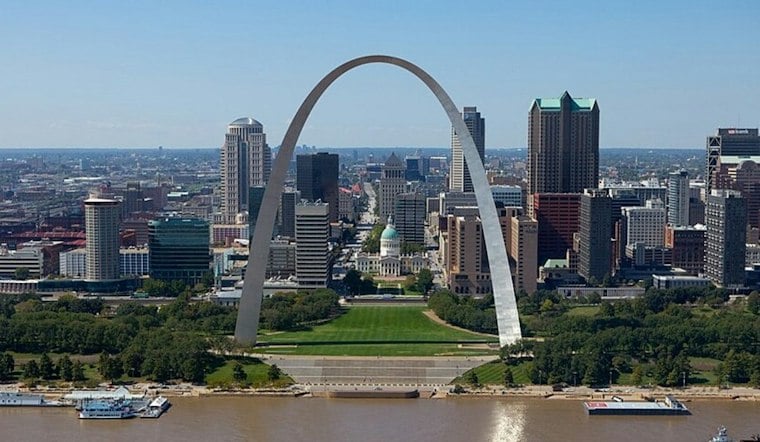
The 2026 festival’s theme is “Anomaly Test Pattern(s),” and it is taking place south of the Gateway Arch grounds, according to ARTICA. St. Louis Public Radio reports that organizers project more than 2,000 attendees this year, compared with about 1,200 a few years ago. The station also reports that artist applications have risen from roughly 45 to 50 to more than 200 for 2026.
ARTICA's rules have stayed consistent even as its footprint has grown: nothing is bought, nothing is sold, and nobody is allowed to simply stand around and watch. The festival is free to attend and nothing is bought or sold on site, according to ARTICA's own description of itself, which also states that every person who attends must interact in some way. That ethos of decommodification and forced participation, per the station's report, has drawn comparisons to Burning Man, the week-long gathering of more than 60,000 people that has taken place in Nevada's Black Rock Desert since 1990 — an event that can cost attendees upwards of $4,000, per the same account. The evidence does not establish any formal affiliation between the two events, but the philosophical overlap is real: the Burning Man Project itself defines commodification as reducing gifting, self-expression, art and people to commercial transactions, and says Burning Man Project considers participation essential to that community's culture.
From Field Experiments to an Anniversary Festival
ARTICA’s first edition, titled Exploring the Edge, took place in 2002, according to the organization. Executive director Nicolette Emanuelle, who moved to St. Louis in 2021, described the festival’s beginnings as artists making art from materials they found in a field, according to St. Louis Public Radio. ARTICA says it showcases the St. Louis region’s artistic contributions; it is a nonprofit governed by a board of directors, as the station reported in 2024.
The festival’s current location followed a forced move. ARTICA lost access to its former home at the historic Cotton Belt Freight Depot in 2024 after property owner SCF cited possible construction at the site, St. Louis Public Radio reported. Good Developments Group then made the current Chouteau’s Landing-area site available to the festival for free. The station also reported that a fire tore through an abandoned warehouse near the site in November 2025.
Growth, Grants and the Festival’s Boundaries
Regional Arts Commission of St. Louis and Missouri Arts Council grants are among ARTICA’s major funding sources, according to St. Louis Public Radio. The station reported that attendance grew from fewer than 500 in 2017 to 1,254 in 2023, when income reached $56,067, up from a previous high of $38,618 in 2022. This year’s projected crowd would be the festival’s largest, according to the station’s 2026 report.
What the Riverfront and Grant Figures Show
The festival’s location is part of a district still subject to long-term planning, not a completed redevelopment. Henning Larsen, the project’s architectural firm, describes Gateway South as an ongoing 50-acre masterplan that sets a framework for incremental development and proposes industrial, mixed-use, residential and cultural zones. Regional grant totals should not be read as ARTICA’s funding. St. Louis Public Radio reported that the Regional Arts Commission distributed $3.7 million in arts-related grants last year, an organization-wide figure that does not specify ARTICA’s award. The Missouri Arts Council says its awards cannot exceed 50% of total project expenses; that program-wide limit also does not establish the size of any ARTICA award.
The festival has also maintained its opposition to on-site commercial promotion as it has grown. Emanuelle rejected a proposed T-Mobile tent that would have distributed promotional swag, according to St. Louis Public Radio. The weekend’s effigy, which the station reports can stand 20 to 40 feet tall, will be burned with city approval and a fire department presence. The City of St. Louis describes its special-event fire-permit process as extensive and intended to protect participants and spectators.
Participation Is Part of the Program
St. Louis Public Radio reports that attendees expected this year include Margaret Wilson, 42, of Carondelet, and Calamity Svoboda, who has attended for eight years, as well as 13-year-olds Sophia Scuzzo of Affton and Alice Weinberg of Overland. ARTICA’s materials say every visitor is expected to interact, bringing professionals and nonprofessionals into the festival’s activities rather than leaving them only as spectators.
The station has also reported on the work behind the installations: the artist known as Auntie Matthew spent nearly 100 hours adding lights, scents and other sensory elements to decorative fixtures around the site. Kyle Kostecki, who performs as Poopyknife, is among the creative figures associated with the event. Musicians including Bob Grant, who plays with the Hogwarsh musical collective at ARTICA’s Turnage Stage, are scheduled to provide live music. The festival’s anniversary edition continues to rely on volunteer labor and donated land, alongside its expectation that visitors take part.





