

























































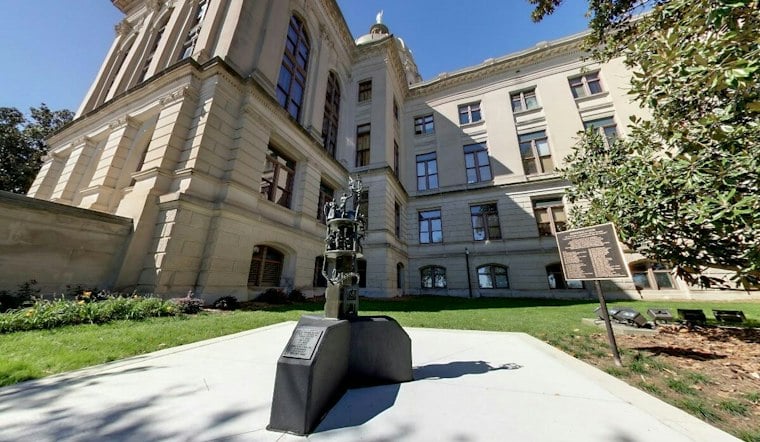
Demonstrators gathered outside the Georgia State Capitol in Atlanta on Sunday for a 24-hour hunger strike, standing in solidarity with immigrant detainees held at the Folkston ICE Processing Center in Charlton County who have been protesting conditions inside the facility. The Atlanta fast mirrored a much larger and longer-running demonstration unfolding roughly 300 miles away, where detainees have refused meals for nearly two weeks.
According to FOX 5 Atlanta, the Capitol demonstrators specifically organized their action to express solidarity with detainees inside Folkston, tying the statehouse protest directly to conditions at the rural detention complex. That internal strike began on October 6, after 45 men inside the facility signed an open letter detailing prolonged detentions without bond hearings, spoiled food, and substandard medical care, according to The Guardian.
A Sharp Dispute Over How Many Are Striking
The scale of the protest inside Folkston is itself a point of contention. ICE officials have acknowledged only 13 participants in the hunger strike, but attorneys with Asian Americans Advancing Justice-Atlanta estimate that between 370 and 500 detainees have taken part across multiple housing units, per The Current GA. The gap between those two figures underscores how difficult it has been for outside observers to verify what is actually happening behind the facility's walls.
Allegations of retaliation against strike organizers have also surfaced. Idris Makhmudov, a Russian asylum seeker who had been held at Folkston for 27 months without criminal charges and who helped organize the strike, was placed in solitary confinement before being deported to Russia on a commercial flight routed through Morocco this month, The Insider reported. His removal has become a flashpoint for advocates who argue it was designed to silence organizing inside the facility.
Advocacy Groups Demand Answers From ICE
On October 9, several advocacy groups sent a joint letter to ICE about alleged retaliation against hunger strikers.
The conditions detainees describe are not new allegations. A U.S. Department of Homeland Security Office of Inspector General report documented safety and health violations at Folkston, including unaddressed mold growth, insect infestations, spoiled food, and delayed specialty and mental healthcare, Georgia Public Broadcasting reported last year. Hoodline has previously covered a DeKalb father detained there whose family cited those same inspector general findings.
How Folkston Became the Nation's Largest ICE Facility
The scale of the unrest is tied to a massive expansion that transformed Folkston into the largest ICE detention facility in the country. Under a $47 million federal contract modification, private prison corporation GEO Group merged the Folkston ICE Processing Center with the neighboring D. Ray James facility, expanding total bed capacity from roughly 1,100 to nearly 3,000, The Current GA reported. That contract was temporarily delayed in June 2025 after being flagged for review under a federal policy requiring Department of Homeland Security contracts exceeding $20 million to be vetted by the Department of Government Efficiency, according to The Washington Post.
The expansion carried clear financial stakes for both GEO Group and Charlton County. GEO Group reported $254 million in profit in 2025 — a nearly 700% increase over 2024 — driven by $520 million in new or expanded federal contracts including its southeast Georgia operations, Hoodline reported in August.
State Law Fuels a Growing Detainee Population
The population swelling Folkston's cells traces back to state policy as much as federal contracting. Georgia House Bill 1105, enacted in 2024, requires local law-enforcement agencies and detention facilities to honor 48-hour ICE detainers and verify immigration status, according to Hoodline. Hoodline has reported that routine traffic stops can end in ICE transfers. Hoodline has separately reported on a Venezuelan soccer pro held at Folkston who missed his daughter's first birthday while detained there.
For now, the discrepancy between ICE's count of 13 strikers and advocates' estimate of up to 500 remains unresolved, as does the full scope of any retaliation against those who organized the protest. What is clear is that Sunday's fast outside the Capitol brought a facility most Georgians will never see much closer to the state's political center, even if only for 24 hours.





