

























































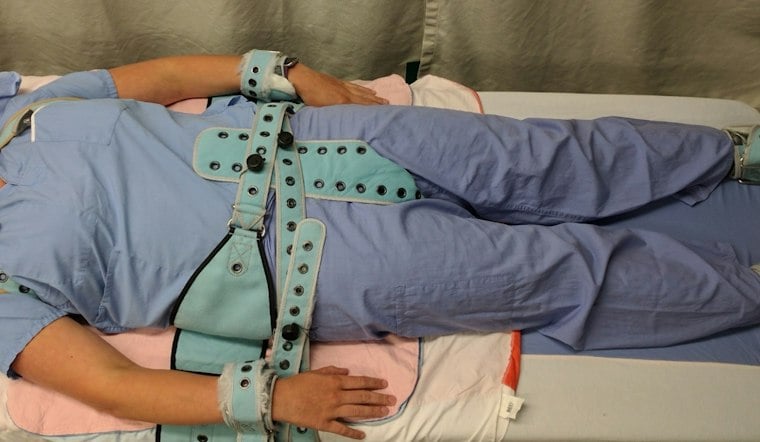
Patients being treated in custody at hospitals are routinely shackled to their beds by one limb, two limbs, three limbs, or all four — around the clock, according to healthcare providers who rallied in northeast Atlanta on Thursday afternoon demanding that hospitals change the practice. The providers say the restraints, combined with a lack of privacy during medical care, amount to mistreatment of people who are still entitled to basic standards of treatment while hospitalized.
The rally, organized by Atlanta-based healthcare providers, is tied to an open letter calling for an end to patient medical-privacy violations that has gathered more than 200 signatures from across 25 states, according to 95.5 WSB. The group behind the push is demanding that hospitals provide both better treatment and more privacy for patients who are in custody, the station reports.
Shackled Around the Clock, Advocates Say
Mark Spencer, executive director of Scoop, described the restraint practices as relentless. “This is just standard practice 24 hours a day,” Spencer said, according to the station's report. He pushed back on the justification some facilities offer for keeping officers stationed at a patient's door rather than inside the room, arguing it doesn't actually reduce the restraints patients endure — the patient is still shackled to their hospital bed regardless of where the officer stands.
Routine shackling is also flagged as a concerning practice in a report from Stop Criminalization of Our Patients, per the same WSB Radio account. The healthcare providers at Thursday's rally are specifically asking hospitals to improve the overall quality of care given to patients who are in custody, not just address the restraint question.
What National Medical Guidance Says
The concerns raised in Atlanta echo standards laid out by national medical bodies. The AMA Code of Medical Ethics states that individuals have a fundamental right to be free from unreasonable bodily restraint, and that except in emergencies, restraint should be ordered only by a physician — never used for punishment or staff convenience — with the least restrictive option applied and removed as soon as it's no longer needed.
The Joint Commission's updated requirements, effective at the start of 2025, say restraint or seclusion should be used only when less restrictive interventions won't work and there's an imminent risk of physical harm, according to The Joint Commission. Those requirements also call for continuous in-person observation by trained staff and a debriefing that addresses a patient's physical well-being, psychological comfort, and right to privacy.
A commentary in the AMA Journal of Ethics adds that incarcerated patients generally retain autonomy in health decision-making and privacy rights over their protected health information, and that physicians should request removal of handcuffs for clinical reasons and ask for private conversations with patients. The same commentary cites a survey finding that day-to-day care was more likely to deviate from the standard of care for incarcerated patients than for patients who were not incarcerated.
A Growing National Pattern
The Atlanta rally arrives amid a string of cases elsewhere drawing scrutiny to how custody and medical care intersect. In California, federal immigration agents surveilled a man named Bayron Rovidio Marin in his hospital bed for 37 days without charging him, and his attorneys said he was shackled to the bed for several days and that agents listened to every conversation he had with his doctors, according to the Los Angeles Times. A federal judge ultimately ordered officials to remove the guards and restraints, finding the government had failed to show Marin had violated any law or posed a flight risk.
In Western Australia, a 16-year-old Indigenous girl was shackled to a hospital bed after being taken into custody, with a family photo showing her ankles bound in chains and locked to the underside of the bed, The Guardian reported. The state's justice department said medical practitioners can request that restraints be modified or removed when clinically necessary — a policy that echoes a similar 2016 case in which a Noongar man was handcuffed and shackled to a hospital bed while comatose after collapsing during a court appearance.
Research on hospitalized patients in custody has also pointed to the scale of the issue nationally. Roughly 2.2 million people are incarcerated in the United States, and an aging prison population has driven up both the frequency and severity of off-site medical care needed, according to a study published on PubMed. Separate research published on PubMed found that while blanket restraint protocols are often framed as necessary for public safety, their indiscriminate use can cause physical and psychological harm and reinforce prejudice, urging hospitals and correctional officials toward individualized restraint plans instead.


