

























































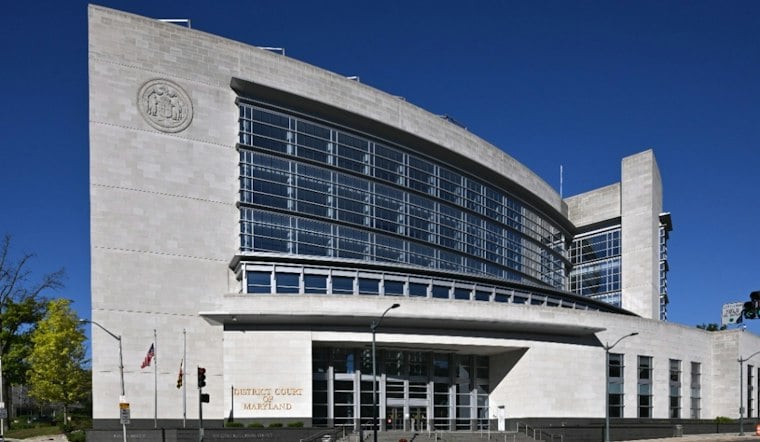
A 35-year-old Baltimore man has pleaded guilty to distributing cocaine in Baltimore while keeping loaded firearms at his residence. The trafficking organization transported cocaine from California to Maryland, while David Carroll handled local distribution. Carroll's guilty pleas cover both possession with intent to distribute controlled substances and possession of firearms in furtherance of a drug trafficking crime, and he now faces sentencing early next year.
The U.S. Attorney's Office of Maryland announced the pleas Friday, October 2, 2026, as reported by WBFF. Federal and local law enforcement began investigating the Baltimore-based drug trafficking organization in 2023, according to the outlet's reporting, uncovering a network that distributed cocaine and transported bulk quantities of the drug from California into Maryland, where it was stashed in various stash houses around the state.
Surveillance footage reportedly showed Carroll repeatedly visiting a Baltimore apartment used as a stash house. In October 2023, investigators watched him leave that apartment with suspected drugs concealed under his clothing, the station's report states. Around the same time, another member of the organization was seen leaving the apartment carrying a duffel bag containing 19 kilograms of cocaine, which officials said investigators seized.
Hand-to-Hand Deals and a Search Warrant
Authorities also observed Carroll conducting drug transactions directly at his Baltimore residence, per the same account. In January 2024, investigators witnessed him complete a hand-to-hand transaction with a customer, and surveillance in November 2023 and again in March 2024 captured suspected drugs being carried into his home.
That surveillance led to a search warrant executed at Carroll's residence in May 2024. Agents recovered three loaded firearms, 20 boxes of ammunition, more than 100 grams of fentanyl-pressed pills, and more than 300 grams of cocaine, the report notes.
Why the Firearm Charge Changes Everything
The firearm count carries weight beyond the drug charges themselves. Under federal statute 18 U.S.C. § 924(c), a conviction for possessing a firearm in furtherance of a drug trafficking crime carries a mandatory minimum of five years in prison that must be served consecutively to any sentence for the underlying drug offense, according to the U.S. Sentencing Commission. That means Carroll's firearm sentence cannot simply run alongside his drug sentence — it stacks on top of it.
Carroll faces a maximum of 20 years in federal prison for possession with intent to distribute controlled substances, and a minimum of five years up to life in prison for the firearms count, per WBFF's reporting. He is scheduled to be sentenced on January 26, 2027.
Part of a Broader Federal Push
The case was announced alongside regional leadership from the Drug Enforcement Administration, Homeland Security Investigations, IRS-Criminal Investigation, the Baltimore Police Department, the Baltimore County Police Department, and the Maryland Department of Public Safety and Correctional Services, according to the U.S. Department of Justice. The prosecution falls under the Homeland Security Task Force initiative established under Executive Order 14159, which directs federal, state, and local agencies to pool resources against transnational criminal organizations and multi-state narcotics rings, the department states.
U.S. Attorney Kelly O. Hayes, who leads the prosecution, was officially sworn in as United States Attorney for the District of Maryland in June 2025 after serving as interim U.S. Attorney and chief of the office's Southern Division since 2021, according to the Justice Department. Hayes has made interstate drug networks and violent crime central priorities for the district since taking the post.
Carroll's case follows a string of similar HSTF prosecutions in Maryland. In September 2026, federal judges sentenced 30-year-old Alcedo Hodge Jr. of Parkville to seven years in prison for distributing cocaine and possessing firearms after investigators intercepted a supply route between Virginia and Maryland, the Justice Department reported. That same month, 47-year-old Damon Toogood received 57 months in federal prison for fentanyl sales on a West Baltimore block, illustrating how the task force targets everything from street-level open-air markets to bulk interstate supply rings.
The partnership between federal and local prosecutors has deepened in recent years. In September 2025, the U.S. Attorney's Office for the District of Maryland and the Baltimore City State's Attorney's Office swore in Special Assistant United States Attorneys to jointly pursue cross-jurisdictional narcotics and illegal firearm offenses, according to the Office of the State's Attorney for Baltimore City. Cross-designating local prosecutors allows city cases to leverage federal mandatory minimum sentencing statutes that aren't available under state law alone.
A Recurring California-to-Maryland Pipeline
Carroll's case is not the only one tracing bulk narcotics back to the West Coast. In August 2026, federal prosecutors in Maryland unsealed a superseding indictment against three men charged in a cross-country trafficking ring that moved bulk methamphetamine and press pills from Stockton, California, to buyers in Maryland, according to the Justice Department — a case Hoodline covered in August. Federal task forces say they frequently trace bulk drugs seized in Maryland back to West Coast suppliers and transport hubs.
These enforcement actions are unfolding even as overdose deaths in Maryland have been falling. Provisional public health data shows fatal drug overdoses in Baltimore City dropped nearly 27 percent in 2025 to 568 deaths, down from 777 in 2024 and 1,043 in 2023, according to CBS News. Statewide, overdose fatalities fell 26 percent in 2025 to 1,315 deaths — a 10-year low — while fentanyl-involved deaths dropped 31 percent, according to the Office of Governor Wes Moore. State officials have cited public-health measures and community partnerships amid the decline.
Carroll's sentencing in January will mark the next step in a case that federal officials have framed as part of a sustained effort to dismantle cross-country drug pipelines feeding Baltimore's streets.



