

























































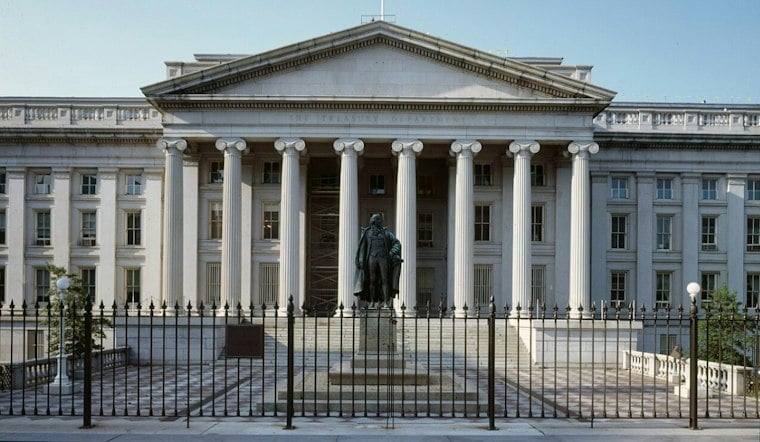
The U.S. Treasury Department slapped Bank of America with $1.2 billion in combined penalties Tuesday, accusing the nation's second-biggest bank of failing to catch more than $5 billion in suspicious transactions — many of them tied to Chinese money laundering networks and cartel-linked cash flowing across the southwest border.
The Office of the Comptroller of the Currency assessed a $750 million civil penalty against the bank, the largest in the regulator's 163-year history, and that amount was credited toward Treasury's overall $1.2 billion enforcement action, according to the U.S. Department of the Treasury. Federal regulators determined that more than 20% of the unflagged transfers were directly tied to national security priorities, including Chinese money laundering networks and southwest border illicit finance, according to the Financial Times.
As part of the settlement, Bank of America admitted to willful violations of the Bank Secrecy Act, formally acknowledging it failed to maintain an effective anti-money laundering program and failed to conduct required due diligence on correspondent accounts for foreign financial institutions, the industry outlet Banking Dive reported. U.S. law requires banks to perform heightened scrutiny on foreign correspondent banking relationships specifically to prevent cross-border laundering, a legal obligation spelled out under the Bank Secrecy Act and its implementing rules at 31 C.F.R. Chapter X, which require risk-based compliance programs and mandatory suspicious activity reporting to FinCEN.
Treasury Secretary Calls Out Failures
Treasury Secretary Scott Bessent framed the penalty as a warning shot to the entire banking industry, according to ABC24. Bessent said banks failing to meet anti-money laundering and sanctions obligations expose the U.S. financial system to significant illicit finance risks, and added that even the biggest financial institutions are not above the law.
The enforcement action wasn't limited to money laundering oversight. The Treasury's Office of Foreign Assets Control separately reached an $11.6 million settlement with Bank of America resolving apparent violations of federal sanctions programs targeting Iran, Russia, international narcotics trafficking, and global terrorism, per the same Treasury account. OFAC identified the sanctions-program violations as part of the broader review into the bank's compliance failures.
A Pattern Regulators Say Went Unaddressed
This wasn't the first warning Bank of America received. The bank had already been placed under a formal OCC cease-and-desist order in December 2024 requiring management to fix long-standing compliance flaws that executives had allegedly known about for years without correcting, the Treasury notes. Federal regulators found the bank's compliance staff lacked adequate skills and expertise even after that order was issued.
The timing stung for investors as well. The penalty landed on the eve of Bank of America's scheduled third-quarter earnings report, and the bank's shares dropped 1.8% in after-hours trading, the Financial Times reported.
How It Stacks Up Against Other Bank Penalties
At $1.2 billion, the fine is the third-largest in Treasury Department history, trailing only the record $3.4 billion FinCEN penalty levied against cryptocurrency exchange Binance Holdings in November 2023, according to Treasury records. It also arrives roughly two years after Canadian lender TD Bank agreed to pay $3.09 billion across multiple federal agencies — including a $1.3 billion FinCEN fine — in October 2024, a case that involved drug cartels allegedly bribing bank tellers and stands as the largest Bank Secrecy Act penalty ever assessed against a U.S. depository institution, per FinCEN records.
The Bank of America case reflects a broader federal push prioritizing illicit drug trade proceeds from Latin America and trade-based money laundering networks tied to East Asia, according to the Financial Times. Whether the case leads to further individual accountability or operational restrictions on the bank, similar to the growth cap federal regulators imposed on TD Bank after its settlement, remains to be seen.





