

























































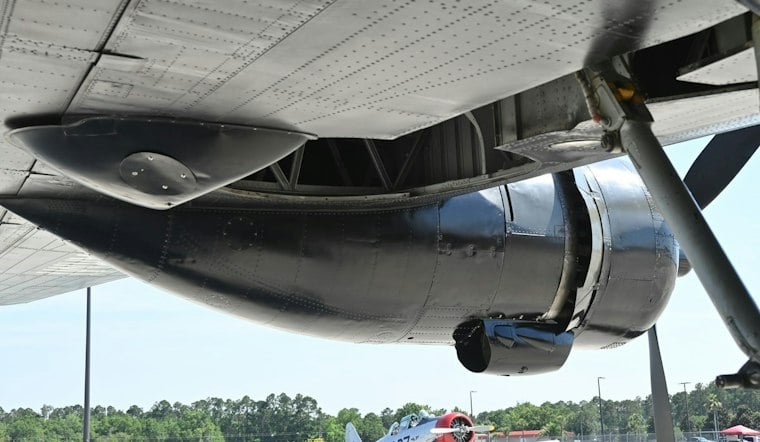
Eighty-two years after his B-24 bomber went down over the Adriatic coast of Italy, U.S. Army Air Forces Staff Sgt. Nick Gavalas finally came home. The Birmingham native, who was just 20 years old when he died in 1944, was laid to rest Friday after DNA testing confirmed his identity more than eight decades after he was considered missing in action.
Gavalas grew up in Birmingham, was active in his church, and graduated from Ramsay High School in 1940, according to WBRC 6 News. He went on to serve with the 718th Bombardment Squadron, 449th Bombardment Group, stationed in Italy during the war, as reported by DVIDS.
A Mission Over Udine That Never Came Home
On January 30, 1944, Gavalas was serving as an armorer-gunner aboard a B-24 Liberator bomber on a mission to Udine, Italy, DVIDS reports. The plane was shot down on the return flight and was last sighted near the town of Grado, on Italy's northern Adriatic coast, per the outlet's account. He was one of six men killed when the bomber was attacked over Italy, according to the WBRC report.
No remains recovered near Grado were ever associated with Gavalas, and he was declared non-recoverable in August 1949, DVIDS notes. The wreckage of the bomber was later discovered in a lagoon on an island, according to Gavalas's family, as relayed by the station's report.
DNA From His Mother Cracked the Case
The breakthrough came through a DNA sample furnished decades ago by Gavalas's mother. A laboratory in Nebraska used that sample to finally identify his remains, the same report states. The Defense POW/MIA Accounting Agency formally accounted for Gavalas on June 10, 2026, DVIDS reports, and his family received the call confirming his identity that same month.
“The littlest piece of DNA, they can almost figure it out,” Georgette Kennedy, Gavalas's niece, told WBRC, describing the leap in forensic capability that finally closed the case. Kennedy said her family kept Gavalas's memory alive for generations, never letting go of the hope that he would one day be found.
Planes Overhead as Family Says Goodbye
Family members gathered at the cemetery Friday to say goodbye, with planes flying overhead in Gavalas's honor during the service, per the same account. Kennedy's own mother, who had carried the family's memory of Gavalas for years, died eight years before Friday's ceremony and did not live to see her brother come home. Gavalas's nieces, who attended the burial, range in age from 57 to 92.
Sources differ on exactly where Gavalas was laid to rest Friday. WBRC reported the service took place at Alabama National Cemetery in Montevallo, while DVIDS reported his remains were scheduled for interment at Elmwood Cemetery in Birmingham. “We are just thrilled that he's home,” Kennedy said, according to the station's report.
Part of a Record Year for DNA Identifications
Gavalas's case lands amid a surge in identifications by the Defense POW/MIA Accounting Agency, which identified 231 service members in the fiscal year ending September 30, 2025, its highest total in recent years, according to Stars and Stripes. The agency credited new DNA techniques, maturing projects and increased prior-year funding for the record-breaking stretch, the outlet reports. A newer SNP-based DNA processing method has also expanded the agency's ability to match remains with living descendants, with 30 identifications in fiscal year 2025 made possible because the technique was available, per Stars and Stripes.
As of that reporting, 71,806 service members from World War II remained unaccounted for, and the agency conducted 104 recovery and investigative missions along with 30 disinterments over the prior year. Similar cases have surfaced elsewhere in recent months: the remains of Air Force Lt. Joseph Burke of Troy, who died at 20 as a prisoner aboard a Japanese ship attacked by U.S. forces, were identified through mitochondrial and Y-chromosome DNA analysis, according to WHEC. In Exeter, California, Sgt. Adolph P. Aguirre returned home after 83 years and was buried beside his parents in September, according to KMPH.
A Message to Other Families Still Waiting
Kennedy said she hopes Gavalas's story encourages other families still searching for answers to keep going. Families of the missing should not give up hope that their loved ones will eventually be brought home, she said. For the Gavalas family, the decades-long wait ended with a DNA match, a flyover, and a burial that finally let them say goodbye.


