

























































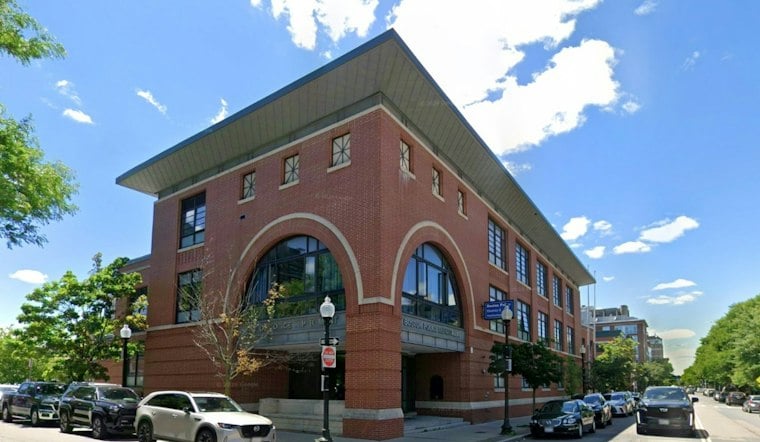
A Boston mother of two was taken into ICE custody outside a South End police station hours after she was arrested on a shoplifting allegation at a Target store, according to her family, who say agents showed no identification or warrant before putting her in handcuffs. Melanie Tinoco, 29, had been released on bail from the Boston Police Department's District D-4 station when immigration agents were waiting for her outside, her husband says.
Tinoco's husband, Martin Gurfinkiel, who works as an Uber driver, told CBS News he was picking up a delivery order at the Target when the incident began. He said the family was accused of not paying for items, but insists they never left the store and were simply walking to get a shopping cart. Boston police arrested Tinoco for shoplifting and took her to the station to be fingerprinted, and a Boston Police Department spokesperson confirmed she was arrested, booked and released on bail, per the same outlet's reporting.
Once released after several hours at the station, Tinoco walked out to find ICE agents waiting. The station's report says agents detained her without showing identification or a warrant and placed her in handcuffs and a vehicle. Tinoco's family told the outlet she does not have her medication with her and that agents injured her wrists during the arrest.
Fingerprints Flow to Federal Databases Automatically
Tinoco came to the United States from Ecuador and is the mother of two children, ages 7 and 11, one of whom lives with autism, according to the same account. She has a pending asylum application, valid work authorization and an immigration hearing scheduled for 2027. Attorney Jason Thomas, who represents Tinoco, said he was uncertain why ICE arrested her given her pending status.
The mechanism behind the station-door apprehension traces back to routine booking procedure. Fingerprints taken during a local arrest are automatically sent to an FBI database accessible to other federal law enforcement agencies including ICE, per the article. That automated pipeline, built on the federal Secure Communities program, cross-references booking biometrics against Department of Homeland Security immigration records the moment a local department fingerprints an arrestee, according to the Michigan Law Review — meaning federal agents can track someone's location at a police station without any direct communication from local officers.
Attorney Todd Pomerleau, who also represents Tinoco, said she was in a lawful immigration process that appeared to be ignored. Under federal regulations governing asylum seekers, applicants become eligible for an Employment Authorization Document 150 days after filing and are granted one after 180 days, according to USCIS, which corroborates the defense attorneys' statements that Tinoco held valid work authorization while her case was pending in immigration court.
Why Boston Police Released Her Rather Than Hold Her
Boston police did not hold Tinoco for ICE because they are not legally permitted to. In the 2017 case Lunn v. Commonwealth, the Massachusetts Supreme Judicial Court ruled that state and local officers lack statutory authority to arrest or hold individuals solely on federal civil ICE detainers once state custody grounds expire, according to the Harvard Law Review — the first such ruling by a state supreme court in the country.
Boston's own Trust Act, enacted in 2014 and revised in 2019, explicitly bars police from asking residents about immigration status, sharing release times with ICE, or holding people on civil detainers without a judicial criminal warrant, per Boston.gov. A Boston Police Department spokesperson said the department remains committed to the Trust Act, that immigration status is not a factor when working with victims, witnesses or suspects, and that community trust is critical to serving the city. Target referred CBS News to Boston police for comment, and ICE did not respond to the outlet's request for comment.
State's Emergency PROTECT Act Adds Another Layer
The Tinoco case lands just weeks after Massachusetts Governor Maura Healey signed Chapter 163 of the Acts of 2026, known as the PROTECT Act, an emergency law restricting state and local officers from using local resources for federal civil immigration enforcement and limiting status inquiries during investigations. The law took effect immediately upon Healey's signature on August 5, 2026, establishing strict rules on recording or sharing citizenship status, according to a Mass.gov advisory. The Boston City Council had already adopted a resolution in March 2026 supporting the measure, specifically citing concerns over federal immigration arrests near courthouses and public facilities.
Boston's sanctuary posture has also survived a direct federal legal challenge. A federal district court in May 2026 granted the city's motion to dismiss a Department of Justice lawsuit that had challenged the Trust Act, ruling that federal law cannot compel municipal resources to be used for federal civil immigration enforcement, according to the Public Rights Project. The DOJ had originally filed that suit in September 2025.
Tinoco is being held at an ICE facility in Burlington, and her lawyers have filed a federal court petition seeking her immediate release. Gurfinkiel is now caring for the couple's two children alone. Her detention also arrives against a backdrop of intensified federal enforcement statewide: ICE arrested 1,406 people across Massachusetts between September 4 and September 30, 2025, during a surge the agency called Operation Patriot 2.0, led by ICE Enforcement and Removal Operations Boston. Nationally, tracking data from Syracuse University's TRAC Immigration found that roughly 70.8% of people held in ICE detention as of April 2026 had no criminal convictions.



