

























































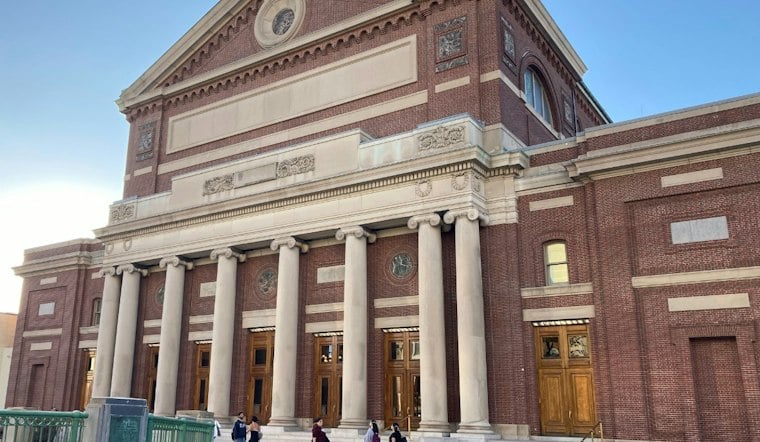
A piece of software is listening to the Boston Symphony Orchestra play this week, and talking back. “already and not yet,” a new commission from composer Tod Machover, is having its world premiere at Symphony Hall through Saturday, built around a live AI system that picks up individual musicians and orchestral sections through microphones, reshapes what it hears, and sends the result back into the room through speakers.
The piece premieres with the orchestra under conductor Kent Nagano, according to the Boston Symphony Orchestra, which notes the AI system is controlled live onstage by Manaswi Mishra, the MIT Media Lab PhD researcher who designed it. As The Boston Globe reports, Ana Schon, a graduate student also at the Media Lab, mixes the sound live in the hall while the AI reacts to the orchestra musicians’ improvisations in real time. Because the system responds to whatever the players actually do onstage, it produces different music every time it performs, per the Globe’s account.
Musicians across the orchestra were asked to listen to one another and improvise in several ways as part of the piece, the Globe reports, and Machover has said the AI will produce variations on incoming sound and connect different parts of it rather than simply layering in pre-recorded material. He described one specific effect to the paper: the system is programmed to expand the brass sound and send it around the hall.
Three Movements, One Argument About Democracy
The work is structured in three movements — “Smash Up,” “Wake Up,” and “Stand Up” — that correspond to different stages of democracy, according to MIT News. Per the Globe, Machover has said the piece was inspired by the nation’s current political crisis and reflects both his view of the present situation and a possible future for democracy. He has also said, per the Globe, that he is not trying to demonstrate that human musicians can be replaced by machines.
That framing matters because Machover has spent decades building a different kind of relationship between performers and machines. Machover’s career includes several operas, and he has explored machine learning and artificial intelligence for decades. His earlier hyperinstruments, which respond to performers, have been used by Yo-Yo Ma and Joshua Bell. “already and not yet” belongs to that hyperinstrument lineage rather than to autonomous AI agents or generative song-generating tools.
A Composer Wary of the Tools He’s Building With
Machover has been pointed about what he dislikes elsewhere in AI music. The Waltham Times quotes him criticizing “the two things that people are mostly doing with AI in music, which I think are terrible” — systems trained on large databases to mimic existing work closely enough to be sold, and text-prompt tools that generate finished songs from a verbal description. The Globe reports Machover has said current AI can imitate existing works closely enough for similar music to be sold, and that text-prompted tools risk dulling creativity. His own aim, per the Globe, is music intended to challenge listeners and help them discover things.
The irony, as the Globe tells it, is that Machover keeps AI largely out of his own daily life. He reportedly uses almost no AI tools personally, does not use chatbots, and manages his calendar manually, telling the paper he prefers not to automate most tasks because every detail matters to him. His mother taught piano and encouraged creativity.
A Preview Session With the Orchestra
Before opening night, Machover, Mishra, and Schon demonstrated the AI system at Symphony Hall, according to the Globe, and Boston Symphony Orchestra musicians played with it during that session. The Globe describes the musicians as open and inquisitive about the technology. Composer George Lewis is set to moderate a conversation with Machover before Saturday’s performance, per the Globe. Lewis has argued, as reported by the Globe, that AI discourse tends to focus more on technological power than on exploring humanity.
Part of a Bigger Week at Symphony Hall
The premiere anchors a broader slate of programming the orchestra is calling “Technology and Our Humanity,” running October 22 through 25, which the MIT Media Lab says will bring the lab’s researchers to Symphony Hall alongside the performances. The series explores the relationship between music, technology, and humanity, with Machover’s AI system collaborating with musicians.
Earlier this month, AI models developed by a KAIST-led research team performed improvised jazz alongside human musicians at South Korea’s Jarasum Jazz Festival, with 12 human artists collaborating with the AI across 26 pieces in 12 performances, as reported by The Korea Times. That system analyzed the flow of human performances in real time, allowing it to generate improvised accompaniment or, in some cases, take over a performance outright.



