

























































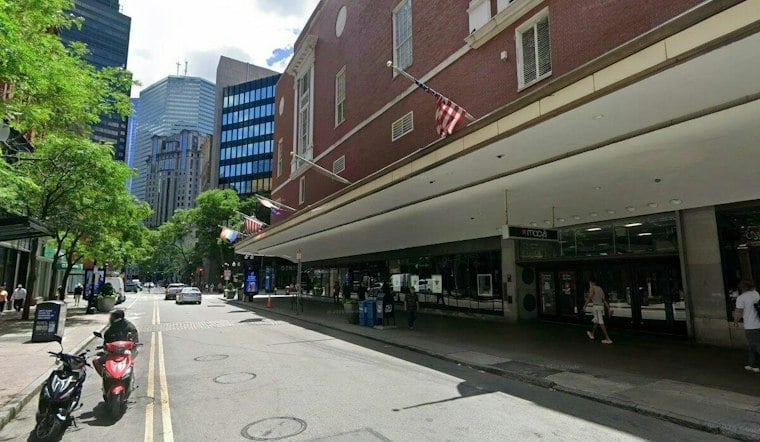
Boston City Councilor Miniard Culpepper wants to ban new data centers across the entire city, citing fears over energy and water consumption from the power-hungry facilities. There is just one problem: city officials say they have only confirmed the existence of a single data center within Boston's limits, even though dozens are believed to be scattered throughout the city.
Culpepper filed a hearing order in September calling for a citywide ban that would define data centers and designate them a prohibited use across every zoning district in Boston, according to MassLive. The proposal specifically targets facilities used for artificial intelligence, cryptocurrency mining, and cloud computing, according to The Daily Free Press, which reported that Culpepper cited Boston's density and scarce land and power infrastructure as reasons to act before major projects emerge. A hearing on his proposal is scheduled for 2 p.m. Monday at Boston City Hall.
Culpepper said he only recently learned about the Markley Group data center operating above the Macy's department store in Downtown Crossing, and that his office has confirmed just one data center in the entire city. “The reality is, we don't even know what their role is, other than they're storing data,” he said, per the same report.
A 920,000-Square-Foot Giant Hiding in Plain Sight
That one confirmed facility is no small operation. The Markley Group's 1 Summer Street building spans 920,000 square feet, was originally built in 1949 and retrofitted in 1998, and serves as New England's largest multi-tenant telecommunications building, housing more than 90 network carriers, according to Dgtl Infra. Markley describes it as New England's largest and most comprehensive carrier hotel, and it sits at a key transit and fiber-optic intersection directly above the retail floors of Macy's.
Yet that single known site is almost certainly not the whole picture. A MassLive analysis found at least 14 qualifying data centers of 10,000 square feet or larger in 2025 BERDO reports submitted to the city, seven of which are freestanding facilities owned by Verizon, including one at 451 D St. and another at 426 Belgrade Ave. in West Roxbury. Verizon did not respond to multiple requests for comment on those facilities, the outlet reported.
Boston currently has no dedicated permit specific to data centers, instead relying on reporting required under the city's Building Emissions Reduction and Disclosure Ordinance, known as BERDO 2.0. That ordinance requires commercial and non-residential buildings of 20,000 square feet or larger to report annual energy and water usage by May 15 each year and to begin meeting mandatory emissions intensity limits, with a goal of net-zero emissions citywide by 2050, according to CodeGreen. Large buildings covered by BERDO account for over 40% of Boston's greenhouse gas emissions.
Why Nobody Has a Master List
Part of the problem is definitional. Data centers lack a single consistent definition, and websites that try to map them nationally are often outdated, inaccurate, or full of duplicate listings, per the MassLive report. The EPA's Energy Star program defines a data center as a facility designed and equipped for high-density computing used for data storage and processing, typically requiring dedicated power supply and cooling systems, but that definition excludes less sophisticated setups like server closets and training rooms — a distinction that matters as Boston tries to decide what, exactly, it would be banning.
Deepjyoti Deka, a researcher at the MIT Energy Initiative and program manager for its data center power forum, said Greater Boston likely has no hyperscale data centers — the massive campuses that can span millions of square feet and draw more than 100 megawatts — but does have smaller facilities. Markley's capacity tops out around 30 megawatts, placing it in the colocation category rather than hyperscale territory, while edge data centers typically draw less than 10 megawatts and colocation facilities can reach up to 100 megawatts. Deka also noted that most computer-based information and services people rely on daily are housed in data centers of some kind.
Even the state cannot produce a master list. The Massachusetts Executive Office of Energy and Environmental Affairs has said it does not have a list of existing data centers anywhere in the state, according to the MassLive report — a gap that complicates enforcement at exactly the moment both state and city officials are trying to regulate the industry.
Cambridge Hit the Same Wall First
Boston is not the first city in the region to run into this problem. The Cambridge City Council unanimously asked the city manager in March to investigate regulating data center development, but a city spokesperson said Cambridge is aware of only two freestanding data centers — a Verizon facility at 89 Fulkerson St. and another at 300 Bent St. — with other smaller installations supporting laboratory and research operations around the city. The spokesperson added that no significant building built principally for data storage and processing had gone up in Cambridge in more than 20 years, though the city did build a data center inside its fire department headquarters to support 911 and emergency response operations.
Cambridge Vice Mayor Burhan Azeem said data centers are, at their core, simply rooms full of computers used for many purposes well beyond training AI models. The proposal would protect smaller server rooms and computing infrastructure used by institutions.
Boston's Move Fits a Statewide Pattern
Culpepper's push lands amid a wave of municipal action across Massachusetts. Holyoke became the first city in the state to ban future data center construction, and moratoriums or power caps have since followed in Lowell, Westfield, Shutesbury, Wilmington, and Mansfield, according to NEPM. Hoodline has covered Wilmington's own draft bylaw, which would cap smaller facilities at 2 megawatts while banning larger ones outright, and Mansfield's Town Meeting passed a similar measure in May.
Lowell's moratorium followed community pushback over the Markley Group's roughly 352,000-square-foot facility and a dispute over four proposed additional generators, per The Cool Down. That local friction, rather than a rush of new hyperscale proposals, helps explain why so many Massachusetts communities are acting preemptively.
At the state level, Governor Maura Healey signed Executive Order No. 658 in September, requiring data center developers to secure local host community approval and community benefit agreements before state permits are issued, while shielding utility ratepayers from infrastructure costs, according to Pierce Atwood. The order also requires developers to disclose facility location, size, physical footprint, expected energy demand, water consumption, and other characteristics before permits are granted, with regular reporting afterward. It followed Healey's decision in June to halt state tax incentives for data centers while directing agencies to build regulatory guardrails for public health and ratepayers, according to Mass.gov.
Despite the alarm, regional grid data suggests New England has so far avoided the explosive hyperscale boom seen elsewhere in the country. ISO New England's May CELT Report found only two proposed large-load projects, totaling up to 285 megawatts, in formal study across the entire six-state region. Still, public sentiment runs strongly against local development: a national UMass Amherst poll conducted in August found that 65% of Americans oppose AI data center construction in their own communities, with only 11% in support and nearly half expressing strong opposition.
Whether Boston can translate that sentiment into an enforceable ban remains an open question, given that the city still lacks a centralized registry or dedicated permitting classification for data infrastructure. For now, the hearing Monday at City Hall will test whether councilors can write a rule for an industry they admit they cannot fully see.




