

























































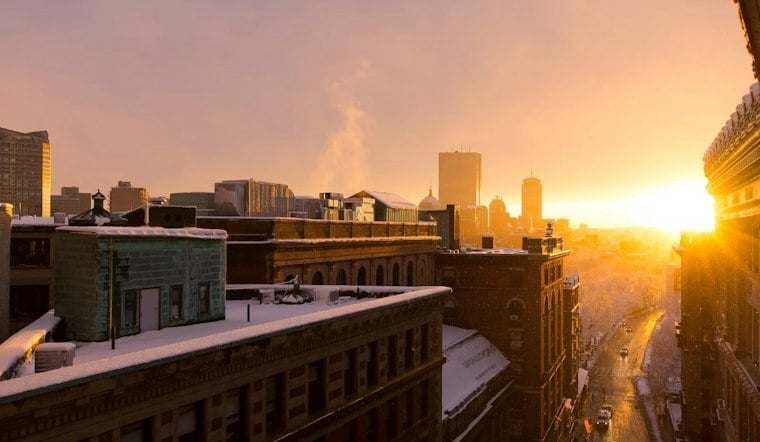
The sun is about to put on one of Boston's favorite free shows again. Starting in late October, the setting sun will align with the city's street grid in Back Bay and beyond, a biannual spectacle known as Bostonhenge that draws hundreds of onlookers to sidewalks and crosswalks for a fleeting photo opportunity.
The phenomenon happens when the sun sets at just the right angle to slip between buildings lining Boston's wide thoroughfares, creating a glowing corridor effect for about 15 minutes. During the alignment window, the sun sets at roughly 250 degrees on the compass — short of due west's 270 degrees — and visibility depends on the weather.
Prime viewing spots include the intersection of Arlington, Columbus, and Stuart streets at Statler Park, as well as Boylston Street and the stretch of East 1st through East 8th streets in South Boston, including East Broadway, the Globe reports. CBS News Boston lists Stuart and Boylston streets among Back Bay viewing areas and identifies Statler Park as a safe, off-street spot to watch.
Why Boston's Grid Makes This Possible
The reason this works at all traces back to the 1850s, when architect Arthur Gilman designed Back Bay's street grid, modeling wide boulevards like Commonwealth Avenue on the grand avenues of Paris, according to the Friends of the Public Garden. Bostonhenge falls in late October and mid-February rather than on the equinoxes, per Black Owned Boston.
That piecemeal layout is actually typical of Boston as a whole. Cartographer Andy Woodruff mapped out the city's theoretical sunrise and sunset street alignments back in January 2013 on the Bostonography blog, finding that Boston's fragmented, non-uniform grid produces multiple separate henge moments in different neighborhoods throughout the year, rather than a single citywide event. Meteorologist Dave Epstein, per the Globe, explains the mechanics simply: the sun moves closer to due west each day and passes between buildings as it sets, before eventually moving too far from the alignment and disappearing behind them instead.
From Quiet Photo Hobby to Social Media Spectacle
The phenomenon of calculating these urban solar alignments in Boston actually goes back decades in academic circles — MIT's own version, MITHenge, was noticed and publicized by architecture research affiliate Thomas K. Norton in the 1970s; students put up posters advertising a sunset celebration, according to MIT News. In the mid-1990s, physics doctoral student Ken Olum found an old poster and recalculated the MITHenge schedule; the earlier calculations had rounded the sun's azimuth angle to the nearest degree. Olum earned his Ph.D. in 1997, and his information is the basis for MIT's current MITHenge webpage.
Bostonhenge itself stayed a niche photography pursuit until February 2023, when local photographer Jack Daryl posted crowd photos and video from Stuart Street on social media, inspiring scores of other photographers and onlookers to start showing up, per CBS News Boston.
A Nationwide Trend, Boston-Sized
Boston's version is often described as a smaller cousin of New York's Manhattanhenge, where the sun aligns with the city's east-west street grid. Astrophysicist Neil deGrasse Tyson claims to have coined the term Manhattanhenge and described the alignment in a 1997 Natural History magazine piece, according to Wikipedia. Tyson, who directs the Hayden Planetarium at the American Museum of Natural History, has called it a unique phenomenon in the world, if not the universe, per the Globe, and has noted that tall buildings lining the streets create a vertical channel that frames the setting sun for a striking photo.
Similar henge moments are now celebrated in cities including San Francisco, Chicago, Baltimore, Philadelphia, Raleigh, and Toronto, the Globe reports. Chicago's version works a bit differently than Boston's or Manhattan's: because Chicago's grid follows true cardinal directions, Chicagohenge aligns directly on the spring and autumn equinoxes, while Boston's and Manhattan's rotated grids push their alignments to specific calendar windows instead.
Safety First on Rush-Hour Streets
Viewers should avoid looking directly at the sun, and Statler Park offers an off-road viewing option, according to the same CBS News Boston report.
If clouds roll in and block this month's window, there's no need to panic. Those who miss the fall alignment will get another shot in early February, per the Globe, when the sun makes its return pass through Boston's street canyons on its way back toward spring.





