

























































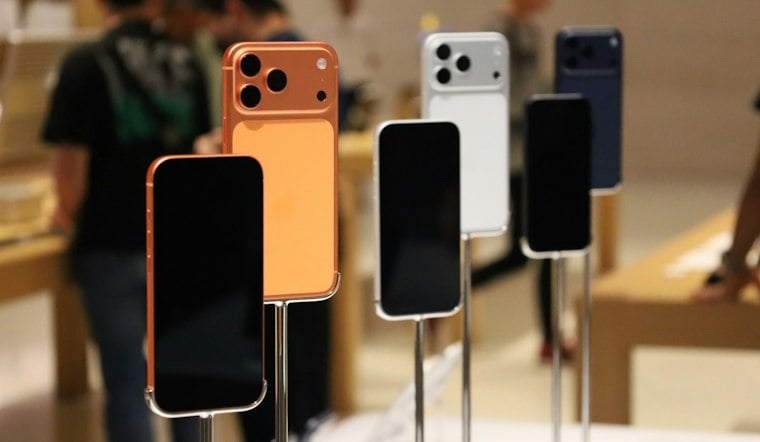
A California iPhone owner has taken Apple to court over claims the company oversold what its newest phones can actually do on Wi-Fi 7 networks. Terald Smith filed a proposed class action against Apple Inc. on October 16 in the Superior Court of California for Santa Clara County, alleging the iPhone 17 and iPhone 18 lineups are marketed as Wi-Fi 7 devices despite lacking the hardware capabilities to fully support the standard.
The case, filed by the firm Diemer & Wei, LLP and docketed as case number 26CV506247, zeroes in on the wireless chip inside the phones. According to a summary of the complaint published by Claim Depot, the chip is limited to a 160 MHz channel width and 1024-QAM, while true Wi-Fi 7 performance calls for 320 MHz channels and 4096-QAM. The complaint alleges that gap means the phones take in data from a Wi-Fi 7 router at less than half the speed the router is capable of sending it.
Apple's Marketing Versus the Fine Print
Apple has touted the new wireless silicon as a selling point. In its own announcement, the company said the iPhone 17 lineup introduces N1, a new Apple-designed wireless networking chip that enables Wi-Fi 7, according to Apple. Apple's own support documentation adds that the listed models support Wi-Fi 7 across the 2.4 GHz, 5 GHz and 6 GHz bands along with Multi-Link Operation, per guidance published on support.apple.com.
The lawsuit, however, claims that framing glosses over real limits. It alleges Apple's marketing includes a footnote stating Wi-Fi 7 is available in supported countries and regions, but that the footnote does not warn buyers about the channel-width and QAM restrictions. The complaint further claims Apple flagged only one of those limitations, and only on a technical page aimed at corporate IT teams rather than everyday shoppers.
One Buyer's Side-by-Side Speed Test
Smith says he bought his iPhone 17 Pro Max based on its Wi-Fi 7 marketing, and claims he either would not have purchased the phone or would have paid less had the alleged limitations been disclosed upfront. To test the claims, the complaint describes Smith comparing his new phone's internet speeds against an older iPhone 15 running on the earlier Wi-Fi 6 standard. The older phone delivered roughly the same speeds and was sometimes faster, the complaint states.
That anecdotal result tracks with independent testing. Reporting from Cult of Mac found the iPhone 17 Pro Max was no faster than phones running on Wi-Fi 6 or Wi-Fi 6E, even though Apple's chip may still offer benefits like improved reliability and reduced battery impact despite the speed ceiling. MacRumors has separately reported that FCC documents show the N1 chip in all iPhone 17 models supports up to 160 MHz of channel bandwidth, well short of the 320 MHz maximum the Wi-Fi 7 standard allows, and that the same 160 MHz ceiling already applied to iPhone 16 models.
What the Wi-Fi 7 Standard Promises
The Wi-Fi Alliance introduced Wi-Fi CERTIFIED 7 in January 2024, touting advanced features including 320 MHz channels and 4K QAM, which the organization says delivers transmission rates roughly 20% higher than 1024-QAM. The group projected more than 233 million Wi-Fi 7 devices would reach the market in 2024 alone, growing to 2.1 billion by 2028. Against that backdrop, Smith's lawsuit alleges buyers had no way to work around the shortfall, arguing no setting or accessory can make the iPhone 17 or 18 models fully Wi-Fi 7 compatible.
What the Lawsuit Is Asking For
The suit asserts a claim under California's Unfair Competition Law, which bars unlawful, unfair or fraudulent business practices along with deceptive or misleading advertising. The proposed class would cover California residents who bought a new iPhone 17, 17 Pro, 17 Pro Max, 18 Pro or 18 Pro Max in the state for personal use and still lived there when Smith filed suit.
Smith is seeking repayment of part of what class members paid, along with a court order barring Apple from advertising the phones as Wi-Fi 7 devices without disclosing the alleged limitations. The requested relief also includes corrections to Apple's sales materials and online support page, notification to class members, and attorneys' fees. As of the most recent update to the case summary, there is no settlement, no claims process and no money available to consumers at this time.





