

























































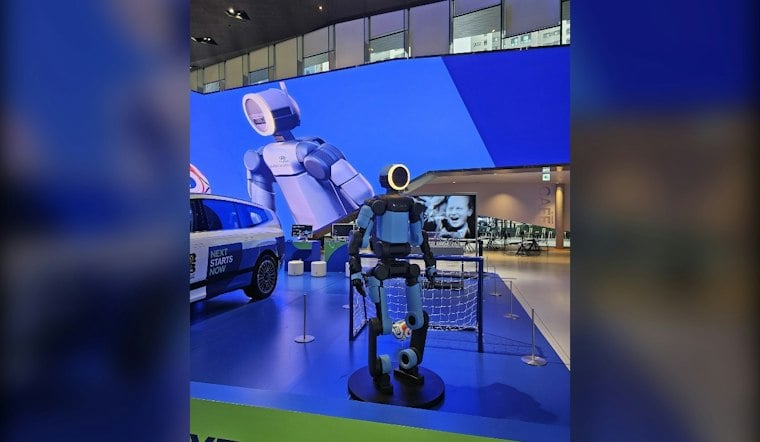
A prototype named Hugo, described as a mountain troll, is being developed by Cambridge startup Dynamic Creatures. The company wants Hugo to eventually appear in hotels and amusement parks.
Dynamic Creatures is a Cambridge startup partnered with Boston Dynamics and built largely on its technology, according to The Boston Globe. It's headed by Marc Theermann, a veteran of Boston Dynamics who previously served as the company's chief strategy officer. Theermann has cited incoming requests for entertainment appearances as evidence of commercial interest in the market, in an interview with the Association for Advancing Automation.
Theermann has identified safety around children as a design concern. Dynamic Creatures is developing SnowJay, a platform for interactive robots.
The Case for Guest-Facing Robots
In the Association for Advancing Automation interview, Theermann described the company’s aim of making robots approachable through character designs such as Hugo. He sees that as a way to familiarize people with humanoid machines before they encounter more utilitarian versions in factories or warehouses.
That strategy of lowering the emotional barrier to robots runs alongside a parallel push to lower the financial one. Dynamic Creatures has introduced a commercial leasing model for theme park and hospitality operators, letting venues deploy platform-based interactive characters in a matter of months without a large upfront capital investment, according to FinSMEs. The company emerged from stealth in September as Boston Dynamics' official entertainment and hospitality partner, backed by seed funding from Eniac Ventures, Kindred Ventures, Heliad, Sunshine Lake, and BlueGrass Ventures, along with angel investment from Boston Dynamics founder Marc Raibert.
Beyond Hugo: A Lavender Poodle and a Proprietary Brain
Dynamic Creatures has also developed Danielle, a pink poodle. The company describes its SnowJay AI platform as combining reinforcement learning control, real-time computer vision, and behavioral programming so robots can respond contextually to guests rather than repeat fixed animatronic routines, according to AI Insider.
Disney has separately described its BDX droids as guest-facing characters, a distinct project from Dynamic Creatures’ Hugo, according to The Walt Disney Company.
Public Context for Guest-Facing Robots
Disney Parks Blog said BDX droids Red, Oskar and Grek were set to return to Star Wars: Galaxy’s Edge at Disneyland beginning May 22, appearing at Black Spire Station in a new way. These Disney characters are a separate guest-facing robotics example, not Dynamic Creatures’ Hugo prototype, according to Disney Parks Blog.
For local business context, a City of Cambridge startup resource guide says the city’s Community Development Department offers programs, resources and services to Cambridge businesses. The guide does not establish that the city provides specific support to Dynamic Creatures, according to the City of Cambridge.
Boston Dynamics Leans Industrial as Spinout Chases Hospitality
Boston Dynamics has offices in Waltham and makes the Atlas humanoid robot and Spot quadruped, according to the Globe. Hyundai announced in August that it plans to scale U.S. manufacturing capacity for the electric Atlas humanoid to 30,000 units annually by 2028, with 25,000 units already reserved for industrial assembly tasks at Hyundai and Kia facilities, per Humanoids Daily.
Boston Dynamics also opened a dedicated Robotics Metaplant Application Center in Georgia this year at Hyundai Motor Group Metaplant America, where it tests and trains humanoid robots on real-world automotive component sequencing and assembly, according to the Association for Advancing Automation. Robert Playter served as Boston Dynamics' chief executive during the period Theermann worked there, before the company tapped Rohit Prasad, a former Amazon senior vice president who led Alexa AI development, as its new CEO this month to lead the commercial deployment of its physical AI systems.
Regulators Watching as Robots Enter Public Spaces
The push to put semi-autonomous machines in close contact with the public is already drawing scrutiny from local governments. In August, the San Mateo County Board of Supervisors in California voted unanimously to draft what would be the nation's first local commercial humanoid robot permitting ordinance, proposing mandates for emergency kill switches, on-site human supervision, and lithium-ion battery fire safety standards, according to Tech Times. Hoodline previously reported on that county's early robot rules push, which cited fire and job-displacement concerns.
The project remains a prototype, with hotels and amusement parks as the company’s stated target market.





