

























































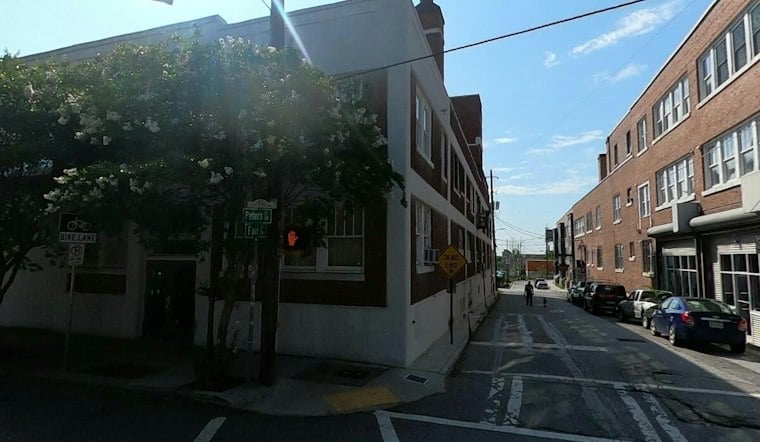
Georgia’s Department of Transportation plans to move two pedestrian signals away from the Swift & Co. Lofts in Castleberry Hill after residents and preservationists objected to equipment installed just inches from the historic brick facade. The planned changes also include black signal mast arms and granite curbing at two neighborhood intersections, with work expected to be completed by the end of 2026.
The signals were installed on Peters Street as part of broader area improvements, according to Axios. One faces Peters Street; the other faces the Peters Street and Fair Street intersection, where it sits perpendicular to a ground-floor residential window. Residents raised concerns that the signal could shine directly into the living space, and the installation drew objections from residents and historic preservation advocates.
A Historic Facade and Preservation Review
The brick building dates to the late 1800s, according to WSB-TV. Preservation advocates said placing the equipment so close to its exterior altered the building’s historic character. WSB-TV also reported broader complaints that pedestrian signals and other street improvements were affecting the character of the community, including concerns raised about earlier projects.
Castleberry Hill has been listed on the National Register of Historic Places since 1985, and the Swift & Co. Lofts are within a preservation easement intended to prevent changes to the facade. WSB-TV reported that GDOT said it had complied with Section 106 while also evaluating whether some signal equipment could be relocated outside those requirements.
What Preservation Review Can—and Cannot—Tell Us
As general context, the Advisory Council on Historic Preservation says Section 106 requires federal agencies to consider effects on historic properties for projects they carry out or that receive federal financial assistance, permits or approvals, and to give the council an opportunity to comment before a final decision. That general rule does not establish what caused GDOT’s decision in Castleberry Hill. A separate Savannah preservation review illustrates a different issue: in 2013, Historic District Board of Review staff recommended relocating a projecting business sign at 125 Martin Luther King Jr. Boulevard to provide 10 feet of sidewalk clearance—not reviewing pedestrian signals or the Castleberry Hill project, according to the Chatham County-Savannah Metropolitan Planning Commission.
Separately, Atlanta’s Moving Atlanta Forward campaign planned street and sidewalk improvements in 50 corridors as part of a $200 million investment funded by voter-approved T-SPLOST measures in 2016 and 2022, according to 11Alive, citing the Atlanta Department of Transportation. That citywide program provides broader background on planned street and sidewalk work, not evidence of a pattern of preservation disputes.
Community Response
Rebecca Bily, chair of the Castleberry Hill Neighborhood Association’s transportation and code enforcement committee, called the relocation decision “a big win for us.” “We’re very happy,” Bily said, adding that GDOT had taken the community’s concerns into consideration.
David Mitchell, executive director of the Atlanta Preservation Center, called the decision “an affirmation that what we do is important.” GDOT began reviewing potential changes to address community concerns in August. The current plans include black mast arms, which Axios reported would align with standards and regulations for the National Register of Historic Places, as well as granite curbing at two Castleberry Hill intersections.
Work Scheduled Through 2026
Natalie Dale told Axios the work is expected to be completed by the end of 2026. The preservation easement protecting the Swift & Co. building’s facade remained a central point in residents’ objections. Separately, a September traffic-safety package reported by The Urbanist addressed changes affecting historic areas; that report concerns a different package and does not establish a connection to the Castleberry Hill project.





