

























































For seven years, Joe MacLaughlin kept his right hand tucked in his pocket at the CBS News New York studios, hiding a tremor he wasn't ready to explain to colleagues. The veteran sports producer, who spent more than two decades at the broadcast station, was diagnosed with early-onset Parkinson's disease in his 40s, and he spent years quietly struggling with tasks as basic as buttoning a shirt or pulling a credit card from his wallet before he decided to share his story publicly this month.
MacLaughlin's account, detailed by CBS News New York, describes a slow unraveling that many young-onset patients know well. He withdrew from friends and colleagues as his symptoms worsened, and at one point he could no longer manage a knife and fork together while eating. According to the outlet, more than 1 million people in the United States are living with Parkinson's disease, a number that frames MacLaughlin's experience as part of a far larger population quietly managing the same disease.
Dr. Susan Bressman, head of neurology at Mount Sinai and the physician MacLaughlin first saw in 2019, has warned that the isolation so many patients retreat into carries its own cost. She said social withdrawal is emotionally, cognitively and physically unhealthy, a dynamic MacLaughlin lived out as his tremor and other symptoms grew more intrusive over time, per the station's report.
A Young-Onset Diagnosis and a Marriage Built Around It
MacLaughlin's diagnosis falls into a category clinicians call young-onset Parkinson's, which affects people diagnosed before age 50 and makes up roughly 5% to 10% of all Parkinson's cases nationally, according to the Parkinson's Foundation. Patients diagnosed at that age often spend years trying to manage progressive symptoms while still working through the peak of their careers, a tension that shaped MacLaughlin's own decision to keep his condition hidden at the office for so long.
Through it all, his wife Tracy stayed by his side. The two have been married for about six years, and the station's report notes she never considered walking away from the relationship as his symptoms progressed. MacLaughlin tried a long list of medications, trials and treatments, at one point taking 22 pills a day just to manage his symptoms.
Three Surgeries, One Fighting Chance
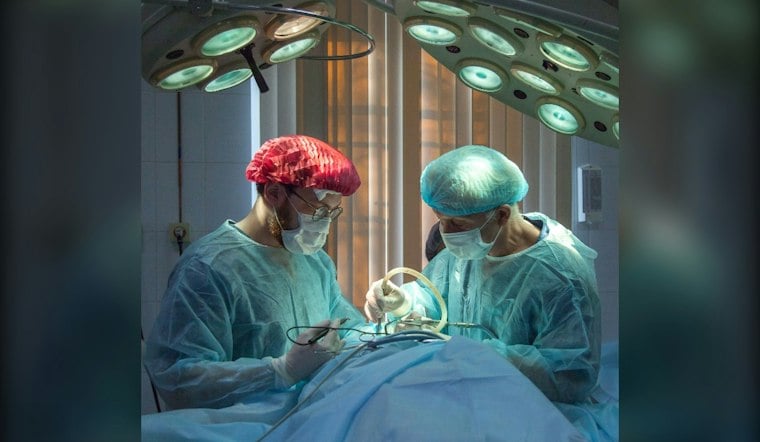
When medication alone stopped being enough, MacLaughlin turned to deep brain stimulation, a surgical treatment that the Food and Drug Administration first cleared for Parkinsonian tremor nearly 30 years ago, in 1997, before the agency expanded approval for advanced motor symptoms in 2002 and for earlier-stage disease in 2016, according to the Parkinson's Foundation's account of the therapy's regulatory history. The treatment works by delivering targeted electrical pulses to brain structures such as the subthalamic nucleus or globus pallidus internus, disrupting the abnormal signaling caused by dopamine cell loss, per the National Institute of Neurological Disorders and Stroke.
MacLaughlin called the surgery his fighting chance. The procedure required three separate operations: electrodes were placed in the left side of his brain first, then in the right side four weeks later, followed a week after that by implantation of a chest controller that functions much like a cardiac pacemaker. His neurosurgeon, Dr. Brian Kopell of Mount Sinai, has performed more than 1,000 deep brain stimulation procedures over his career, according to Neurovations Education.
Kopell also co-leads Mount Sinai's Living Brain Project, which analyzes brain tissue gathered during elective deep brain stimulation surgeries like MacLaughlin's to study living human neurobiology, drawing on data from more than 600 enrolled patients, according to Mount Sinai Health System. The research initiative is designed to gather real-time neurochemical data during the operations without adding procedural risk for patients.
Shaking Stopped Within Minutes
MacLaughlin's surgery lasted about three hours, and the effects showed up almost immediately. He began noticing a difference roughly 45 minutes after waking from the procedure, and he has reported that his shaking stopped once the device was activated. He has since returned to traveling and going out to dinner, activities that had grown difficult during the worst of his symptoms.
Tracy said she felt relieved once the surgery was behind them. MacLaughlin has said he now feels mentally, emotionally and energetically like he is in his 30s again, and he has urged that deep brain stimulation could change many more lives if more patients knew it was an option.
A Disease With a Growing National Price Tag
MacLaughlin's story lands amid mounting evidence of how costly Parkinson's has become nationally. A March 2026 report from The Michael J. Fox Foundation for Parkinson's Research found that Parkinson's disease and atypical parkinsonisms cost the U.S. economy $82.2 billion in 2024, with indirect costs such as lost wages and unpaid caregiving making up $58.4 billion of that total. An estimated 1.1 million Americans currently live with the disease, a figure the Parkinson's Foundation projects will climb to 1.2 million by 2030 as the population ages, making it the second most common neurodegenerative disorder in the country after Alzheimer's disease.
Men are diagnosed with Parkinson's at roughly 1.5 times the rate of women, a gap researchers attribute to potential protective effects of estrogen along with differing environmental exposures, according to the Parkinson's Foundation's epidemiological data. In April 2026, Congress enacted legislation establishing the National Parkinson's Project, creating an advisory council under the Department of Health and Human Services to coordinate a whole-of-government strategy against the disease, as reported by Brands Review Magazine. MacLaughlin's decision to speak publicly follows a similar path taken by Dead Kennedys guitarist East Bay Ray, who disclosed his own Parkinson's diagnosis while vowing to keep working.



