

























































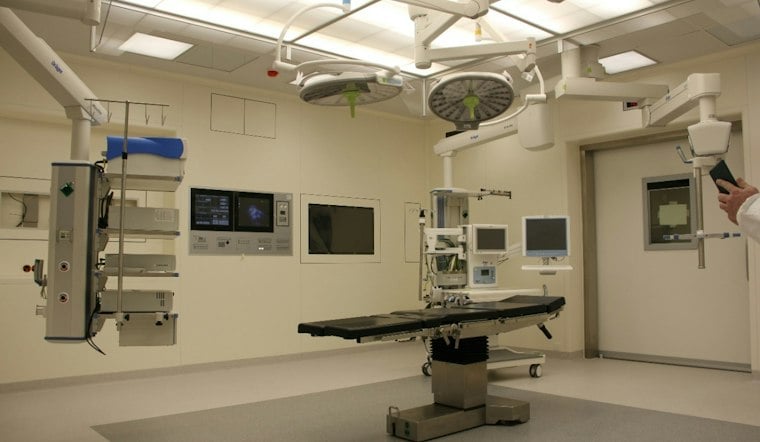
A 66-year-old man with prostate cancer had his tumor removed without the surgeon ever stepping into his operating room. Dr. Vipul Patel controlled the robotic instruments from AdventHealth Celebration while his patient lay on the table at AdventHealth Minneola, 35 miles away, and the procedure successfully removed the man's prostate.
A qualified surgeon was also present in the room with the patient throughout the operation, according to AdventHealth, as reported by ABC13. The hospital told ABC News that the patient continues to do well post-surgery. Patel is the founder and medical director of the Global Robotics Institute at AdventHealth Celebration, located in Celebration, Florida, near Orlando.
The case is being described as the first robotic telesurgery performed between two hospitals in the United States, according to ABC News. It was carried out as part of a Food and Drug Administration-authorized clinical research study examining whether robotic surgery like this could eventually be implemented more broadly. The outlet notes that important questions about the study's safety, effectiveness and technical performance remain under investigation.
Why Distance Matters in Specialized Care
In a statement shared by AdventHealth, Patel said access to highly specialized care has often depended on where a patient happens to live. He added that telesurgery may help reduce those geographic barriers to specialized treatment, a point AdventHealth has echoed in describing the Minneola-to-Celebration case as an investigational robotic prostatectomy marking a milestone in surgical research.
That framing fits into a broader shift researchers have tracked recently: 2025 brought enough technological advancement to make telesurgery increasingly available, with potential to expand access to care for remote and rural populations, according to the American College of Surgeons. A federal study listing on ClinicalTrials.gov describes telesurgery more broadly as a highly trained surgeon performing a procedure through a secure internet connection while the patient is located elsewhere entirely.
A Much Longer Distance, Tested First
Patel's team didn't start with 35 miles. Nearly a dozen telesurgery procedures were previously performed between hospitals in Orlando and Luanda, Angola, separated by more than 7,000 miles, per ABC News's reporting. One of those cases, detailed by AdventHealth, involved Patel performing a robotic prostatectomy on a patient in Angola while operating from the Nicholson Center in Celebration, Florida, a procedure the hospital called the longest-distance telesurgery ever completed.
The American College of Surgeons noted that the Angola case marked the first U.S.-based transcontinental telesurgery since surgeon Jacques Marescaux performed a robotic cholecystectomy in 2001. That earlier procedure relied on roughly 10,000 miles of direct fiber-optic cable linking Orlando, Miami, Brazil and Angola to transmit data fast enough for real-time control, according to the same report.
Research into the broader safety and feasibility of robotic telesurgery in urological procedures has looked at measures including procedural success, complication rates and round-trip latency — the lag between a surgeon's hand movement and the robot's response — though that body of work is described in limited detail in available findings. For now, AdventHealth and Patel's team are continuing to gather data on the Minneola case as part of the ongoing FDA-authorized study into whether this kind of remote operation can move beyond a research setting.



