

























































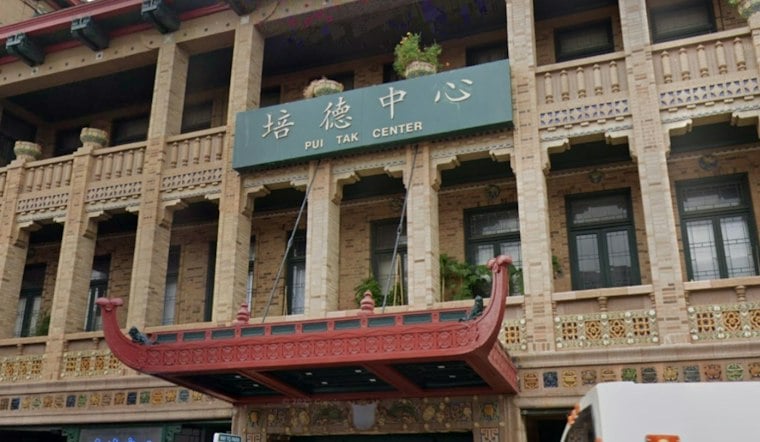
The Pui Tak Center, the ornate brick landmark that once served as Chinatown's unofficial “city hall,” has landed a $750,000 restoration grant to patch its deteriorating roof and repair its ornate iron and leaded-glass windows. The 98-year-old building at 2216 S. Wentworth Avenue is the only Illinois project funded this year under the federal Save America's Treasures initiative, which awarded grants to 24 sites nationwide.
A Matching Grant With Strings Attached
As reported by the Chicago Sun-Times, the award requires matching funds, and Pui Tak Center executive director David Wu said the center will raise that match from foundations and individuals. Illinois has already set aside a $200,000 capital grant for the building in fiscal year 2027, and the Sun-Times reports the 36,000-square-foot structure is Chinatown's only Chicago Landmark building, with three stories of patterned brickwork and prominent pagoda-shaped towers.
The building was designed by Christian Michaelsen and Sigurd Rognstad, two Norwegian architects who, per the same report, had never been to China when they drew the plans. Anita Luk, former director of the Chinese American Museum of Chicago, said the facade includes patterns representing longevity, butterflies, phoenixes, lotuses and plum blossoms, and the structure also includes sculptures resembling dolphins. The Sun-Times notes that the Chinese Exclusion Act limited the number of Chinese architects practicing in the United States at the time, which helps explain why the building's Chinese-inspired design came from Scandinavian hands.
From Merchants Hall to Church-Run Community Center
Built in 1928 as the On Leong Merchants Association headquarters, according to the station's report, the building earned its “city hall” nickname because it hosted association business, a Chinese-language school and community celebrations, and functioned informally as a neighborhood court, according to the Pui Tak Center. The Pui Tak Center's own history page dates construction to 1926-1928, while Chicago YIMBY has cited 1928 and the engineering firm Wiss, Janney, Elstner Associates has put the start of construction in 1926 — accounts that diverge on the exact timeline.
The building's history took a darker turn in 1988, when the FBI and Chicago Police Department raided the property and seized gambling equipment and $350,000 after on Leong businessmen were found to be operating an illegal casino there, per the same account. The Chinese Christian Union Church bought the building in 1993 and renamed it the Pui Tak Center, according to Landmarks Illinois, and it has remained Chinatown's only protected city landmark ever since. The church still owns the building today, and the two organizations are working together to raise rehabilitation and restoration funds.
Years of Piecemeal Repairs Add Up
This is far from the building's first restoration push. Landmarks Illinois notes a $500,000 project in 2008 and 2009 restored the building's terra cotta, and a separate $500,000 project in 2019 installed new HVAC systems and a flat roof. A more recent preservation project spanning 2022 to 2024 cost $950,000 and covered masonry repairs, terra-cotta restoration and canopy work, backed in part by a $250,000 Chicago Adopt-a-Landmark grant and a $250,000 capital grant from the Illinois Department of Commerce and Economic Opportunity.
The Pui Tak Center also spent around $500,000 on terra cotta work separately and restored its front canopy in 2022 at a cost of $900,000, the Sun-Times reports. The center was listed on the National Register of Historic Places in September 2025, and the building will be featured at Open House Chicago on October 17.
Looking Toward the Building's 100th Birthday
Landmarks Illinois reports the center aims to raise additional funds to restore the building's storefront and roof and complete other necessary repairs as it approaches the structure's 2028 centennial, with the current restoration effort planned for completion by that milestone anniversary. The building today houses social services and, per Pui Tak Center's own figures, serves about 3,500 people annually through its adult education, youth and community programs.
Save America's Treasures was founded in 1998 and is funded by revenue from federal oil and gas leases, according to the Sun-Times. The National Park Service has reported awarding $24.4 million in the latest grant round, though National Park Service materials elsewhere have cited figures of $24.25 million and $25.2 million for related announcements — a discrepancy the agency's own postings do not resolve. Over more than two decades, the National Park Service says the program has awarded more than 1,300 grants totaling over $300 million to historic sites nationwide.





