

























































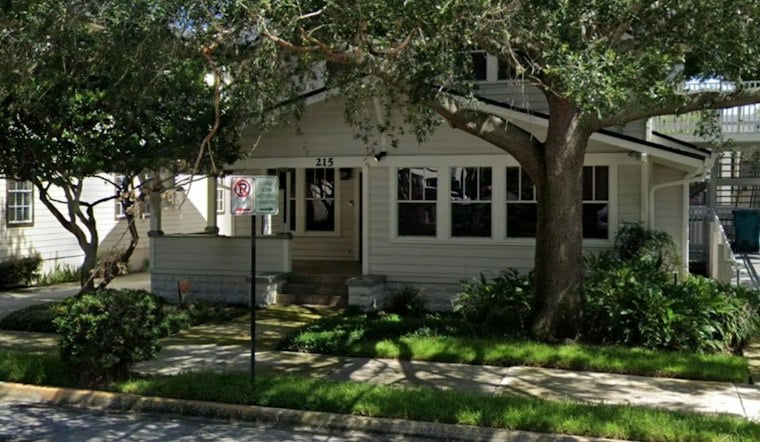
Climate First Bank has opened a new branch in a converted 1920s home near downtown Orlando, and it's already planning its next Central Florida project: a roughly $4 million branch along U.S. Highway 441 in Mount Dora that's expected to open in 2027. The moves mark a steady expansion for the sustainability-focused lender, which is headquartered in St. Petersburg and already operates branches in Winter Park and Mount Dora.
The new downtown Orlando location sits at 215 E. Livingston Street, inside the Lake Eola Historic District, according to GrowthSpotter. The building itself has a backstory: it's a single-family home dating to the 1920s that was rebuilt in 2001, and the branch now occupies roughly 2,500 square feet of that structure. KMF Architects oversaw the building's design for its new life as a bank branch, per the same report.
That reuse-and-retrofit approach lines up with how the building was handled during construction. According to Interstruct, which completed the build-out, the project covered 2,553 square feet as a second-generation commercial space previously occupied by a law firm, and the team aimed to help the branch achieve Gold LEED status.
A Mass-Timber Branch Planned for Mount Dora
Looking ahead, Climate First Bank plans to open a 5,000-square-foot branch along U.S. Highway 441 in Mount Dora in 2027, with an investment of approximately $4 million, GrowthSpotter reports. The project is expected to use structural mass timber and reuse locally sourced wood, and the bank intends to pursue net-zero energy efficiency through rooftop solar, vertical bifacial solar panels designed to absorb sunlight on both sides, and 3D solar technology, according to the same report. Once that branch is complete, the bank says it will have three branches in the Orlando market.
The Mount Dora plans follow the bank's earlier retrofit of its Winter Park branch, a 2,120-square-foot flagship location that opened in 2022. In 2023, the bank devoted $900,000 to specialized renovations of that 3,620-square-foot building at 1150 South Orlando Avenue, according to a GlobeNewswire release. That retrofit was designed to achieve net-zero performance and included 27.1-kilowatt solar panels, among them translucent vertical panels installed in front of windows, as the bank was pursuing LEED v4 Platinum certification. A year later, the bank reported the Winter Park branch had grown into its largest, with $155 million in deposits and achieved LEED Platinum certification.
Bank Leaders Point to Growth Around Central Florida
Climate First Bank CEO Lex Ford said the bank sees a major opportunity to expand in Central Florida, pointing to what he described as a booming population and thriving small business community in the region, according to GrowthSpotter. Ford also said the bank's investment and expansion continues its commitment to mission-driven banking with a personal touch, per the same report.
Those statements follow a year in which the bank touted rapid growth. It surpassed $540 million in assets during the prior year, according to a GlobeNewswire announcement from early 2024, and lent more than $152 million in mission-aligned loans in 2023. As of that same announcement, the bank served personal and business banking customers across 49 states, and it was also finalizing plans at the time for a permanent location on Highway 441 in Mount Dora — the project now moving forward as the 2027 branch.
Solar Lending Remains Core to the Bank's Mission
Bank president Lex Ford has described the scale of that solar push in blunter terms. Speaking on an American Banker podcast, Ford said, “We've put solar on somewhere around 2,000 homes in the state of Florida, over a hundred million dollars in solar lending,” adding, “We've also done probably another $35 million in commercial solar lending.” The podcast's host, Penny Crosman, also noted that the bank recently exited de novo status and planned to expand outside Florida. Ford said the bank has produced an impact report since its earliest operations to track the environmental effects of its lending and other activities.
Bank president Lex Ford has described the scale of that solar push in blunter terms. Speaking on an American Banker podcast, Ford said, “We've put solar on somewhere around 2,000 homes in the state of Florida, over a hundred million dollars in solar lending,” adding, “We've also done probably another $35 million in commercial solar lending.” Podcast host Penny Crosman also noted the bank recently exited de novo status and planned to expand outside Florida, and Ford said the bank has produced an impact report since its earliest operations to track the environmental effects of its lending and other activities.





