

























































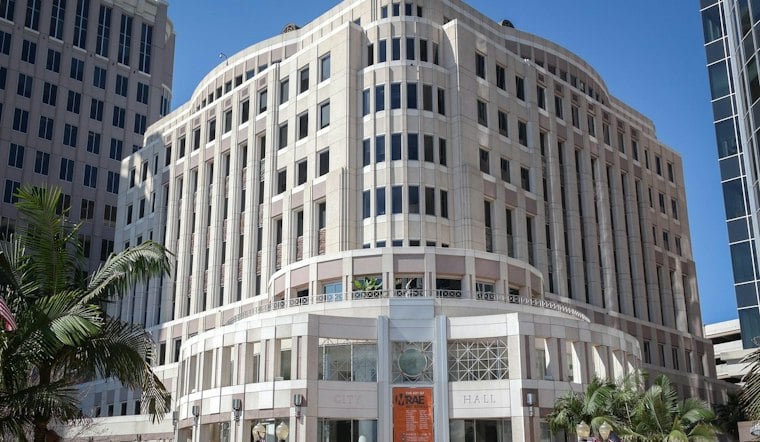
Orlando Mayor Buddy Dyer is facing pushback over a $7.2 million funding request the city submitted to the state to support immigration enforcement activity, after advocates say security blocked them from entering city hall this week to deliver a letter opposing the plan. The Orlando Police Department applied for the money earlier this year specifically for equipment, hardware and software, and officials say it will be used to buy 750 new police radios to replace outdated equipment.
The request, first detailed by Orlando Weekly, was approved by Florida's State Board on Immigration during a board meeting in late September. The grant is now scheduled to go before Orlando City Council on Dec. 7 for final approval. An OPD spokesperson said accepting the money to replace radios would not change the department's day-to-day operations, adding that the grant does not provide federal authorities with access to OPD's radio channels.
Advocates Say They Were Turned Away Twice
Members of the Immigrants Are Welcome Here coalition rallied at Orlando city hall on Tuesday, attempting to deliver a letter opposing the grant request to Dyer's office. About a dozen advocates were blocked from entering by city hall security, according to the same report. Sheena Rolle, a lifelong Orlando resident and chief strategy officer of Florida Rising, said this is the second time that we have been refused access to city hall by security.
Advocates said they were told their only option to contact Dyer's office was scheduling an appointment by email. The coalition has requested a formal meeting with the mayor to discuss how the $7.2 million would be used and what protections, if any, exist for Hispanic and Haitian residents. Sarah Robinson, pastor at Audubon Park Covenant Church and a coalition member, said the issue concerns fiscal responsibility, community trust and the proper role of local government.
What the Letter Argues
The coalition's letter warned that expanding the city's 287(g) enforcement capacity risks eroding trust and discouraging residents from reporting crimes or cooperating with police out of fear, the group said. Orlando currently has a 287(g) agreement with the federal government, which allows police officers to be deputized for immigration enforcement duties, including detaining unauthorized immigrants. As of June, about 100 OPD officers, roughly 10 percent of the department, had been deputized under that agreement, per Orlando Weekly's reporting.
Tonya Jones, another voice cited in that coverage, said seeking millions in new funding to bolster 287(g) capabilities signals that immigration enforcement is becoming central to Orlando's police department. The coalition has also argued that city funding should preserve parks, public works and social services rather than invest in immigration enforcement.
A Statewide Funding Push
Orlando is not alone in seeking this money. Altamonte Springs and Orange, Lake and Osceola counties have also applied for state grant funding tied to immigration enforcement, the outlet reported. The State Board on Immigration was created by the Florida Legislature in 2025, the same year lawmakers and Gov. Ron DeSantis allocated $250 million in state funds to support the Trump administration's immigration agenda.
Elsewhere, the dollar amounts and purchases have varied widely. The Miami Herald reports that Florida's State Board of Immigration Enforcement unanimously approved $90 million in new and amended grants for 56 county and city police departments, with the Orange County Sheriff's Office requesting $10 million — $9 million of it for 910 portable radios — and the Polk County Sheriff's Office requesting $10 million, including $8.7 million for encrypted radio systems and servers. Statewide, $147 million in immigration-enforcement grants has been approved and nearly $5 million disbursed to 25 local agencies, according to Transparency Florida data cited by the Herald.
Other agencies received approval for different kinds of equipment. According to CBS12, Altamonte Springs won approval for 20 biometric scanners, while the Seminole County Sheriff's Office was approved for $1.16 million in reimbursement, most of it covering the cost of transporting detainees for ICE. A similar pattern has played out beyond Florida: ProPublica reported that Pantego, Texas, received $100,000 after a single immigration arrest under its 287(g) agreement.
Questions Over Whether Joining Is Required
Reporting diverges on whether Florida law actually mandates local participation. WFLX has reported that since February 2025, every law enforcement agency in Florida is required to have a 287(g) agreement. The Miami Herald, however, has reported that the law does not explicitly require local municipalities to join, even as it argued that officials in smaller municipalities who rejected proposed agreements violated the state's laws against so-called sanctuary cities.
Florida Attorney General James Uthmeier has warned that cities face consequences for stepping back from ICE cooperation, saying there are penalties where they choose to do so without justification, according to Orlando Weekly's separate coverage. More than 30 Florida cities have never signed 287(g) agreements in the first place, that report noted. Meanwhile, Bloomberg reports that Florida cities are trying to pull their police out of the federal immigration enforcement push altogether, with officials in Doral exploring how to end an agreement allowing local officers to make immigration arrests on behalf of ICE.
Questions have also surfaced about how some of this grant money is being spent. WFTV has reported that some reimbursements are going toward equipment with broader day-to-day policing applications, raising the question of how those purchases meet the state's requirements for spending the money. Separately, an OPD spokesperson has said the grant supports everyday law enforcement use and carries no reporting requirements beyond those already mandated by the state.
The scrutiny around enforcement capacity comes against a backdrop of concerns about how quickly some officers are being trained for immigration duties. An investigation by the New York Times, cited in Orlando Weekly's reporting, found that ICE has faced scrutiny over an expedited training protocol, with some officers receiving only a few hours of instruction before taking on enforcement roles.





