

























































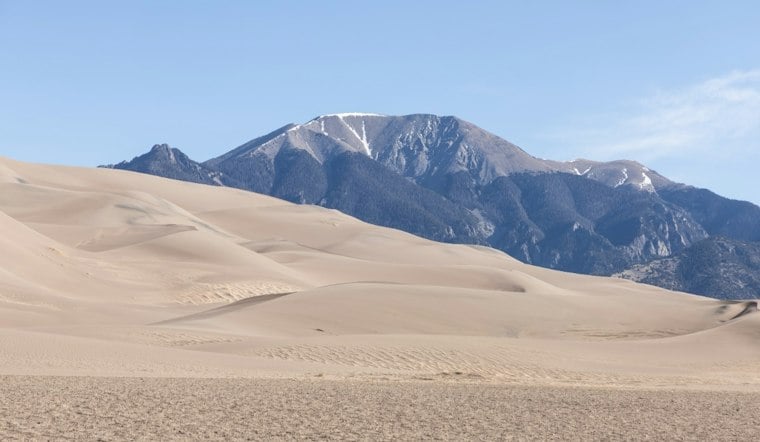
Four or five of the mega dunes towering over Colorado's San Luis Valley appear to be shrinking, according to Andrew Valdez, the geologist at Great Sand Dunes National Park and Preserve who has tracked the dunefield for more than 30 years. Star Dune, long known as North America's tallest, now measures approaching 720 feet, down almost 40 feet from where it stood in 2000. High Dune has followed a similar pattern, generally dropping in height even as it ticked back up to about 685 feet over the past year after measuring around 710 feet in 2000.
The drops don't mean the dunefield itself is disappearing. As reported by the Denver Gazette, Valdez measures the mega dunes every year and describes the process less like surveying a static landform and more like studying something alive. Star Dune has gotten longer even as it's gotten shorter, and it has moved northward over the years, according to the same report. Bend Dune, meanwhile, has reached more than 735 feet and is getting taller while also moving northward, per the Gazette's account.
A Dune That Briefly Overtook the Record
The shuffling atop the leaderboard isn't new. In 2020, Hidden Dune became North America's tallest dune at 742 feet, temporarily surpassing Star Dune, which stood at 741 feet, according to the National Park Service. Hidden Dune now stands about 740 feet tall but is generally dropping over time, the Gazette reports. High Dune, too, is no longer the highest point in its immediate area; a neighboring dune to its west now stands more than 10 feet taller, per the same account.
Changes in height at Star Dune or High Dune can look dramatic to visitors as winds shift and dune heights fluctuate. The dunes have risen and fallen for roughly 400,000 years, fed originally by sediment from ancient Lake Alamosa and more recently by playa lakes — mostly dry lake beds that occasionally fill with water and sediment — that blow sand toward the dunefield, according to the Gazette.
Why the Overall Sand Pile Isn't Going Anywhere
Wind does the sculpting, but the Sangre de Cristo Mountains trap sand along the range front, and streams flowing down from the peaks deliver additional sediment to the dunefield, per the Gazette's reporting. Vegetation growing on the surrounding sand sheet actually blocks much of that sand from ever reaching the dunefield at all. The park's own website states that the overall dunefield isn't growing because new sand simply isn't arriving in sufficient quantity — though ice ages and extremely dry periods can thin that vegetation, and an extended drought could send more sand blowing toward the dunes, the Gazette notes.
The active 30-square-mile main dunefield contains an estimated more than 5 billion cubic meters, or about 1.2 cubic miles, of sand; opposing winds and river recycling help stabilize the system, according to the Park Service. Remarkably, about 90% of the park's total sand deposit actually sits in the surrounding grassland sand sheet, with the visible main dunefield containing only around 10% of the total supply.
The Humming Dunes and a Quiet Park
Part of what makes the dunefield feel alive, in Valdez's words, is sound. Sand avalanches tumbling down the mega dunes produce a deep, low-frequency hum, a phenomenon the Park Service says inspired Bing Crosby's 1940s hit “The Singing Sands of Alamosa.” Great Sand Dunes and Yellowstone have been identified as two of the quietest places, according to Durango Roadtripping.
The dunes sit within a park that itself grew out of a fight over water. Congress passed the Great Sand Dunes National Park and Preserve Act in November 2000, expanding the protected area, according to National Parks Traveler. Groundwater, along with surface water in Medano Creek, feeds a hydrology that keeps recycling sand back into the dunefield even as individual peaks rise and fall.
Visitor Pressure Meets an Extreme Landscape
Visitors are showing up to see all this in record numbers. Annual visitation has climbed from a long-term average of 250,000 to 300,000 visits up to nearly 600,000 in recent years, prompting park administrators to pursue new infrastructure and visitor management planning, according to Heart of the Rockies Radio. Those crowds are arriving at a park where, despite moderate ambient air temperatures at 7,500 feet of elevation, summer sand surface temperatures regularly climb to 150 degrees Fahrenheit during afternoon hours, per the National Park Service.
Medano Creek, which runs along the edge of the dunefield, adds its own quirk: the stream experiences what the Park Service calls surge flow, a rare phenomenon in which sand dams repeatedly build up and burst in the streambed, sending beach-like waves downstream. The process is part of how sediment keeps cycling back into the larger dune system rather than washing away for good.
For now, Valdez plans to keep doing what he's done for three decades: walking the dunefield each year with survey equipment, tracking which mega dunes are climbing and which are shrinking. As the Gazette reports, he's candid that the behavior of the dunes still seems largely random to him at this point. Researchers have applied lessons from Great Sand Dunes to studying dunes on Mars and Saturn's moon Titan, and geoscientific research at the park has also used LiDAR mapping and examined the valley's wind regimes.





