

























































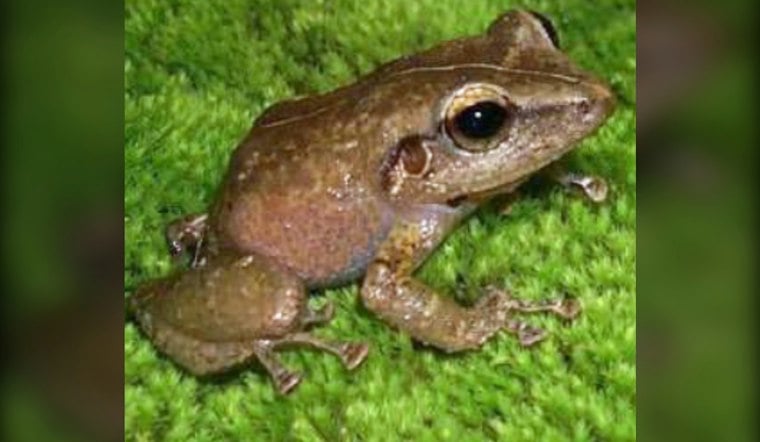
A coqui frog was captured in Waikīkī. Biologist Brenden Holland captured the frog.
According to Honolulu Civil Beat, coqui frogs have already been found on Oʻahu's North Shore, and the Waikīkī capture adds to growing worry that the pest could spread across the island if conditions do not change. Oʻahu's current major infestations are concentrated in Waimānalo, Kuliʻouʻou and Pālolo Valley, where the terrain makes full eradication an enormous undertaking. Nate Dube, manager of the Oʻahu Invasive Species Committee, has estimated that wiping out the frogs could take decades, with at least 10 years needed per site in Pālolo and Waimānalo alone, not counting additional colonies elsewhere.
Known Populations and Isolated Captures
The Oʻahu Invasive Species Committee lists three known breeding populations—Waimānalo, Pālolo Valley and the Kuliʻouʻou summit. In a separate May 2014 report, the Hawaiʻi Department of Agriculture reported capturing single coqui frogs in Kahaluu and Waimanalo on Oʻahu.
A Volunteer-Led Fight in Pālolo Valley
Michael Shiroma has spent years hunting coqui frogs near his Pālolo Valley home, which once sat next to an orchid nursery. Civil Beat reported that he first contacted the state Department of Agriculture and Biosecurity for help in 2021. Community members later organized formally in March; the group now has at least 60 members and has volunteered more than 2,000 hours and killed almost 11,000 frogs around the neighborhood, according to the report.
Shiroma has argued that eradication remains possible if the state funds the work and restricts nurseries. Civil Beat reported that he has spent more than $100,000 of his own money on the effort, using acid to asphyxiate the frogs.
Nurseries Blamed, But Enforcement Has Lagged
Residents have called on the state to better regulate plant nurseries, which have fueled the coqui frogs' spread across the islands and are blamed for much of the infestation's reach. Historically, those who spread coqui frogs have faced fines of up to $25,000. Under Hawaiʻi Revised Statutes 141-3 and 124-13, intentional transport, propagation or sale of coqui frogs is technically a Class C felony carrying fines between $50,000 and $200,000 and up to three years in prison, according to a 2007 analysis published by the University of Nebraska-Lincoln Digital Commons.
By November 2024, the Hawaiʻi Board of Agriculture had voted to adopt long-delayed rule amendments, but Small Business Regulatory Review Board review and gubernatorial approval were still required before the rules could become law, according to the Sierra Club of Hawaiʻi. Advocates had pushed for about two years to get the amendments passed after industry resistance and administrative delays stalled earlier efforts.
Why the Noise Problem Runs So Deep
Part of what makes coqui frogs so disruptive is biological: unchecked by the snakes, tarantulas and birds that keep populations in check in their native Puerto Rico, the frogs reach densities in Hawaiʻi of about 20,000 per hectare and sometimes more than four times that. Their calls can reach the volume of a leaf blower.
The ecological stakes extend beyond sleepless nights. University of Hawaiʻi research shows the frogs can consume up to 50,000 leaf-litter invertebrates per acre each night, putting pressure on native insects and spiders, and researchers have raised concern the frogs could even serve as a high-density food source that helps brown tree snakes establish themselves if the predatory reptile ever reaches the islands.
State Funding Has Not Matched the Scale of the Problem
Invasive species experts have estimated that addressing the Pālolo infestation alone would cost more than $5 million over five years.
For now, Dube has said the invasive species committee faces many fronts at once but receives little support.
Lessons From Wahiawā and the Neighbor Islands
Oʻahu has eradicated a coqui population before. A coqui infestation near Schofield Barracks in Wahiawā was eradicated in an effort involving seven agencies, including the military. Coqui frogs have been present on Oʻahu since at least the late 1990s, after first arriving on the Big Island and Maui in 1988. The state agriculture department formally designated the coqui a pest in 2009, by which point frogs had reached every main Hawaiian island except Kahoʻolawe and Niʻihau.
Today the Big Island is fully infested, and Maui continues to struggle with its own coqui populations.
Researchers Eye New Tools, Including a Fungus
Some researchers are looking beyond manual capture and citric acid altogether. Hawaiʻi Pacific University is researching a chytrid fungus approach to controlling coqui and other frog species, and Holland, an associate biology professor at the university, plans to study how the frogs spread in the wild using radio trackers. A suitable chytrid fungus strain could eventually offer a biological tool to address Hawaiʻi's frog problem, though that research remains ongoing.
Volunteers Elsewhere on Oʻahu Report Progress
In Waimānalo, Oʻahu's volunteer Coqui Frog Task Force has reported hand-capturing nearly 4,000 invasive frogs over two years through organized weekly night hunts, according to Hawaii News Now. The effort mirrors the grassroots approach seen in Pālolo, with residents forming patrol teams to manually collect frogs in both residential yards and forested areas, even as experts caution that full elimination in steep valley terrain remains unlikely without sustained state funding and dedicated field crews.
State biosecurity officials are also trying to close gaps further upstream. Hoodline previously reported on a new Biosecurity Academy launched this month in partnership with Leeward Community College, aimed at training up to 20 new inspectors to address a system in which state inspectors currently check only about 15% of inbound agricultural cargo. Residents who suspect a coqui sighting anywhere in the islands are urged to report it through the statewide pest hotline at 808-643-PEST or online at 643pest.org, which routes reports directly to island-specific invasive species committees.





