

























































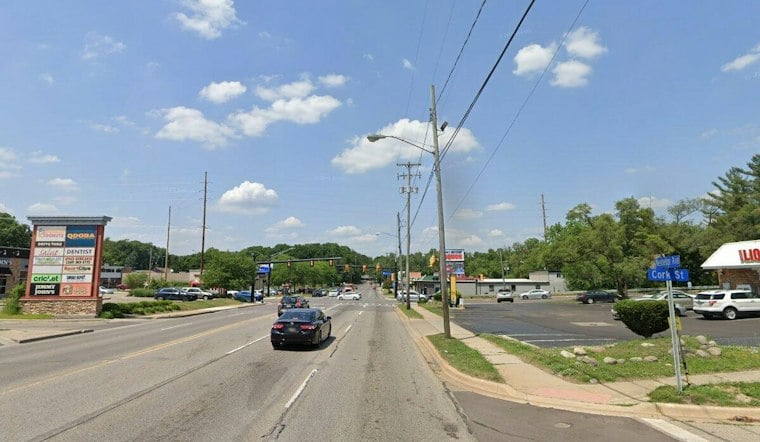
Cork Street between Westnedge Avenue and Portage Street is about to go on a road diet. The Kalamazoo City Commission approved a $403,065 contract with the Michigan Department of Transportation on Monday to fund safety improvements along the corridor, part of a larger $1.15 million project that will convert the busy street from four travel lanes down to three starting in 2027.
The project, originally planned for 2026, will turn Cork Street into one travel lane in each direction with a shared center turn lane and bike lanes on both sides, according to MLive. The redesign will also add several pedestrian islands at Park Street, Rose Street, Ash Street, St. Mary’s Street and Burke Street, replace existing traffic lights, repair sidewalks, and fill in gaps where pedestrian pathways are currently missing. Construction is expected to run from spring through fall of 2027, funded by a mix of federal, state and local dollars.
The section of Lovers Lane south of Cork Street will also be reduced to one lane, a change James Baker, Kalamazoo’s public services director, said is meant to slow traffic and eliminate a blind corner near the Millwood Elementary crosswalk, which is used by schoolchildren, the outlet reported. City project plans published by the City of Kalamazoo identify the road-diet segment on Lovers Lane as running between Foley Street and Portage Street.
Crosswalks and Lighting Built Into the Design
The project design includes pedestrian refuge islands and flashing beacons. The new bike lanes on Cork Street are intended to connect to the city’s broader non-motorized network stretching between Oakland Drive, Whites Road and Burdick Street.
This isn’t the first time Cork Street has been reshaped. Engineering firm Wightman previously completed a 1.91-mile reconstruction of Cork Street from 500 feet west of Lovers Lane to Sprinkle Road. The city funded the project in 2018, and Wightman’s construction video covers March through October 2020. The work converted that eastern stretch from four lanes to three and replaced a culvert at the Davis Creek crossing. The redesign will add bike lanes along Cork Street.
A Pattern Across Kalamazoo’s Streets
Cork Street is the latest in a string of Kalamazoo roads to be narrowed this way. The city has already converted Portage Street, Whites Road, Park Avenue and Oakland Drive from four lanes to three. The commission approved a similar four-to-three lane conversion for Portage Street between Cork Street and Stockbridge Avenue in May, in partnership with MDOT, according to a meeting recording from TelVue Connect.
Kalamazoo’s Imagine Kalamazoo 2025 Master Plan sets out a broad vision for the city. The broader push is tied to Kalamazoo’s $100 million Streets for All initiative, which Smart Growth America reports is supported by the federal Bipartisan Infrastructure Law and has allowed the city to convert downtown one-way streets into two-way corridors to slow traffic.
Residents Split on Priorities and Payoff
Not everyone is on board. Tina McClinton, who lives in south Kalamazoo, criticized the Cork Street project and argued the city should instead prioritize stormwater drainage and crime reduction. “You never have the money. … Yet, you can come up with $1.3 million to mess up another road like you did Portage (Street),” she said, adding, “Your priorities are all backwards.” Her concerns echo pushback documented on ActiveRain, where critics have argued that four-to-three lane conversions along major commercial gateways create bottlenecks and slow vehicle flow.
Others see the results differently. Tobi Hanna-Davies, who lives at Heritage Senior Living, praised the Portage Street improvements, including the new turn lane onto Phillips Street and pedestrian islands. “It is such a safety improvement for people coming and going to Phillips Street,” she said. David Greeley, a south Kalamazoo resident and cyclist, said the changes have made a real difference for him. “It is wonderful. I can actually ride on a bike for the first time, and it is safe,” he said, adding that he’s looking forward to similar improvements coming to Cork Street.
What the Numbers Show
The city’s broader push toward road diets is backed by data. Research cited by the Michigan Municipal League indicates that four-to-three lane road diets can reduce overall crashes by as much as 40%, with a 2012 Michigan Department of Transportation research project finding reductions of up to 40%. Locally, Second Wave Media reported in September that overall vehicle crashes in Kalamazoo dropped 25% following the city’s traffic-calming street reconfigurations and lane reductions. Whether that trend eases the concerns of residents like McClinton remains to be seen as Cork Street’s turn comes up next.





