

























































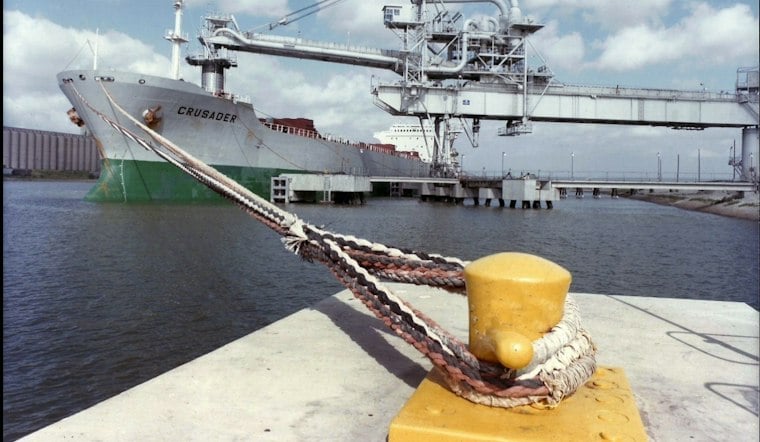
The Port of Corpus Christi has moved 162.7 million tons of cargo through its channel in the first nine months of 2026, a record for that stretch and a sign that South Texas's energy and industrial export machine keeps grinding forward even as crude volumes soften. The milestone caps years of channel and bridge construction meant to let bigger ships dock, load and leave faster than ever before.
That nine-month total marks a 6.1% jump over the previous record set during the same period in 2025, according to a report from container-news.com. Third-quarter volume alone rose 3% from a year earlier, even though it still trailed the port's 2024 third-quarter record, the outlet reported. The growth came despite a rocky year for the port's single biggest commodity: crude oil.
LNG Picks Up the Slack as Crude Slips
Liquefied natural gas has become the port's breakout performer. LNG volumes jumped 46.2% to 6.6 million tons in the third quarter of 2026 alone, per the same container-news.com report, building on a 15.4% annual increase to 18.6 million tons in 2025 that the Port of Corpus Christi announced in its own fourth-quarter report. Crude oil, meanwhile, remained the port's largest single cargo category even as it declined 2.8% to 30.4 million tons in the third quarter, the port's report notes.
The pattern held across all of 2025 as well. Crude oil volumes fell 2.3% to 127.4 million tons for the year, according to freightwaves.com, even as the port and its customers still moved 203.4 million tons through the channel overall, down just 1.5% from 2024. The port ships out roughly 2.5 million barrels of crude a day, which amounts to about half of all U.S. crude oil exports, according to a report from marketplace.org, which also notes that energy makes up roughly 40% of Corpus Christi's local economic output.
A Deeper Channel and a Taller Bridge
Much of the recent momentum traces back to two massive infrastructure projects completed in 2025. The port finished its four-phase Corpus Christi Ship Channel Improvement Project last year, deepening the channel from 47 to 54 feet and widening it from 400 to 530 feet, the port announced. The same project had earlier involved a $625 million, six-year effort to expand 11.9 miles of the channel, intended to let larger vessels through and allow more two-way traffic, freightwaves.com reported separately.
Above the water, the long-delayed, $1.3 billion Harbor Bridge opened in 2025, replacing the aging original span, according to constructiondive.com. The new bridge's towers rise 538 feet, tall enough to accommodate the taller ships now able to carry more cargo through the widened channel, the outlet reported. Those twin projects, port officials say, are central to the facility's claim as the third-largest port in the country by total waterborne tonnage, with $1 billion in capital investment since 2015.
Jobs and Commutes Haven't Kept Pace With Industry
The scale of investment on the industrial side has been staggering: nearly $60 billion in private capital poured into petrochemical facilities and manufacturing sites near the port between 2012 and 2023, according to research from trerc.tamu.edu. That period brought major facilities including TPCO, OxyChem, Steel Dynamics and Tesla to the Corpus Christi metro area, the research notes.
But the region's workforce hasn't grown at anywhere near the same pace. The Corpus Christi metro area's labor force expanded less than 1% from 2012 to 2023, compared with a statewide average of 19.2%, per the same research. Manufacturing jobs have clustered in ZIP codes within San Patricio County and along the ship channel, and the industrial buildout has pushed up both the number of commuters and the average commuting distance across the region, the research found.
Even so, the broader outlook for South Texas remains upbeat. Record port activity following major investments is expected to trigger new activity and opportunity across the region, according to a report from the San Antonio Business Journal. The port's nine-month record, paired with its newly deepened channel and taller bridge, positions Corpus Christi to keep absorbing larger ships and bigger cargo volumes as it heads into the final quarter of 2026.


