

























































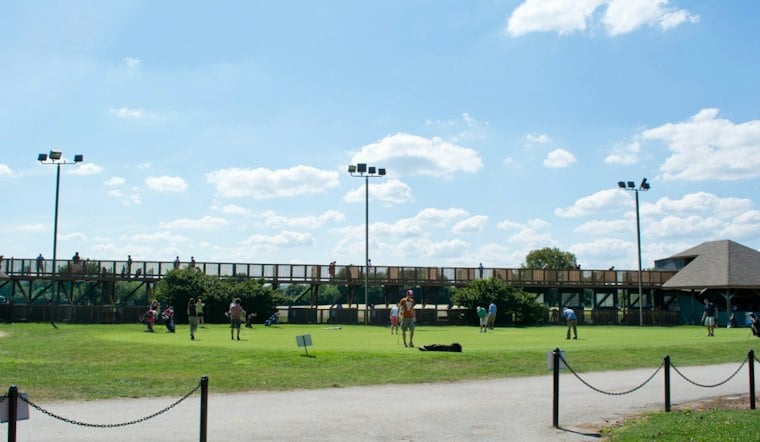
A typical D.C. resident bikes about 40 miles a year, enough to rank the District 13th among big American cities for resident biking, but two fights happening at once have local cyclists worried about losing ground rather than gaining it. One involves a federal makeover of the East Potomac Park golf course that could wipe out a beloved 3-mile riding loop. The other is a fight to revive a Connecticut Avenue protected bike lane project the city killed off in 2024.
The data on local riding habits comes from streetlight data cited by Axios, which frames the East Potomac golf course makeover and the Connecticut Avenue bike lane dispute as the two recent flashpoints putting D.C.'s bike-access debate in the spotlight. Per that report, President Donald Trump carried a rendering of the new East Potomac golf course links as reported by The Washington Post, and the rendering appeared to wipe out the popular 3-mile perimeter loop that cyclists and runners rely on.
An Olympian Leads the Charge at Hains Point
Davey Hearn, an Olympian canoeist who was accused of vandalizing the Lincoln Memorial Reflecting Pool, will headline a protest against the East Potomac plan on Sunday, October 4, organized by the Washington Area Bicyclist Association, according to Washingtonian. The felony destruction-of-property charge tied to the incident was dismissed, while prosecutors sought dismissal without prejudice of the remaining charges. Kalli Krumpos said Hearn will speak about standing up for rights and celebrating great spaces, per Axios.
The redevelopment itself would expand the 300-acre public municipal golf course by roughly 50 acres, using White House construction debris transported to the site as landfill, Washingtonian reports. The fear among cycling advocates is straightforward: the course expansion could sever the park's perimeter loop entirely. Because East Potomac Park and Hains Point sit on land where federal agencies control roughly 90% of D.C.'s shoreline, according to the National Capital Planning Commission, District officials have no direct jurisdiction over the park's road layouts or golf course plans.
Connecticut Avenue Cyclists Jam Rush Hour Traffic
Cycling advocates have also renewed their push for more protected bike lanes across D.C., and that frustration spilled onto Connecticut Avenue on Wednesday morning, when dozens of cyclists jammed up rush-hour traffic to call for reviving a bike lane project the city scrapped. The six-mile ride ran from Chevy Chase Circle to Dupont Circle and ended in a rally pressing the city to prioritize what organizers called Streets for People, according to WUSA9.
D.C. studied adding bike lanes to Connecticut Avenue for more than three years before Mayor Muriel Bowser officially canceled the proposed $7.7 million, 2.7-mile protected lane project in April 2024. The cancellation followed pushback from some shops and restaurants along the corridor and a 2,700-resident petition opposing the designs, despite D.C. Council support for the plan, the Post reported. The scrapped version would have removed more than 300 parking spaces and cut vehicular travel lanes from six down to four.
Safety data had backed the project. A District Department of Transportation study designated Connecticut Avenue a High Injury Zone after tallying 1,507 police-reported crashes along the corridor between 2015 and 2019, nearly half of them occurring while peak-hour reversible traffic lanes were active, per Washingtonian's reporting. DDOT permanently removed those reversible lanes in 2021 to help mitigate the crash rate.
A New Mayor Could Reshape the Fight
Whoever becomes D.C.'s next mayor will inherit this debate, and that's likely to be Janeese Lewis George, who is widely expected to take office after winning the June 2026 Democratic mayoral primary. Her picks for agency leadership could determine whether the Connecticut Avenue bike lane project gets another look, Axios notes. Lewis George campaigned on expanding protected bike lane networks and previously opposed federal efforts to dismantle existing city cycle tracks, including the 15th Street protected lane, according to Truthout.
But even a sympathetic mayor cannot control what happens on federal land like East Potomac Park, since that jurisdiction rests with federal agencies rather than the District government. That jurisdictional gap is a persistent obstacle for cycling advocates: the city can revisit its own canceled street projects, but it has no authority over a National Park Service golf course expansion, no matter who sits in the mayor's office.
The disputes are unfolding against a backdrop of surging demand for alternatives to driving. Capital Bikeshare logged a record 6.6 million trips in 2025 and expanded past 850 stations regionally by June 2026, prompting DDOT to award Lyft a new five-year operating contract, according to the District Department of Transportation. Permitted dockless e-scooter and e-bike operators are also part of the region's micromobility landscape.
Yet bike-lane infrastructure remains a point of debate amid that ridership growth.


